
Future of Beaver Stadium taking shape
Trending
UNIVERSITY PARK -- Penn State didn't just give new head coach Matt Campbell a hard-hat tour a few weeks ago -- it handed him a preview of the future.
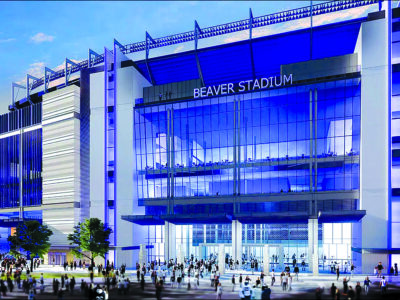
Beaver Stadium's $700 million revitalization is rising fast on the west side, and Campbell walked straight into the superstructure that will define the next generation of Penn State football. Steel towering overhead, crews welding and lifting, the stadium already feels like it's shifting into a new era.
Campbell's visit, shared across Penn State's social media channels, confirmed what fans have been hoping to hear. The West Tower, the centerpiece of the project, is on schedule. Michael Abbondante, senior project manager for Barton Malow, told Campbell the tower's structural work will be finished ahead of the 2026 season.
The interior clubs, suites and Welcome Center will still be under construction, but the building itself -- the massive new silhouette on the west side -- will be complete when Campbell leads the Nittany Lions onto the field (West Shore Home Field, to be precise).
And the new west-side bleachers? They're going to soar. Abbondante told Campbell the upper deck will sit higher than the old press box that came down in early 2025. Beaver Stadium has never had seating that high, and the effect will be unmistakable. The stadium is growing upward, outward and into a new identity.
Campbell stopped during the tour to thank the construction team for the work happening behind the scenes.
"It is my honor to represent this," he told staff. "And I can promise all of you, all this hard work you're putting in to make this really special, we're going to put that same work behind the scenes to make the product on the field really special. We'll look forward to making you proud this fall."
Beaver Stadium has been under construction since May 2024 as part of a three-year modernization designed to transform the venue into a year-round entertainment destination.
The PAM Healthy Misitano Family Tower, named after a $25 million gift from alum Anthony Misitano, is the centerpiece of the project. Rising 195 feet and adding 600,000 square feet of interior space, the tower is the most dramatic change Beaver Stadium has seen in decades.
Penn State Athletic Director Patrick Kraft has called it a "superstructure," and Campbell's tour made it clear why.
One of Campbell's stops was the Marzano Club, the cornerstone of the new tower. The 50,000-square-foot space will house 2,500 club seats, multiple bars and an outdoor terrace overlooking the stadium and campus. Club seats will include food, beer and wine, making the Marzano Club one of the most significant premium upgrades Beaver Stadium has ever offered.
The West Tower also will feature the Schuyler Family Club, a 25,000-square-foot premium space with seating for about 2,000 fans. Pricing for 2027 season tickets starts at $4,500 for the Marzano Club and $4,900 for the Schuyler Club. A capital gift of $10,000 per Nittany Lion Club account is required to purchase season tickets in either space.
Penn State recently held a topping-out ceremony to place the final steel beam atop the tower, marking a major milestone in Phase II. With the structure now fully framed, crews are pushing toward the next benchmark: having the tower's exterior complete before Penn State's Sept. 5 opener against Marshall. The interior work will continue into 2027, but the stadium's new profile will be visible this fall.
Campbell's tour wasn't just a walk-through. It was a glimpse of the stage he'll be coaching on for years to come -- a stadium being rebuilt to match the ambition of the program. The revitalization is designed to modernize fan experience, expand premium seating, improve accessibility and create spaces that can host events year-round. Beaver Stadium is being built for the future, and Campbell got to see that future taking shape in real time.
The project also received a fresh jolt of momentum this week. Penn State announced a new $5 million philanthropic gift from Bob and Sandy Poole, bringing the reported fundraising total above $135 million. That figure includes the $50 million gift from West Shore Home for naming rights to the stadium's field, which went into effect in 2025.
Poole, a 1972 Penn State graduate, is president and CEO of S&A Homes and Allied Mechanical and Electrical, and chairman and CEO of Poole Anderson Construction. All are based in central Pennsylvania. He has served on the board of directors for Geisinger Health and chairs Penn State's Schreyer Honors College External Advisory Board.
Kraft called the gift "extraordinary generosity and unwavering commitment," noting that the Pooles have supported Penn State for decades in ways that expand opportunities for students and strengthen the university experience.
With Campbell now fully immersed in the project and the West Tower rising toward its 2026 debut, Beaver Stadium's transformation is accelerating. The revitalization remains on schedule for completion in 2027, backed by growing philanthropic momentum and a clear vision for the future of one of college football's most iconic venues.