
A return to the State Museum
Trending
I remember when I was in elementary school, during those few years my parents and I lived in Mechanicsburg, that the highlight of my summers wasn't the pool or the playground or even the long, lazy evenings chasing fireflies.
It was the Pennsylvania State Museum of History in Harrisburg. To a kid who loved stories, old things and the feeling of stepping into another world, that museum was a universe unto itself.
My parents signed me up for the museum's summer kids programs -- month-long classes that felt like a secret club for curious children. We weren't just visitors. We were explorers. Our instructors would take us behind the scenes, through doors marked "Staff Only," into rooms where the lights were dim and the air smelled faintly of dust, old paper and time. I didn't know it then, but those were the museum's archives, the quiet heart of the building where history slept.
Some of those rooms thrilled me. Others terrified me. I was always scared of the Native American exhibits -- not because of anything in the museum itself, but because I had watched too many 1950s Lone Ranger episodes where "evil Indians" lurked behind every rock, waiting to scalp Clayton Moore. Childhood fears don't always make sense, but they feel real enough when you're standing in a dim hallway staring at a mannequin in full tribal regalia. I'd cling a little closer to the group, pretending I wasn't nervous, pretending I wasn't imagining the figure turning its head.
Still, I loved those classes. I loved the feeling of being trusted with something special. I loved the way the instructors spoke to us like we were capable of understanding big things -- history, culture, the weight of objects that had survived long before we were born.
I remember I was devastated because I was sick and couldn't attend the final class - although I don't remember what it was about. My mom got me into another class so I wouldn't miss the finale.
I also enjoyed stopping by the museum gift shop each time and buying a confederate or union soldier. And there was riding the magnificent escalator up to the second level. Sometimes, we ate lunch in the museum cafeteria.
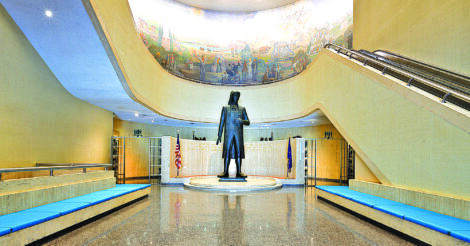
That escalator wasn't just an escalator -- it was a ride. It carried you upward behind a gigantic statue of William Penn, his bronze presence towering like a guardian of Pennsylvania's past, and in front of a sweeping mural that stretched across the wall like a storybook come to life. The whole ascent felt ceremonial, as if the museum were slowly revealing its secrets one floor at a time. Even now, decades later, I can picture the way the mural's colors glowed under the lights and how Penn's silhouette seemed to follow you as you rose.
And then there was the Planetarium on the third floor -- another favorite -- where visitors of all ages could explore the universe through space and time. The room would go completely dark and suddenly Earth's night sky appeared above us, followed by tours of the Solar System, distant planets, stars, nebulae, galaxies and even the farthest edge of the observable universe. For a kid sitting in a padded seat on a summer afternoon, it felt like the cosmos had opened just for us.
Or my parents (Dad was more patient than Mom) would take me back through the museum to look at an exhibit again. Dad would also be open to stopping at the old Kiddie City toy store in Camp Hill. Another treasured stop in my past.
I would forgo purchasing an American soldier to grab a Mego superhero instead. They were a measly $4 back in the day. The shelves were filled with Superman, Batman, Wonder Woman and so many others. I remember only needing a few more, but we moved to Maine at the start of my fourth-grade year and I never finished my collection.
That move felt abrupt in the way childhood moves often do -- one moment you're standing in a familiar aisle debating between Shazam and Aquaman, and the next you're in a different state, a different school, a different life. I didn't have the words for it then, but looking back, I can see how those small rituals -- the museum visits, the gift shop soldiers, the Kiddie City superheroes -- were anchors. They were the things that made the world feel steady.
Years later, I did stop by the museum. It was under renovation, so parts of it were closed, but visiting did bring back a lot of memories.
Walking through the building as an adult was like stepping into a dream where everything is familiar but slightly rearranged. The echoes in the hallways sounded the same. The smell -- that mix of cool air, old exhibits and faint cafeteria food -- was exactly as I remembered.
Even the way the light filtered through the upper windows felt unchanged. But the spaces themselves had shifted. Some exhibits were gone. Others were modernized. The escalator still rose behind William Penn, but the mural looked smaller somehow, as if my childhood eyes had stretched it wider.
I found myself slowing down in places where I used to rush, and rushing through places where I once lingered. That's the strange thing about returning to childhood landmarks -- you're not just revisiting a place, you're revisiting the person you were when you first walked through it.
I thought about those behind-the-scenes rooms, the ones that once felt forbidden and thrilling. I wondered whether the kids in today's programs still get to see them, whether they still feel that same jolt of excitement when a staff-only door swings open.
I wondered if any of them are scared of the Native American exhibits the way I was, or if they're braver, or if they've grown up with different stories that make the mannequins less frightening.
Mostly, though, I thought about my parents -- about my mom finding a way to get me into another class when I was sick, and my dad patiently walking me through the same exhibits again and again. I didn't realize then how much effort that took, how much time they gave up so I could stare at dinosaur bones or Civil War dioramas for the 10th time. Childhood is full of gifts you don't recognize until much later.
The museum itself was one of those gifts. It taught me to love history, to appreciate the quiet power of objects that have survived long before us. It taught me that learning can feel like adventure, that curiosity is something worth following, that the world is bigger and older and more interesting than any one place we live.
And even though the museum has changed, and I have changed, the memories remain -- vivid, warm, and stitched into the fabric of who I became. Every time I think of that escalator rising behind William Penn and in front of that mural, I'm right back there: a kid with a plastic soldier in his pocket, a head full of stories and a whole world opening up in front of him.
•••
Greg Williams is a reporter and Weekend Editor for The Sentinel. A Mifflin County native, he has been writing for The Sentinel since 1991.