
Expert shares insights, research and practical tips
Trending
McVEYTOWN -- Like many high school students at the start of the pandemic, Keegan Lee fell into an endless cycle of scrolling social media, hoping to connect with others during the period of global isolation.
A senior at the Burlington School in North Carolina, Lee learned social media only contributed to the loneliness she felt and negatively impacted her mental health. Despite those negative feelings, she had a difficult time staying off social media.
The irony puzzled Lee, as a tool intended to help people socialize seemed to divide them further. She decided to search for answers herself.
For 60 days, Lee unplugged from social media and journaled her thoughts. To better understand her behavior and the various psychological effects of social media, Lee reached out to Dr. Bilal Ghandour, an Elon University (N.C.) professor who specializes in child and teen mental health.
As Lee sent her journal to Ghandour, he responded to each entry with scientific and medical explanations of her certain moods and actions. Ghandour helped Lee understand that social media's addictive nature is due to the delivery of personalized content through algorithms that collect data using online footprints.
Ghandour also shared that there's a dopamine rush -- or a reward -- derived from the seeming validation of people who interact with social media posts by liking, commenting, reposting and sharing posts. With each rush, many users look for more validation, creating a vicious cycle of addiction.
Lee transformed her journal entries and Ghandour's research into a book called "60 Days of Disconnect," which she co-authored with the Elon professor.
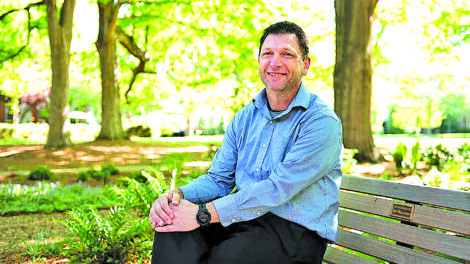
It was just one of the stories that Ghandour discussed on Tuesday night during a Parent Night Topic session, organized by the Tuscarora Intermediate Unit No. 11, on the subject of "Student Anxiety and Social Media." He shared insights, research and practical tips to help parents support their children.
One of the most surprising facts that Ghandour stated was, the average teenage student spends 8 to 10 hours daily on their phone. "It's a fundamental and massive issue," he said.
There was a shift in the 1990s where students began to be influenced more and more by the images they would see on television. Observers saw models on the runaways and wanted to look just like them.
Unfortunately, those being influenced kept getting younger and these desires sped up the process of their development to be much faster than it was supposed to be. "In the 21st century, our children are growing up faster and it puts them in danger in numerous ways," Ghandour said.
He talked about role models coming from reality-based shows and how these type of individuals were "being famous for being famous." While these shows might seem innocent enough with their influences, they are leaving huge impressions with younger minds.
"Children are like, 'I want to be this person,'" he explained. These new-found idols use formidable marketing skills to build their success.
By 2013, the reality stars have cemented their place as role models for students, who "want to be popular and the center of attention."
With the advent of social media in 2015, these same teens seek feedback on their status by seeking feedback, or likes. "We become observed frequently," Ghandour said. "And we're at a vulnerable stage where a lot of people are getting feedback. You need to be successful to get feedback, but they are not designed to manage this continuous feedback."
Many teenage relationships are superficial. "They're trying to find the next element to make them exciting or interesting," he added.
The quest for popularity becomes so intense that eventually students lose focus, especially at school where it becomes difficult for educators to get their attention. "Our teens are forever elsewhere," Ghandour said.
Facetime and Zoom enables students to see each other and the content they are posting, with some level of communication. It's mixed with texting and posting content -- which does not provide that immediate response -- and students are left wondering and worried about validation. "There's no immediate response, which is distracting," Ghandour said. "It creates bad habits which are problematic circumstances."
The behavior becomes engrained so that students pursue it as they seek more and more attention on social media. "They post something and get an immediate reaction," He added. "Isn't that more fun than studying or being bored?"
Students struggle to develop meaningful relationships and detach themselves from technology.
"We overwhelm our children with a lot of activities," Ghandour said. Parents and teachers want to successfully raise kids rather than raising successful kids.
He said getting into a top-notch school should not be the objective; lots of successful graduates fare well when graduating from other schools and entering the workforce.
"We forget about what really, really matters," Ghandour added. "We need to spend more time talking, and less time talking about what doesn't matter."
In a 2024 study by Pew Research Center, 45% of teenage students in the United States ages 13 to 17 surveyed admitted they spend too much time online, and even more -- 48% -- believe social media has a negative impact on people their age.
Using social media platforms to post videos, photos or commentary designed to generate feedback from others can be detrimental to students who are already struggling to define themselves.
"The major downside I see is the lack of a stable formation of yourself and your confidence level," Ghandour said. "When you are bombarded with images and comments of people who are trying to one up each other, it becomes very easy to be cast aside or to want to imitate. So, you end up imitating a person or a look or a mindset that's really not you, but you're just so tempted to copy someone in order to get approved, get acceptance, get ahead."
The tendency to imitate others pushes students away from discovering their authentic selves.
Over the past decade, statistics indicate that depression and anxiety have nearly doubled in students.
"You end up being really superficial and paying attention to appearance," Ghandour said. "Of course, those things are very important to teenagers in general, but they get amplified when they are constantly bombarded with these messages.
"We were never designed as human beings to get feedback every five seconds," Ghandour added. "It's not in our DNA."
Some schools are trying to find alternate ways to help students. According to the Juniata County School District website, the DuBois Area School District has implemented the Beaver Buddies Hotline, a source of student-recorded messages designed to uplift members of the community. The hotline contains more than 120 messages including silly jokes, calming words, pep talks and affirmations appropriate for all ages.
Individuals can call the Beaver Buddies Hotline at 1-855-KID-HUGS. Once connected, callers are prompted to press a number to hear different types of uplifting messages.
Ghandour's Zoom presentation is available for free on the TIU11 website at www.tiu11.org.