
Trending
MIFFLIN -- Long before roads crossed the Juniata Valley and long before towns like Mifflin and McAlisterville appeared on a map, Native peoples hunted, traveled and made their homes throughout the region.
Evidence of those lives still surfaces today in farm fields, along stream banks and in private collections carefully preserved by local historians and artifact enthusiasts. Those pieces of the past will once again take center stage when the Juniata County Historical Society hosts its fifth annual Indians and Ice Cream event at the Tuscarora Academy Museum in Mifflin.
The afternoon program has become one of the museum’s most popular summer events, drawing visitors interested in local history, archaeology and the stories hidden within centuries-old relics.
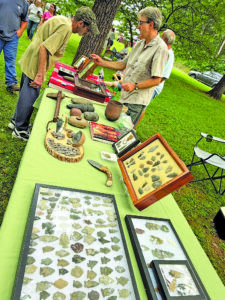
This year’s program, slated for 1:30 to 4 p.m. Sunday at the Tuscarora Academy Museum, will feature displays from local collectors Andy Paige and Steve Zeiders, along with representatives from the Historical Society of Perry County, who will bring portions of their collections of prehistoric and Native American artifacts. Visitors will have the opportunity to view and discuss stone tools, projectile points and weapons that offer a glimpse into everyday life in the region long before written records existed.
For many attendees, the attraction lies not simply in seeing the artifacts but in understanding the people who made and used them.
A carefully shaped stone point is more than an interesting object. It represents a hunter who depended upon skill and knowledge of the landscape. A scraper or cutting tool tells a story of work, survival and family life. Together, the relics help paint a picture of a world that existed in the Juniata Valley centuries before European settlement.
One of the unique aspects of the event is that no one knows exactly what pieces will be displayed until the collectors arrive.
"That will be a surprise to all of us whatever the three collectors bring," said Tuscarora Academy Museum curator Jessica Eaton Guyer.
That element of discovery has become part of the annual tradition. Each collection reflects decades of study and preservation, and each artifact carries its own story. Some may have been found locally. Others may represent cultures that once occupied broader portions of Pennsylvania and beyond.
For families, the event offers a chance to experience history in a way that textbooks cannot replicate. Children can stand inches away from tools fashioned by human hands hundreds or even thousands of years ago, while parents and grandparents share stories of local landmarks, farms and fields where similar artifacts have been discovered over the years.
The Juniata County Historical Society will also share pieces from its own collection, including Native American bags and moccasins from Plains tribes dating from approximately 1880 to 1900. The items provide another perspective on Native life and craftsmanship, showcasing artistic traditions passed down through generations.
For Guyer, the event is about creating connections between the past and present.
The artifacts on display represent thousands of years of human history, yet they often spark some of the most immediate conversations. Visitors stop to compare finds, discuss local history or share memories of artifacts discovered by previous generations of their families.
In that sense, the gathering is as much about community as it is about archaeology.
The setting itself reinforces that connection. The historic Tuscarora Academy Museum serves as a repository for the county’s collective memory, preserving stories from different eras of local history. During the event, relics from prehistoric cultures share space with a landmark that has educated and informed generations of Juniata County residents.
The combination of history and fellowship has proven remarkably successful.
"We are sure grateful that people still enjoy coming to it," Guyer said. "Maybe it's when the love of history and ice cream unite."
Visitors can enjoy ice cream sundaes provided by The Crème Stop of McAlisterville, with proceeds benefiting the museum. While the ice cream has become a hallmark of the event, the real draw may be the opportunity to connect with a chapter of local history that reaches back thousands of years.
The stone tools, projectile points and other relics on display represent generations of Native peoples who lived, hunted and traveled throughout the Juniata Valley long before the first permanent European settlements. Each artifact offers a tangible link to those lives and serves as a reminder that the region’s history did not begin with the arrival of colonists but stretches far deeper into the past.
Whether visitors come for the artifacts, the stories or the sundaes, they will leave with a greater appreciation for the people who first called this landscape home and for the local residents who continue to preserve that history for future generations.