Robotics come long way in Mifflin County classrooms
Program growing in popularity with students
LEWISTOWN — Robotics have come a long way since The Robot in the popular 1960s TV sci-fi classic “Lost in Space” crashed into living rooms and cautioned its teenage owner of potential harm.
“Danger, Will Robinson!” the B-9 model, class YM-3, environmental control robot who had no given name. The machine was endowed with superhuman strength and futuristic weaponry and additionally often displays human emotions.
Fast forward six decades and the Mifflin County High School STEM (science, technology, engineering and mathematics) offers a robotics and engineering class to students in grades 10 through 12.
“In this introductory level course, students’ progress through skill-based levels of robotics and coding technologies,” Mifflin County High School technology education teacher Rebecca ConnerMiller said.
“They start off working with Ozobots to learn about the basic interaction between machine and programming language, where they are introduced to different types of sensors, simplistic block coding and strategic thinking,” ConnerMiller added.
Ozobots are small programmable robots that use color sensors to read the color of the surface they are driving on. They are used in education to teach coding and STEAM concepts.
“Students then progress into the Lego Robotics series where they follow detailed instructions to create several builds which incorporate new components such as color sensors, light blocks, motors, etc.,” Conner Miller said.
Students have advanced through these builds and coding prompts to explore the differences between block coding and text block coding.
Following this series, they have moved onto “Coding Games,” introducing written text code in a fun and easy to interpret method.
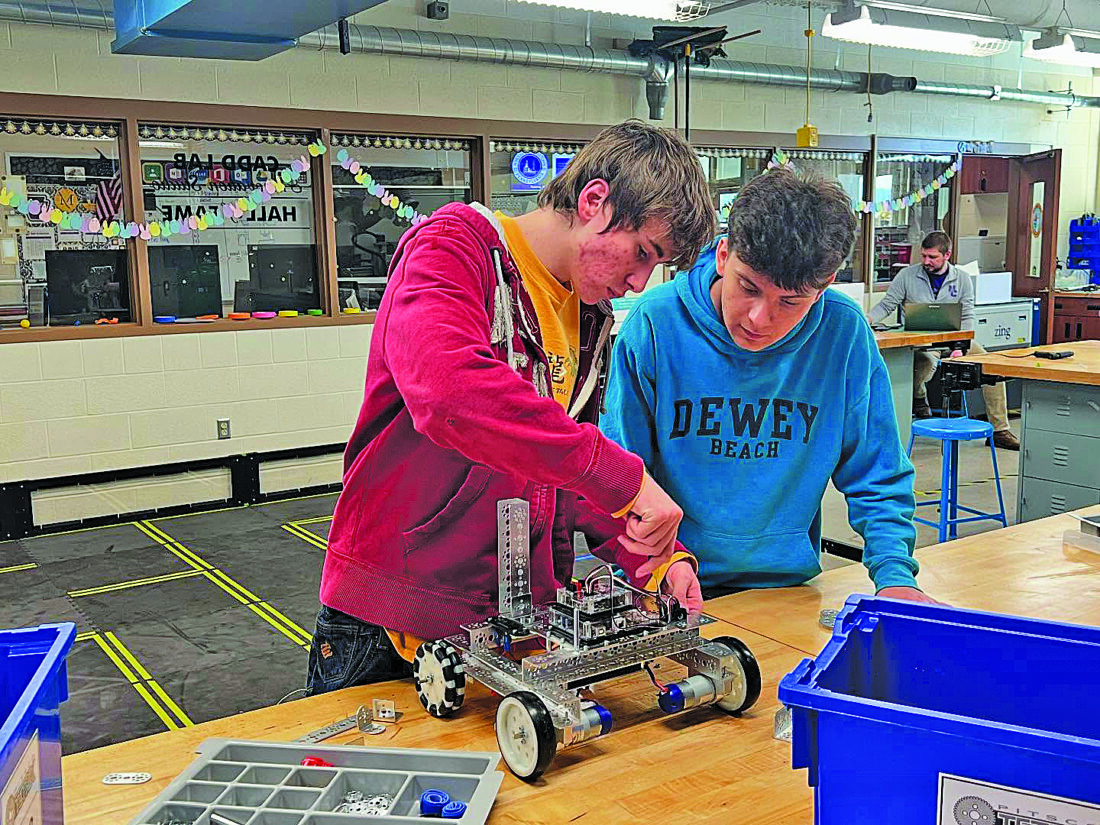
“Which brings us into the main focus of the class, Tetrix Robotics and the Tetrix Prizm,” ConnerMiller explained. “Students will work in teams to build robots that can meet specific challenge goals determined by the collaborative game.”
For the games, students programmed their robots to run autonomously to meet a predetermined challenge and created a strategic build to accomplish driver-controlled game goals.
“The power of this course is learning through failure, developing resiliency and constantly working through the engineering design process to identify a need, build a solution, and test and modify to improve,” ConnerMiller said.
The course has come a long way since it was introduced 10 years ago. ConnerMiller, who teaches the course with Aaron Specht, said it started off small with one section and two kits.
Since then, it has gained in popularity. “We currently have two sections and 10 robots, which is close to maxing out due to the restrictions of scheduling,” ConnerMiller added.
The instructors believe it’s become so popular because it is an educationally fun, hands-on and highly interactive class. Students have experienced collaboration, brainstorming, problem-solving and strategic thinking.
“They never cease to amaze with all the creative solutions they identify to make their robots perform at a higher level of excellence: ConnerMiller said.
The Robotics and Engineering curriculum has advanced each and every year due to incoming students’ prior knowledge. Teachers also have integrated more STEM lessons, activities and clubs at the elementary schools, middle school and junior high school levels.
The work showcased by the high school students has proven that they are capable and feel comfortable taking on higher risk challenges.
Their projects also have spoken volumes about their talents.
ConnerMiller highlighted a few of the more impressive ones from recent Tetrix Robotics Challenges:
Autonomous Maze Navigation, where students wrote code to direct a robot through a complex maze.
Driver Control Challenge, where students utilized a remote control to test hands-on driver skills.
Driver Control Game, where student teams raced each other through a driver-controlled maze with time deductions and strategic maneuvering challenges. For this game students also developed a robot arm which not only had to pick up a golf ball, tennis ball and foam ball, but it had to have the ability to push or carry each of the balls to specific-scoring zones.
Autonomous and Driver Control Game, where student teams competed in three systematic challenges: creating an autonomous code to push a tennis ball into a scoring zone; using a robotic arm to remove rings from the ring holder and deliver the rings to a scoring zone and utilizing a push bar to collect and push foam balls and tennis balls into scoring goals.
“This is a teamwork environment, and kids love working in productive teams.” ConnerMiller added. “Some of the best moments are when students find success through modification and accomplish the goals they set for themselves.”
Mifflin County School District Superintendent of Schools Vance Varner said STEM standards are being infused into core subject areas in which teachers challenge students to utilize the Makerspaces to create “artifacts” that solve problems, test hypotheses and showcase understandings as individuals or in a team scenario.
“Students within all eight MCSD schools are being immersed in STEM education,” Varner said. “Primary students are learning to code and program devices such as Bee-Bots, Code & Go Mouse, Ozobots and Micro:bits. They are participating in engineering challenges in their Makerspaces and classrooms, which push them to be innovative problem-solvers, and they are learning how to showcase their work through the use of greenscreens and video editing platforms.”
In electives, STEM standards have helped push the development of new courses which focus on STEM concepts such as digital electronics, robotics and engineering, 3D printing, laser engraving, advanced computer science, mechatronics program at the Mifflin County Academy of Science and Technology and more.
Local News

Madyson Reich crowned 2026-27 SUN Area Dairy Princess
Calendar
The Sentinel offers nonprofit and other community organizations an opportunity to promote upcoming events for free ...
Submit memories for ‘I Remember When’ 2026
LEWISTOWN — The Sentinel’s “I Remember When” special edition for 2026 will soon be published. This year, ...
Officials approve $150K child welfare prevention grant
MIFFLINTOWN — Juniata County Commissioners approved a three-year, $150,000 Children’s Trust Fund grant ...
Planning director shares expansion project updates