
Who is Beaver Stadium’s namesake?
The man grew up in Mifflin County
Trending
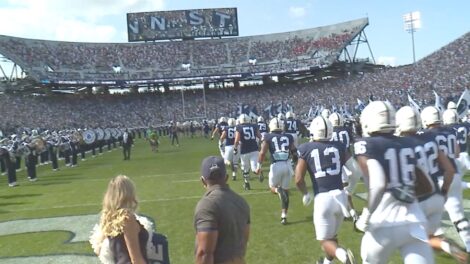
UNIVERSITY PARK -- Known for its "Whiteouts" and hostility toward whomever is playing its beloved Penn State Nittany Lions, the immense roar of 110,000 football fans at Beaver Stadium emanates from Happy Valley on select Saturday afternoons.
The current stadium has hosted Penn State games since September 1960, but the facility can trace its roots back to the original Beaver Field that housed athletic events in the 1890s.
But where did Beaver Stadium get its name? Turns out, it comes from a heroic amputee and American Civil War veteran who grew up right here in the Juniata Valley -- James A. Beaver.
Historians consider Beaver, who was born in Millerstown and raised in Belleville, to be one of the most fascinating yet overlooked figures in Pennsylvania history -- except for the stadium that bears his name.
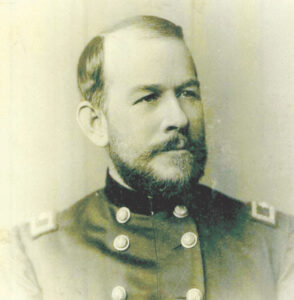
Photos courtesy of Penn State
"I'm not sure he's valued in Pennsylvania history or even at Penn State as he should be," said Jackie Esposito, retired university archivist and co-author of "The Nittany Lion: An Illustrated Tale." "When he was acting president at Penn State, the students credited him on 'The Lemon' to talk about all his rules and regulations for students."
But would Beaver approve of what goes on at the field that bears his name today? After all, while serving as Pennsylvania governor from 1887 to 1891, he was instrumental in the awarding of state funds to improve Penn State's football field, which the students named Beaver Field in his honor.
"He believed very much in students having physical activities, and as part of that he would have supported football," Esposito explained. "I don't think he'd appreciate the stadium being named for him. He would disapprove of the rowdiness. He expected students to behave much better than that."
Beaver's military background often led him to be very rigid with students, she said, and he believed in decorum.
While Esposito wouldn't mind having something named after him, he would be much happier with an academic building than a football stadium. "He was very positive about what he thought needed to be done to make Penn State a fantastic university," Esposito added.
Beaver would focus more on graduation rates rather than the numbers flashing on the stadium's gigantic scoreboard.
"He understood the importance of athletic teams, but he would have looked at the graduation rates of Penn State's athletes versus other Big Ten schools," said Esposito, referring to the fact that Penn State's graduation rates rank in the top tier of Big Ten schools. "It was important that Penn State athletes are getting an education."
After he grew up in both Mifflin and Perry counties, Beaver headed off to Jefferson College (now Washington and Jefferson) in Canonsburg where he graduated in 1856. The young man began a law career in Bellefonte and gained admission to the bar in 1859.
Beaver's promising law career was interrupted by the Civil War. As colonel of the 148th Pennsylvania volunteers, he fought in several key Civil War battles. The young officer's battle wounds prevented him from leading the Union troops at Gettysburg.
"I fell violently upon my face," wrote Beaver of the instant a Confederate bullet tore into his abdomen. "When I turned upon my back, (I) found a hole in my clothing just beneath the two rows of buttons. Without stopping to consider the matter, I inferred that a ball had entered there and that my military service was ended."
Beaver was incorrect in that initial assessment. A field doctor noted the bullet struck a pencil in his pocket, spraying shards of the writing utensil into his abdomen, but deflecting the bullet away from his organs and out through his back. Beaver was knocked out of the battle, but not out of the war.
After a month's recovery, he returned to the brigade still on the mend. The wound that ended his military career came during the Battle of Ream's Station, N.C., in 1864.
Between May 1863 and August 1864, Beaver was wounded four times. While serving as brigade commander, a sharpshooter took aim and put a bullet through his right leg, shattering the bone. He was dragged from the battlefield to a makeshift field hospital, where his right leg was amputated.
"Later as governor, he refused to have his picture taken below the knee," Esposito said. "He thought it would make him seem weak to others. He wanted people to see him as a strong, vibrant, dedicated worker."
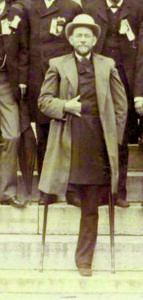
James Beaver, pictured above, is considered by historians to be one of the most fascinating, yet overlooked, figures in Pennsylvania history.
Photos courtesy of Penn State
James Beaver, pictured above, is considered by historians to be one of the most fascinating, yet overlooked, figures in Pennsylvania history.
Beaver was a man who could have been president of the United States if he had wanted the job. After an unsuccessful run for the state house of representatives in 1865, he lost several more attempts in offers for congress and governor in 1878.
In 1880, Beaver was chairman of the Pennsylvania delegation to the Republican presidential convention in Chicago, and his name was circulated as a leading candidate for James Garfield's vice president. Beaver declined and Chester Alan Arthur was selected. Arthur became president when Garfield was shot and later died in 1881.
Had Beaver accepted the nomination, he would have likely become president.
"He was a very interesting governor," Esposito said. "In a time of economic distress in the United States, he managed to keep Pennsylvania out of economic distress. I don't know if people give him enough credit for what he did for the Commonwealth during his lifetime."
When the name of the original football field was chosen, Beaver almost lost out to an obscure member of the Penn State Board of Trustees named Roberts, and to an 1890s version of Anthony Lubrano, the well-to-do alum who donated money to name Penn State's current baseball facility, Medlar Field at Lubrano Park.