
Agnes brought devastation still seen locally
Stories sought for commemorative book
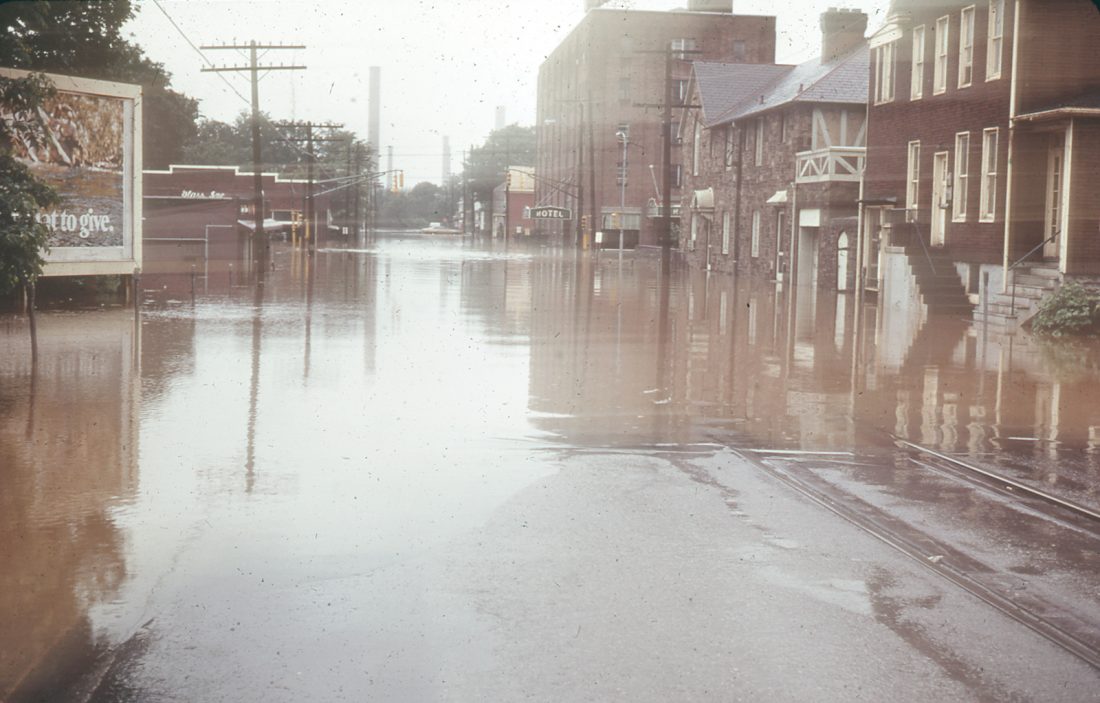
Photo courtesy MIFFLIN COUNTY HISTORICAL SOCIETY
Water Street lived up to its name as seen in the aftermath of Agnes, the tropical storm that struck Central Pennsylvania in June 1972. The Sentinel’s annual hardback book will look back on the devastating flood.
LEWISTOWN — It was June 22, 1972. Rain was predicted by the National Weather Service, but flooding was only anticipated in the far reaches of Western Pennsylvania.
Agnes, a hurricane that had been downgraded to tropical storm status, didn’t read the forecast. Two days later, the destruction of the brutal storm was at its peak.
Next summer marks the 50th anniversary of Agnes, a storm so unique in the record-shattering losses it caused that the National Weather Service vowed never to use the name again – the first of five hurricane names that have been retired.
Here, in the Juniata River Valley, Agnes made itself known in a way that local residents still have not forgotten. Neither has The Sentinel – and for this landmark we have chosen to dedicate our annual hardback book to the storm that changed our lives.
Agnes will be remembered in this special commemorative edition that will be available for presale in late summer and for delivery in time for Christmas.
For me, a young lad who had moved less than a year before from a town that had no significant water flow, it was at first adventurous but eventually scary. Our home, in the northern end of Selinsgrove, was four blocks from Penns Creek and more than half a mile from the Susquehanna. By the time the rain let up, the shoreline was less than a block away. A neighbor found panfish in his yard.
Still, we were among the lucky – the worst we saw was a few feet of water in the basement and several days without power (some in our state had no electricity for three months!).
In Lewistown, it was the beginning of the end of American Viscose Corp., among the largest employers in the area.
How bad was Agnes? A small rainfall over the 72 hours she battered our communities measured 7 inches, in Johnstown. To the east, it was far worse – Lewistown sustained 12 inches of rain, Harrisburg 15 inches and the top rainfall was measured in Schuylkill County: 18 inches.
Riverbanks were quickly swollen and the water had no place to go. Lewistown was the hardest hit of Juniata River communities, as the river crested at 42.1 feet – more than 19 feet above flood stage. No other community in the river basin that includes the Juniata and Susquehanna rivers saw water rise that far above flood stage.
Of the nearly 130 people who died in the flood, which impacted states from Florida to New York, 50 were Pennsylvanians. The $3 billion it caused in damage nationwide also was felt most severely in the Keystone state – some $2 billion, which translates into nearly $18 billion in current value. More than 100,000 people had to flee their homes, many of which saw water at second-floor levels.
As with our other remembrances of the Juniata Valley’s past, we want our readers to help tell the story in their words and with their photographs, to preserve the history for future generations.
The memories to many are painful. But we ask you to share them with us, allow us to share them with the community at large.
Knowing that most photos of the era are not digital, we ask that you allow us to borrow them long enough to scan for use in the book. We will take the utmost care of your photos and offer nothing but respect for your rembrances of this devastating time.
Those who wish to share written memories, show us surviving ephemera, also are encouraged to bring them to our office at 352 Sixth St. in Pleasant Acres. You may share stories via email to living@lewistownsentinel.com, or through our virtual newsroom at www.lewistownsentinel.com. If you have questions, please address them to Lifestyles Editor Jeff Fishbein at the same email or by calling (717) 248-6741.
Local News
Religion briefs
Editor’s note: To submit a nonprofit announcement to The Sentinel’s Religion section, contact Tom Laub at (717) ...

King brings Perry County’s past to America250PA stage
PSP issues nearly 700 citations on distracted driving during crackdown
HARRISBURG — The Pennsylvania State Police issued nearly 700 citations during a three-day statewide enforcement ...
In the region
PennDOT centers to close for Juneteenth YEAGERTOWN — All Pennsylvania Department of Transportation driver’s ...
Calendar
The Sentinel offers nonprofit and other community organizations an opportunity to promote upcoming events for free ...
Road projects continue next week
From staff reports LEWISTOWN — The Pennsylvania Department of Transportation has announced its maintenance ...