
Trending
LEWISTOWN -- Mifflin County High School does not confine history to textbooks -- it is being shaped, sanded and painted by students whose work will soon become part of a storied vessel tied to one of Pennsylvania's most important chapters.
Through a hands-on project in the school's Technology Education Department, students have played a direct role in preserving the U.S. Brig Niagara, a symbol of the state's maritime heritage and the War of 1812.
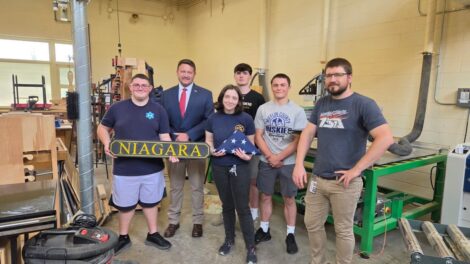
The opportunity began with a modern-day connection rooted in shared local pride. Tyler Gum, a 2004 graduate of Lewistown Area High School who now serves as the Western Division Chief for the Pennsylvania Historical and Museum Commission, reached out to MCHS Technology Education instructor Aaron Specht with a proposal. The Niagara, currently undergoing a major refit, needed replacement trailboards -- the decorative nameplates mounted on the bow of the ship -- and Gum believed Mifflin County students could help.
It was a fitting collaboration, one that bridged centuries of history with contemporary education. More than 250 years ago, Lewistown was the birthplace of Daniel Dobbins, a figure whose contributions were instrumental during the War of 1812.
Born in 1776, Dobbins rose to the rank of captain in the U.S. Navy and played a crucial role in the construction of the original Niagara as well as the fleet that would ultimately secure victory in the Battle of Lake Erie.
The Niagara itself holds a distinguished place in American history. Originally constructed in 1813 under the direction of Daniel Dobbins and master shipbuilder Noah Brown, the brig served as Comm. Oliver Hazard Perry's flagship during the pivotal Battle of Lake Erie. On Sept. 10, 1813, during heavy fighting, Perry made his now-famous transfer from the damaged USS Lawrence to the Niagara, carrying his battle flag across open water before taking command and driving through the British line. From her deck, he led American forces to victory, securing control of Lake Erie and altering the course of the war in favor of the United States.
Today's Niagara, a carefully reconstructed vessel, continues to serve as a floating classroom and ambassador of this history, sailing to ports and connecting modern audiences with the nation's early naval history.
Dobbins' legacy remains deeply embedded in Pennsylvania's maritime story. Erie's Dobbins Landing, a central feature along Presque Isle Bay, stands as a tribute to his contributions. Now, through the work of Mifflin County students, that Lewistown connection is being carried forward -- quite literally -- aboard the Niagara itself.
"This is where the maritime heritage of Lewistown connects with contemporary historic preservation," Gum said. "Having a piece of Lewistown aboard the ship is very special. Dobbins would be proud of the students' work."
The Niagara undergoing restoration today is itself a link across time. While the current vessel is a modern reconstruction, it incorporates non-structural elements tied to earlier versions of the ship and serves as a living symbol of early American craftsmanship.
As the United States prepares to mark the 250th anniversary of its founding, ensuring the ship is preserved and presentable for public education has taken on renewed urgency.
Among the many components requiring attention were the trailboards, which had weathered years of exposure and use. Replicating them required both technical precision and a respect for historical detail -- an ideal challenge for students eager to apply their skills in a meaningful way.
Students began by digitally recreating the trailboards, carefully studying their proportions and design to ensure historical accuracy. This phase underscored a key aspect of modern preservation work: blending technological tools with traditional forms.
From there, the project moved into the school's Production Lab, where students fabricated the new pieces according to exact specifications. Using modern equipment, they translated digital concepts into physical objects, ensuring the replacements would match the originals while also standing up to the demands of life aboard a working vessel.
The work continued with hand finishing, as students sanded, refined and painted each piece. Color selections were provided by the Pennsylvania Historical and Museum Commission to match the historic look of the ship, giving the finished trailboards both authenticity and visual continuity.
For the students, the project became more than an assignment -- it was an experience in stewardship.
Specht described the effort as both "exciting and fun," noting how it connected past and present. "While we used more modern techniques to create the new versions, it was fascinating to be able to look back and see the craftsmanship and skill required to make the originals," he said. "Those builders were truly artisans."
That realization added depth to the project. In retracing the work of early shipbuilders, students gained appreciation not just for the finished product, but for the skill, patience and artistry that defined historical craftsmanship. Their work became part of an ongoing tradition rather than a one-time task.
The students -- and the MCHS Technology Education Department --now join a relatively small group of individuals who have directly contributed to the preservation of Niagara. Their trailboards will become part of the ship's evolving story, seen by visitors and historians as it continues its educational mission.
For the school, the project stands as an example of experiential learning at its best, connecting classroom instruction to real-world impact. For the students, it offers something even more lasting: the knowledge that their work will endure as part of a national historic treasure.
As the Niagara prepares to return to Pennsylvania waters for the nation's 250th anniversary, it will carry with it a renewed sense of purpose--and a tangible contribution from a new generation.
In preserving a symbol of the past, these students have helped ensure that history remains not just remembered but lived.