Watchdog finds charters spend public dollars on sports sponsorships
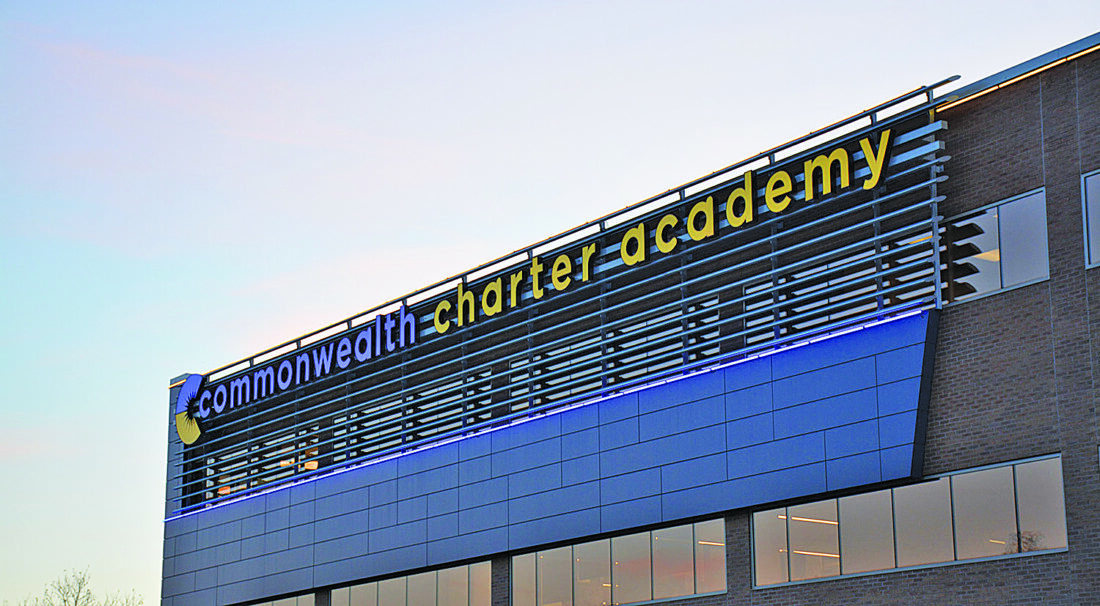
Sentinel photo by MIKE GOSS
The signage on the outside of a Commonwealth Charter Academy building.
MIFFLINTOWN — Cyber charter school funding — or perhaps more specifically the state’s funding formula — has been a hot topic for the Juniata County School District Board of Directors this year as they wrestle with a budget deficit that even a tax increase did not resolve.
During the school board’s regular monthly meeting on June 18, District Superintendent of Schools Christie Holderman shared some information that she received from a watchdog group — Education Voters of Pennsylvania, that summed up her frustration with the state’s charter school funding method.
Highlighted was the fact that Pennsylvania cyber charters are spending public dollars on sports sponsorships — not for local school teams but for professional sports franchises.
Cyber charter schools are tuition-free, online-only public schools that operate independently but are funded by local school districts. When a student living in the Juniata County School District enrolls in a cyber charter, the district is required to pay that school a tuition fee — even though they have no oversight of their spending or academic performance. Most of these dollars come from property taxes that are raised at the local level, according to the Spring Grove Area School District’s website. The York County school district has posted information about cyber charter funding on its website in an attempt to educate others.
For example, the Commonwealth Charter Academy (CCA), which according to its website, is a Montgomery County virtual school in suburban Philadelphia, that provides free education to students in Montgomery County and surrounding areas, including Haverford, Norristown, Pottstown and King of Prussia as well as Philadelphia.
Their site continues, “Our online school creates an education that is customizable to fit the unique needs for each of their students. We understand that every child has a different pace and style of learning. To make this work in your child’s favor, our academic program prioritizes customization for over 2,000 students across the state of Pennsylvania. With this as a priority, your child will be able to embrace their individual strengths while also still having to meet deadlines and take responsibility for their education.”
That’s all fine and dandy, but CCA’s logo is listed as a corporate sponsor of the Wilkes-Barre/Scranton Penguins, the top minor-league hockey farm team of the National Hockey League’s Pittsburgh Penguins, with naming rights to the Ice Level Lounge and CCA banners plastered throughout the arena, according to Education Voters of Pennsylvania.
Education Voters of Pennsylvania didn’t learn about this sponsorship through CCA’s invoices that the school provided in response to a Right to Know request, it was discovered because of the Penguins’ website.
According to Education Voters of Pennsylvania, CCA expenditures for advertising and promotion are bundled into vague, high-dollar invoices that obscure what they are spending tax dollars on. Are the costs of their corporate sponsorships included in these invoices? Maybe, Education Voters of Pennsylvania contends, but it cannot be sure.
In total, CCA provided more than $8,9 million in advertising invoices for the 2023-24 school year in response to a Right to Know request, including two from Target Media Group totaling nearly $4.1 million, with agency fees topping $600,000.
Those numbers are simply staggering to Holderman and others. District Business Manager Rich Meily stated that costs for funding charter schools eats up about 10 percent of the budget. That’s $5 million.
While charter schools use those valuable funds to advertise, students in school districts like Juniata County are having to work harder just to enjoy the basics.
“We have to fundraise to send our kids on field trips,” Holderman said. “We can’t compete with that.”
And they’re not really trying to. Districts like Juniata County just want to pay a fair share.
School districts make more than $1 billion in tuition payments to Pennsylvania’s cyber charter schools annually, according to Education Voters of Pennsylvania. Most of these dollars come from property taxes that are raised at the local level. They are intended to be invested in educating students. However, thanks to a funding formula in Harrisburg and a lack of adequate state oversight, cyber charter schools spend millions of tax dollars every year on things unrelated to educating students, officials at Education Voters of Pennsylvania added.
Director Terrance Shepler agreed the problem is the funding formula. “Parents should have a choice, but the funding formula is the problem,” Shepler explained.
According to information posted on Spring Grove’s website, the problem is Pennsylvania’s cyber charter schools have been operating since 2002, but the way they’re funded is based on a 1997 law designed for brick-and-mortar charter schools. This outdated system means that:
Cyber charters receive the same tuition payments as in-person charter schools, even though they don’t have the same expenses — like safety measures, school buildings and grounds, and on-site student services.
Tuition rates vary widely because each school district calculates its own rate based on local expenses — not on the actual cost of educating a student in a cyber charter. This results in vastly different tuition payments for students receiving the same online education.
It is important to note that this issue is not about limiting school choice. It’s about pro-fiscal responsibility, officials from Education Voters of Pennsylvania say. The call for a reform is solely focused on ensuring that taxpayer dollars are spent responsibly and that cyber charter schools are funded based on actual costs.
Because of this broken funding model, Juniata County and other districts are paying millions to cyber charters that is being spent on things unrelated to educating students. This drains local education budgets and shifts critical resources away from students, Holderman said.
That’s also why Holderman and others are urging those in the county to contact their local representatives about supporting the bipartisan reform bill that passed the state House of Representatives and now sits in the state Senate as both chambers seek to reconcile state budget priorities.
The June 4 passage of Pa. House Bill 1500 puts back in play anticipated tuition savings that failed to pass last year by capping the amount of tuition cyber charters receive.
Cyber charter leaders have stated publicly the cuts would threaten their ability to educate students, and possibly lead to the closure of programs that serve more than 65,000 Pennsylvania students.
Without reform, this outdated system will continue to place a financial burden on taxpayers while failing to improve student outcomes, especially in Juniata County.
Local News
Juniata County Commissioners hear updates
MIFFLINTOWN — Juniata County Commissioners heard updates from Penn State Extension and the Juniata County Library ...
Recognizing grief

Lewistown artist returns to roots with large-scale mural project
Calendar
Reserve Now: •Soup sale — Pick-up 11 a.m. to 12:30 p.m., April 11, Milroy Presbyterian Church, 321 S. Main ...
Officials approve advertising lot for sale
LEWISTOWN — Derry Township Supervisors announced Monday that bidding is open for a Woodland Avenue lot, where two ...