
Local officials say distracted driving crackdown long awaited
Statistics show distracted driving crashes surpass impaired
Trending
HARRISBURG -- On a quiet Thursday afternoon in Harrisburg, Gov. Josh Shapiro signed his name to a bill that had lingered on the fringes of Pennsylvania's legislative consciousness for more than a decade.
With one stroke, Senate Bill 37 -- now the Paul Miller Jr. Law -- became a reality, banning handheld cell phone use behind the wheel across the Commonwealth. The moment was years in the making, and behind the ceremony stood not only lawmakers and officials but also the families who had paid the ultimate price for distracted driving.
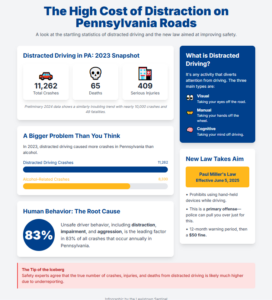
For years, the numbers told their own grim story. In 2023, Pennsylvania recorded over 11,000 crashes involving a distracted driver. Sixty-five people died, and 409 suffered life-altering injuries. Preliminary data from 2024 pointed to nearly 10,000 crashes and 49 fatalities -- a slight improvement but hardly cause for celebration.
Even as vehicle safety improved and traffic enforcement ramped up, the scale of the problem barely budged. Distracted driving crashes now outnumber those caused by impaired drivers, marking a dramatic shift in the dangers facing anyone on Pennsylvania's roads, Pennsylvania Department of Transportation statistics show.
The law itself is straightforward: using a handheld phone while driving -- or while stopped in traffic or at a red light -- is now a primary offense. Officers can pull over drivers only for holding a device.
For the first year, police will issue written warnings, allowing time for drivers to adapt. Citations begin on June 6, 2026, each carrying a $50 fine. There are no points added to a license, but for commercial drivers, it will appear as a non-sanction violation, the law states.
Drivers may use hands-free technology, but holding a device -- even to check directions or make a call -- is off-limits. The law also increases fines for texting while driving and closes loopholes by clarifying that drivers cannot be cited for both texting and handheld use in a single incident.
Maj. Robert Krol, who leads the Bureau of Patrol for the Pennsylvania State Police, underscored the serious threat posed by distracted driving. He warned that any use of a mobile device while operating a vehicle, including texting or talking, is a dangerous act.
Krol stated that such behavior risks the safety of the driver as well as "everyone sharing the road." He also confirmed that under the new law, officers are authorized to pull a driver over for this violation alone.
Krol clarified the scope of the prohibition, noting, "No body part can maintain that phone. So, it's not just holding it. I know a lot of drivers put their phone on their lap and that is illegal now." He added a crucial detail for motorists: "You are still not allowed to pull up that device at a red light, stuck in traffic. That law is very lengthy and real specific."
State Sen. Judy Ward, who represents the 30th District, sees the new law as an overdue response to the spread of cell phones in daily life.
"Over the last 20 years, the presence of cell phones and wireless devices in our culture has continually grown, becoming nearly ubiquitous. With this growth also came an increase in the amount of device use while driving and the need for legislation," Ward said.
For Ward and her colleagues, the law's reach into moments when a vehicle is stopped -- at a light, in traffic -- was deliberate. "Cell phones are highly distracting and habit-forming. Unlike sipping coffee, snacking, etc., picking up a phone often leads to prolonged use. Once it's in your hand, there's a strong chance it stays there even when the light turns green," she explained.
For critics who point out that hands-free technology can still distract drivers, Ward does not disagree but sees the legislation as an important step.
"The best cell phone use behind the wheel is no cell phone use at all. This law isn't meant to be punitive, but to set a standard that we take distracted driving seriously in Pennsylvania," she said. "Yes, hands-free technology can still be distracting. But this law targets the most dangerous form of cell phone use, manual and visual engagement. No law can eliminate all distractions, but this one helps move us in the right direction and work to change behavior."
Behind the legal language and policy debates are stories that do not end well. The law's namesake, Paul Miller Jr., was killed in Monroe County by a distracted driver. His parents, Paul and Eileen Miller, spent years lobbying for the change.
"Their tireless efforts have ensured that his legacy will protect countless others," said Sen. Rosemary Brown, the bill's prime sponsor. Eileen Miller echoed that hope: "This legislation, Paul Miller's Law, will touch countless lives and ensure his legacy continues. Because of Paul Miller's Law, fewer families will suffer the same pain our family has faced."
Data from the Pennsylvania Department of Transportation underscores the scale of the challenge. Distracted driving led to more crashes than alcohol impairment in 2023, a reversal of the trends that shaped decades of road safety campaigns.
And those numbers may be conservative: under-reporting is endemic, as drivers seldom admit distraction and investigators struggle to confirm device use after a crash. Naturalistic studies -- using in-vehicle cameras -- have found drivers engaged in distracting behaviors in over half of crashes involving teen drivers. The official statistics, grim as they are, likely capture only a portion of the real toll.
The law's passage is only one part of a broader effort. Its enforcement will fall to local police and the Pennsylvania State Police, who now have the authority to stop drivers for handheld use alone. The next year will focus on warnings and education, not punishment.
"This law is not about punishing drivers, but about keeping them safe," Ward said. "Law enforcement has been supportive as they understand the dangers of distracted driving and help ensure compliance in a way that builds awareness and promotes safer roads."
Supporters of the law point to evidence from other states. All of Pennsylvania's neighbors already have similar bans. In those states, hands-free laws have led to decreases in distracted driving incidents and related crashes. Ward is realistic about expectations.
"The entire law goes into effect by December 2026. This means the total impact of the law will not be seen until 2027 or later. While exact numbers are hard to predict, it is our hope and expectation that the number of distracted driving incidents will decrease. Every state's statistics are different, but there is evidence that when a state implements a 'hands-free' law, the number of incidents does decrease," she said.
The new law is not the endpoint. As technology develops, so too will the need for legislative updates. Ward acknowledges this: "Because technology is at the center of this bill, it will be important to revisit the law in the future to make sure that the law has kept up with the rapid pace of technological development."
For now, the Paul Miller Jr. Law stands as Pennsylvania's most significant move yet against distracted driving, aiming to shift both culture and behavior. Every driver, every passenger, and every family on the state's roads stands to gain -- or lose -- by how seriously that challenge is met. The message is clear, in the words of Ward: "No law can eliminate all distractions, but this one helps move us in the right direction and works to change behavior."