
McCrory’s career decision put him on path to success
Trending
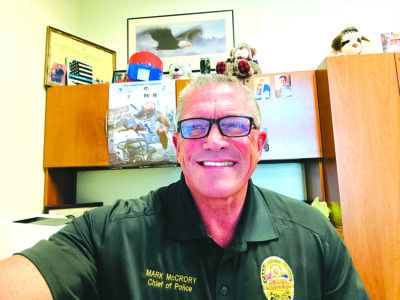
CASA GRANDE, Ariz. -- The destination was planned many years ago. The route traveled was slightly less clear. When Mark McCrory decided on a career in law enforcement, the stage was set for years of achievement and success. It was a stage that was constantly moving forward.
A Lewistown native, McCrory graduated from Lewistown Area High School in 1977 before heading to college to study accounting.
"I started college as an accounting major," McCrory said. "This was recommended to me by both my father and Mr. Barger, who taught accounting in high school. I had always enjoyed it as a high school class and thought it would be something I would enjoy as a career. It did not take me long to realize that was not something I wanted to do the rest of my life. I started looking for a career field that would allow me to be more active and possibly have a certain level of excitement to go along with it. Administration of justice seemed to meet all those expectations and I switched majors."
Even before his revelation in college, there was a police influence in McCrory's life.
"Growing up, I played for the Police Pals in Little League and we were coached by Jay Laub, and my neighbor was Aurie Snook, both Lewistown Borough Police sergeants who seemed to really enjoy their jobs," he said.
"My initial plan was to go into the military after college and I joined ROTC," McCrory continued. "After my sophomore year I went to take the physical to sign on and flunked my hearing test. That fall, the instructors came to me and told me they would show me how to pass it but by then I had decided my career path would be municipal law enforcement. I have never regretted that decision, even for one day."
He graduated from Shippensburg University in 1981 with a degree in administration of justice. It was just the beginning.
He moved to Tulsa, Oklahoma with his girlfriend, Beth, in the spring of 1982. The move was sight unseen, with no job waiting. Mark and Beth were soon married and he applied for openings in the Tulsa Police Department. He started at the Tulsa Police Academy on July 15, 1982.
For the next 33 years, McCrory was one of Tulsa's finest. There were many personal highlights, including several promotions, being selected for and serving on the Tulsa Police Department SWAT team for just under 10 years, working undercover narcotic assignments as an officer and eventually serving as a sergeant in the major narcotics unit until being promoted to lieutenant, being selected as supervisor of the year and state narcotics officer of the year.
The accomplishments speak for themselves, but McCrory's biggest reward is sharing the milestones with family.
"The promotional process was very competitive and the higher you went the fewer positions were available," he said. "I am very proud that Derek attended every promotion from his birth in 1991 until my last one in 2005. To me it was a great personal highlight that he wanted to share those moments with me."
Family is important and father and son are very close. McCrory's immediate family includes wife Shelly, son Derek (33), daughter-in-law Diana (31), step-son Caden (32), Emilio Rodriguez (34) (McCrory took him in at age 17 and he is considered a son), and McCrory's mother, Dolores.
McCrory also enjoyed watching many of his colleagues achieve success.
"After making sergeant, watching people who worked for you and with you getting promoted to leadership positions and assisting them along the way was a big career highlight," he said. "Something that is often overlooked is getting to work closely with so many great officers and experiencing a vast amount of different situations with them. These would go from mundane to actually terrifying but they all are fondly remembered and discussed with those you experienced them with."
The life of a police officer is a mix of situations and experiences, ranging from mundane to heart-pumping. McCrory has witnessed the full spectrum from one extreme to the other.
"All officers remember their firsts," McCrory said. "First time having a gun pulled on you, first arrest, first pursuit, first time you perhaps witnessed death or tragedy, first time getting shot at or the first time you had to go do a death notification."
"However, one event still stands out to me and thankfully I have not had to experience it often. My first police funeral for one of our officers who was killed in the line of duty. K9 officer Dick Hobson and his backer, a friend of mine Steve Downie, were both shot searching an alley for an armed robbery suspect. The suspect opened fire on them with a shotgun. Severely wounding Downie and killing Dick. Attending his funeral is something I will never forget. The crowds of officers and citizens, watching his family arrive at the church, his K9 entering the church and immediately going to sit beside the coffin and how the K9 whimpered. Seeing some of the toughest and bravest people I have ever met crying brought me to tears. It had a very emotional impact on me and everyone at the service."
The harsh reality of police work is the risk officers take every minute of their shift and beyond. The relative calm of a ho-hum day can be shattered in a second when a situation arises. McCrory has seen his share.
"Arguably one of the most dangerous situations involved a 27 hour standoff, when I was a member of the SWAT team," he said. "We were attempting to arrest a well-armed 28-year-old double-murder suspect, who was barricaded inside his apartment and holding his 80-year-old grandmother as a hostage. He fired in excess of 70 shots from various weapons, including an AK47, at various times over the 27 hours. He ended up shooting up my patrol unit but I was out of it at the time. We attempted what is called a "break and rake" on his front windows to allow our snipers to have a better view of the inside of the apartment. This consists of moving three officers to the front. The first officer carries a ballistic shield to provide some cover for the other two. The second officer's job is to break the window and use a tool to pull down all the curtains. The third officer is the cover officer and he is looking over the other two to provide cover fire if needed. I was the second officer and once I broke the window the suspect fired at us with his AK. One round went through the shield but missed both the shield officer and me. We pulled back behind the first cover we had and the suspect fired approximately 15 additional rounds at the cinder block wall we were behind. He fired at one of our snipers, striking some aerosol cans and igniting a fire that quickly spread. The fire department would not enter the area so myself and other officers had to man the fire hoses to get the fire under control. The suspect ended up committing suicide."
The toughest situations for McCrory were ones involving the death of a child or the notification of death to a relative. On one Christmas Eve, a Tulsa Med-X was robbed and the suspect shot and killed the clerk. McCrory, the responding patrol officer, had to inform the clerk's husband his wife had been killed in the robbery. The husband told him his wife was quitting Med-X. The Christmas Eve shift was to be the woman's last.
"Not a great Christmas Eve," McCrory said.
He retired from the Tulsa Police Force with the rank of Deputy Chief of Police on Dec. 31, 2015. At the time, he oversaw the Operations Bureau that consisted of three patrol divisions and the support division. The support division included all the motorcycles, K9s, SWAT, dive team, helicopters and special events.
In February 2016, McCrory and Shelly moved to Arizona after he accepted the job of Chief of Police with the Casa Grande Police Department. He went from a department of 850 to one of 90.
"We agreed to move here for five years and then move back to Tulsa," McCrory said. "We were here for four years and knew we were never leaving, even after I retire."
It has been a storied career so far with many changes in police work. Technology, greater transparency, data usage, drones, training, forensic science and emergency preparedness are just some of the improvements in law enforcement McCrory has seen over the past few decades.
The negatives, according to McCrory, are social media and the spread of inaccurate information, the dwindling number of qualified individuals who want to enter law enforcement, better-armed criminals, the spike in violent juvenile crime and the erosion of public trust over the years due to incidents taking place across the country.
The decline in an officer's mental health and wellbeing and the increase in police unions and their influence in resistance to reforms or changes also impact law enforcement.
"Some unions make it nearly impossible to get rid of a 'bad apple' that may be in a department," McCrory said.
As for retirement, McCrory has not set a timetable.
"My career plans are to keep working until it stops being fun," he said. "I still really enjoy working alongside individuals that range from 21-60 years old. Shelly and I have plans to stay in Casa Grande forever. We have so many great friends here and we don't want to leave."
As for his decision many years ago to enter law enforcement?
"I have no regrets in choosing to become a police officer," he said. "It is something I enjoy more than I can put into words. This career has exceeded all of my expectations and provided me with so many good and thankfully less bad memories. It certainly has not always been an easy job but it has always been a satisfying one. I actually think I was able to make a difference in the community I lived in whether it be Tulsa or Casa Grande. It is not for everyone and I honestly am glad that the three boys elected to go into banking, finance and energy fields rather than policing. When I talk with new officers about the fun side of the job, I remind them if you go to a party with lawyers, accountants, finance officers etc., no one asks them to talk about their day. However, they all want to hear about yours.
Looking back on any career, and even one ongoing, a sense of satisfaction signifies a correct choice.
"I honestly would not change a single thing about my career decisions," McCrory said. "I loved being a police officer in Tulsa and I love being an officer in Casa Grande."
The right decision and the right career, and the right man for the job.