
Why Fairfield, Mont., is running out of water
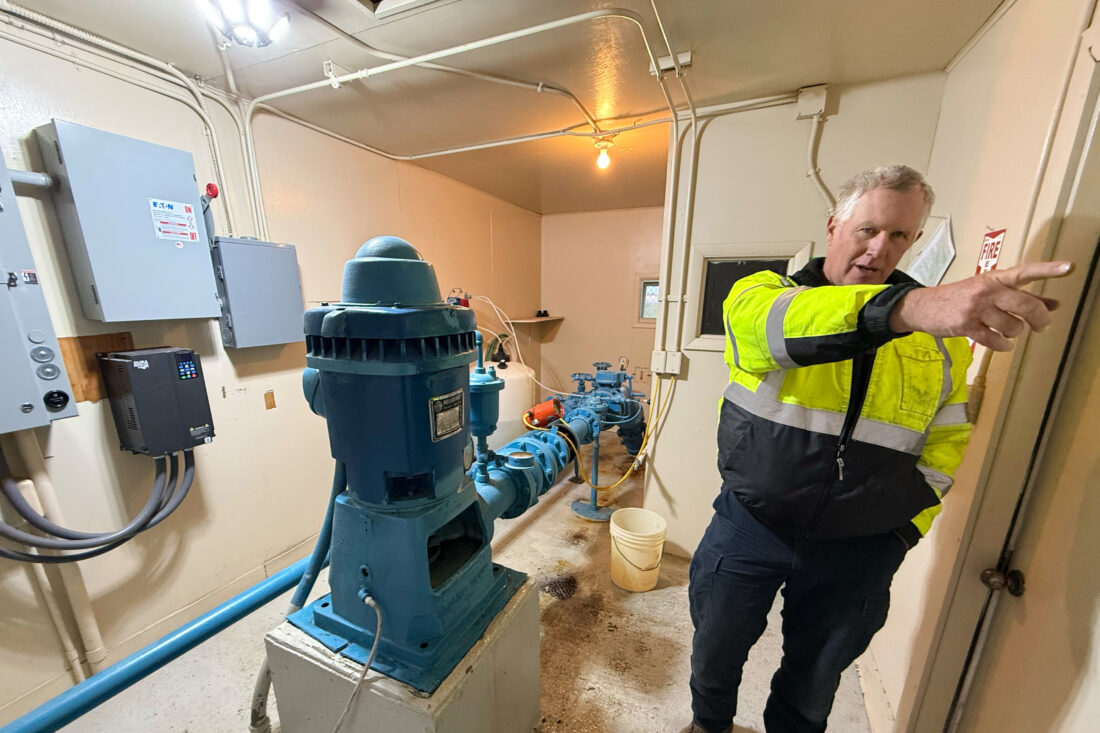
Fairfield Water Supervisor Chuck Dale speaks about the well house he stands in just outside of Fairfield, Mont., Wednesday, April 22, 2026. (Zeke Lloyd/Montana Free Press via AP)
FAIRFIELD, Mont. — Chuck Dale, Fairfield’s water supervisor, wasn’t satisfied with the rain that blew across northcentral Montana Wednesday. It wasn’t nearly enough to refill the depleted wells in the 800-person town about 35 miles west of Great Falls.
“Take a 30-foot cylinder, fill it full of dirt, pack it as tight as you can, pour six inches of water in the top and see what comes out the bottom. That’s the best way to put it into context,” Dale said. “You’re never gonna see anything drop out the bottom.”
The current water shortage — brought about by a combination of failing, decades-old infrastructure and a worsening regional drought — has strained the water supply of residents and the irrigation systems of local farmers. The town council has invested in infrastructure and imposed restrictions on water use, but it’s unclear if those steps will be enough to maintain Fairfield’s water supply.
If more wells start sucking air, Dale said, the town may have to bring in portable toilets.
According to a report from Great West Engineering, a consultant brought in by Fairfield’s local government, the water system loses about half of the water it takes from its wells. According to engineer Austin Egan, a standard rate of loss in a municipal water system is about 15%, more than three times lower. Engineers attribute a lot of the attrition to leaks in old, deteriorating pipes. Nearly two-thirds of the system’s pipes were installed in 1946.
According to Jake Garcin, a spokesperson at the Montana Department of Environmental Quality, the water loss in Fairfield is typical for an old system.
Garcin wrote in an email to Montana Free Press that other small Montana towns, including Fairview, Alberton, Martinsdale and Circle, have recently addressed aging infrastructure. DEQ also said Lockwood, a community just east of Billings, has also struggled with old plumbing.
But in Fairfield, the short supply this early in the year leaves the town with only a few options.
In the summer, the town’s demand will climb to 650 gallons per minute for 16 hours a day. But right now, the town can only pump about 450 gallons per minute for about seven hours a day. When the next two wells go dry, which Dale worries could happen at any time, the town will be down to about 250 gallons per minute.
It might not take until the summer for residents to experience inconveniences. Across Fairfield’s eight wells, three are nonoperational. Another three are running at partial capacity.
“I’d say if we pop these next two wells, then we’ll bring outhouses to the school and to some of the bigger businesses,” Dale said.
Dale said the town last had to ship in outhouses 23 years ago. After that, the town drilled a new, deeper well.
“Theoretically, we should never reach a problem again having that extra well, that deep well, but we’re already there again,” Dale said.
Dale said he knew water supply would be an issue ever since last year. Low quantities of water for irrigation last summer tipped him off that the town’s wells would struggle this spring. That’s because some of the water used by local farmers to irrigate their fields seeps into the groundwater that Fairfield’s wells also draw from, and many area farmers had to shut off their irrigation a month or more earlier than they typically do.
But there wasn’t much Fairfield could do to make up for the water supply loss. The town has tried to drill four new wells in the last two years, including two last week. None found enough water to warrant installing a pump.
At a crowded meeting last week, the Fairfield Town Council passed a slew of measures to mitigate the declining water supply. It allocated funds toward improved plumbing, increased water rates and limited non-essential water use, such as lawn watering.
Christi Hardin, who has spent most of her life in Fairfield, told MTFP Wednesday that she likes to grow tomatoes and peppers in small pots. But she doesn’t plan to plant any this summer because of the shortage. She is prepared to face more significant inconveniences soon.
“Last year was bad. But this year is worse,” Hardin said.
The dryness in Fairfield, the hub of a sprawling farming and ranching landscape, has also pinched agricultural production. The surrounding Sun River Project, an agricultural area comprising two irrigation districts, hundreds of miles of canals and about 93,000 acres of land, is also facing a shortage.
Susie Konen, a Fairfield farmer who irrigates her barley fields, said that the limited water supply makes her more dependent on the weather.
“It’s tough. We’ve been in a drought before,” Konen said. “It affects our production.”
National News

HOLSTEINS ON DISPLAY
Violent tornado tears through Oklahoma town, damaging 40 homes but sparing lives
Why Fairfield, Mont., is running out of water
Georgia wildfires that destroyed more than 120 homes continue to threaten residents
Tick season seems to be off to a fast start, and some experts worry about future illnesses
NEW YORK — Tick season seems to be off to a fast start, with an unusually high number of bites already reported ...
Sickness, cold killed nearly 30 sloths at a Florida import warehouse in 2024 and 2025
ORLANDO, Fla. — Disease and cold temperatures killed nearly 30 sloths at a Florida animal import warehouse in ...