
The fall and rise of Eastern Elk in Pennsylvania
Trending
LEWISTOWN -- Elk hunting has a long and storied history in Pennsylvania. The state's elk population was once on the brink of extinction, but thanks to successful conservation efforts, elk numbers have rebounded, making Pennsylvania one of the premier destinations for elk hunting in the United States.
The popularity of elk hunting in the state can be attributed to several factors, including the thrill of the chase, challenge of hunting such a majestic animal and opportunity to experience the beauty of Pennsylvania's wilderness.
"You typically see the rise and fall of something, but for the elk, you see the fall and then rise where they actually increased," explained Lt. Amy Nabozny, information and education supervisor for the Pennsylvania Game Commission's Southcentral Region in Huntingdon.
Nabozny talked about elk's return to the Commonwealth during her presentation, "Elk of Pennsylvania," at the Towpath Naturalist Society of Juniata and Mifflin County's meeting on Oct. 8 at the Fellowship Hall, St. John's Lutheran Church, 120 N. Main St., Lewistown.
In the 1700s, the Eastern Elk could be found across the entire state of Pennsylvania.
"Elk roamed the entire east coast," Nabozny said. "They could be found from New York down to Georgia."
Within a period of 200 years, European settlements had harvested and wiped out the herds of Eastern Elk, along with bison and eastern mountain lions. In those days, there weren't any conservation or hunting regulations. The Pennsylvania Game Commission was founded in 1895.
"These things thrived at one time in our state, and now they're completely extirpated," Nabozny explained.
"Back then there was no regard to what they were shooting," she added. "Some were shot for meat, but a lot of it was for antlers and hide."
Elk was highly-sought for the ivory in their canine teeth, which was used for decorative jewelry and pocket watches. "It was a sign of elegance or prestige," Nabozny explained.
The herds also declined because of intense forest fires and overcutting of trees to use as timber that wiped out their habitat. "If you wipe out the trees, there's no habitat left, and there's nothing for them to graze or feed on. And there's no cover as well. If you wipe out their resources, they're not going to rebound."
From the 1790s to 1830s, Pennsylvania went from having elk populations across the state to having herds to the southeastern and southwestern regions.
In the 1860s, the population continued to dwindle. The last two elk were reportedly shot in 1877, meaning the Eastern Elk became extinct in Pennsylvania.
The lack of conservation by settlers also deflated the populations of deer, bear, turkey and grouse, which led to the eventual formation of the Pennsylvania Game Commission.
In 1912, with the population of Rocky Mountain Elk bursting at Yellowstone National Park in Wyoming, officials wanted to hold a sanctioned hunt. When the Department of Forestry wouldn't approve it, elk were transferred to other states, including Pennsylvania, rather than see them starve to death.
"That's what we have in Pennsylvania today," Nabozny said.
In 1913, 50 Rocky Mountain Elk were shipped to Pennsylvania in two carloads and split evenly in remote areas in Clinton and Clearfield counties.
A letter sent to park officials from Pennsylvania said the elk were received in healthy condition and being kept in a small covered enclosure until weather conditions improve so they can be released in the spring.
"Elk eat about 20 pounds of food per day, so they were taken to remote areas far away from farms," she added. "That way they would not cause problems with local farmers and cause crop damage."
Additional herds were also sent to the state's game preserve.
In 1921, the first laws were created to protect elk, and, in 1923, the first elk hunt was held. "It was not like any hunt that is permitted today," Nabozny said. "You could only shoot bulls, and they had to be four-point to be legal."
The elk hunts were not held with regularity. In the 1970s and '80s, the Pennsylvania Game Commission started to focus on conservation and habitat work.
"Strip mining did a lot of damage to open areas where nothing was growing," Nabozny said. "They did a lot of habitat work to put areas back into fields, which helped the elk species."
In the 1990s, with healthy herds threatening to overpopulate some areas, traps and transfers were held to spread the high density areas to other parts of the state.
In 2001, the state reinstated elk hunts, which are still held today to harvest some of the species and control the numbers.
Despite its comeback, elk won't be spotted here in the Juniata Valley. They can mainly be found in the north central regions. "Occasionally, they wander down into Blair County and upper Centre County," Nabozny said.
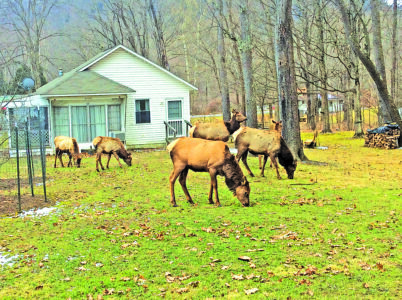
Currently, the number of elk are estimated at 1,300 to 1,400 in Pennsylvania. Elk enthusiasts of nearly 500,000 flock to elk ranges yearly to catch a glimpse of the majestic elk.
"We've come a long way," Nabozny explained.