Local Glider Soldier gave his life against Japan
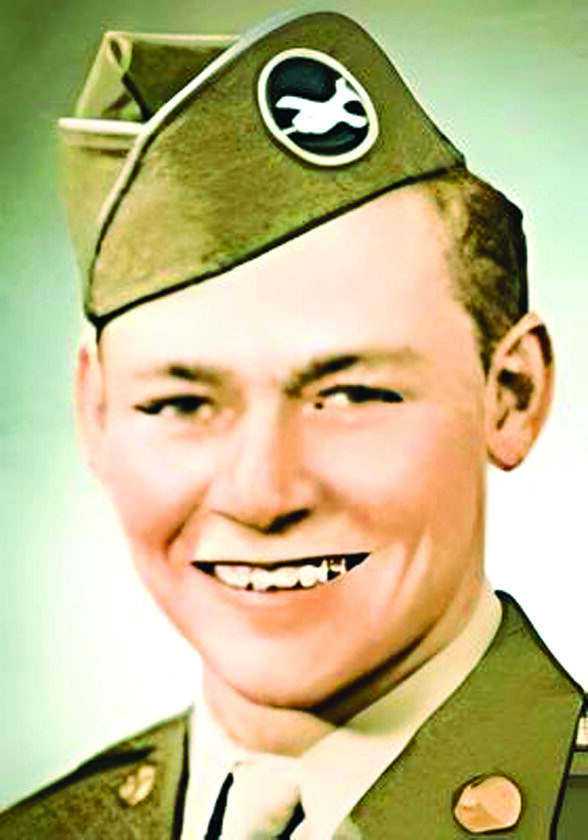
Jack Stanton Blessing. (Stories Behind the Stars)
[Editor’s Note: This article was previously published in the Dec. 5, 2025 edition of The Sentinel].
LEWISTOWN — Japan launched its only paratrooper attack against American airborne forces on Dec. 6, 1944 at San Pablo Air Strip No. 1, Leyte, Philippines. Following aerial strafing and incendiary bombing, nearly 300 Japanese parachutists surprised 11th Airborne Division troops in the early evening.
After hours of fierce battle, the 11th Airborne Division troops counterattacked, clearing the enemy from the air strip and successfully repelling the attack. Unfortunately, the cost of the victory included the life of Lewistown native Jack S. Blessing.
Jack Stanton Blessing was born on July 25, 1924 in Duncannon, Perry County and was raised on Juniata Terrace, Granville Township, Mifflin County. His parents, Harry Stanton and Elizabeth Hatfield Blessing, were natives of the Keystone State. Blessing was the youngest son of the couple’s nine children, which included younger sister Genevieve, older sisters Anna, Catherine and June, and older brothers Blaine, Harry, Tom and George. Blessing’s father was a laborer for the American Viscose Company in Lewistown. At least three of Blessing’s older siblings also worked at the rayon plant. His mother was a homemaker.
Blessing graduated from Lewistown High School in 1942 where he completed a general course of studies. Blessing actively participated in many school clubs and organizations, including student council, Hi-Y, cheerleading, assembly, junior prom committee, and the current events, public speaking, and dramatic clubs. Blessing worked as a stock clerk for variety-store G. C. Murphy Company. He registered for the draft in Lewistown on Dec. 11, 1942.
Blessing enlisted in the Army in Altoona on Feb. 25, 1943 and entered active duty in New Cumberland on March 4, 1943. After completing basic training, he was assigned to the 187th Glider Infantry Regiment, 11th Airborne Division. After training at Camp Polk, Louisiana, the regiment staged at Camp Stoneman, California on April 29, 1944. Blessing and his unit embarked from San Francisco on May 6, 1944 and arrived at Lae, New Guinea on May 29, 1944. The regiment conducted airborne training, practiced amphibious landings, and rehearsed jungle maneuvers until it departed New Guinea on Nov. 11, 1944. Blessing attained the rank of Technician Fourth Grade.
Blessing’s 187th regiment arrived on Nov. 18, 1944 with the rest of the 11th Airborne Division on Leyte Island, Philippines, landing at Bito Beach. Four days later, the 11th Airborne relieved the 7th Infantry Division with the initial charge of guarding the rear installation around Bito Beach. The mission changed in the following days when the Japanese mounted their only airborne attack of the war by parachuting onto the San Pablo airstrip on Leyte. The 187th regiment rushed from Bito Beach and launched a counterattack against the enemy. There was ferocious fighting with heavy casualties.
Blessing was killed in action on Dec. 7, 1944 at the San Pedro airstrip on Leyte Island, Philippines when he was fatally wounded by the enemy while trying to deliver a radio to his battalion.
Blessing’s remains were repatriated to the United States and were laid to rest at Lind Memorial Cemetery in Lewistown. Blessing posthumously was awarded the Silver Star on Feb. 10, 1945 for his “gallantry in action” and for “his great courage, daring initiative and zealous devotion to duty.”
•••
Stories Behind the Stars memorials are accessible for free on the internet and via smart phone app at gravesites and cenotaphs. The non-profit organization is dedicated to honoring all 421,000 fallen Americans from World War II, including 31,000 from Pennsylvania. To volunteer or for more information, contact Kathy Harmon at kharmon@storiesbehindthestars.org or visit www.storiesbehindthestars.org.
Juniata Valley Magazine
Local Glider Soldier gave his life against Japan

Rising voice, steady calling: Youth pastor and singer Patrick Young finds his rhythm

Miss Central Pennsylvania April Gable turns personal history into a mission to fight hunger
Library Minuteman: Ready to help at a moment’s notice
Local Marine among fallen heroes at Iwo Jima in March, 1945