
Built to survive: Conway explains fierce adaptability of Pennsylvania’s bobcats
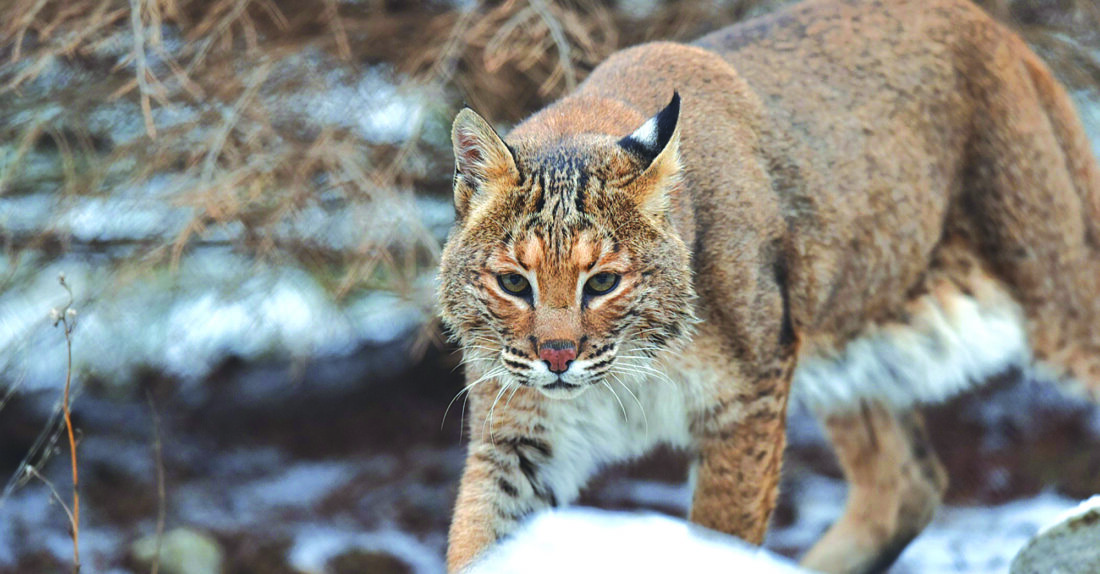
Bobcats were the subject of the Towpath Naturalist Society of Mifflin and Juniata County monthly presentation, “Prowler of the Pines,” which was held at the St. John’s Lutheran Church in Lewistown. (Photo courtesy DCNR)
Editor’s note: This is the second of a two-part series from the Towpath Naturalist Society meeting on March 11 about “Prowler of the Pines,” which featured Jimmy Conway of the Pennsylvania Game Commission.
LEWISTOWN — Bobcats are among Pennsylvania’s most elusive predators, but on Wednesday night, the Towpath Naturalist Society of Mifflin and Juniata County got a rare, detailed look into their world thanks to Jimmy Conway, the Southcentral environmental education specialist for the Pennsylvania Game Commission.
Bobcats were the subject of the Towpath’s monthly presentation, “Prowler of the Pines,” which was held at the St. John’s Lutheran Church in Lewistown.
Conway opened with a question. “How many people here have seen a bobcat or played around with it?” he asked. When several hands went up, he grinned. “So, we’ve all done it.”
He began with physical traits. “General size of these males are generally bigger than females,” he said. “They range usually from 11 to 30 pounds.” Their coats, he explained, are as unique as fingerprints. “Their co-coloration is like our fingerprint. None of them have the same kind of coat.”
He moved quickly into habitat. “As you can see, anywhere in the green, the darker green you’ll see here, that’s primarily males,” he said, pointing to a map. The populations are primarily in wooded areas. “Males have a bigger range of where they’ll go versus females.”
Females, he explained, stay close to home. “The females are more like a homebody,” he said. “They don’t want to stray out of their area.”
Bobcats are solitary and territorial. “They establish home ranges, just like any other wildlife,” Conway said. “They’re going to mark their territory based upon their scent.”
“They breed February through March,” he said. “So right now we are in the breeding season.” Kittens arrive in early spring. “Their litter size is usually from one to six kits,” he said. “3.7 being the average.”
He described how helpless the young are. “Kits are born fully, but their eyes are closed for eight to 10 days,” he said. “The mother has to wean them and nurture them.”
Dens are chosen with care. “Each cat has one main den and several auxiliary dens,” Conway said. “They like to get under tree roots. They’ve got cover. They can hide.”
If disturbed, mothers move quickly. “Within two days, the mother moved her entire den to a new location,” he said.
Food habits often surprise people. “Squirrels,” Conway said. “Chipmunks, mice, raccoons.” But he added a twist. “Contrary to what they say, they like rabbits. They love cats.”
He explained how their claws help them hunt. “Their claws are retracted, so they stay sharp,” he said. “That way, they can actually…” He let the audience fill in the rest.
Their eyesight is even more impressive. “They have light-sensing rods in their eyes,” he said. “It allows them to see objects in a sharper contrast than what we would normally.”
Predators are few. “Owls will actually prey on the young ones,” he said. “Porcupines too. There have been some deaths of bobcats due to porcupines.”
He shared findings from a Game Commission study that implanted transmitters in kittens. “A total of 28 juveniles were implanted,” he said. “Kittens were usually responsive within about six minutes.”
The results showed strong survival. “Survival rate, about 82%,” Conway said. “That’s a pretty good survival rate for an animal in Pennsylvania.”
Roadkill is the biggest danger for juveniles. “September through November, most common mortality on the roads,” he said. “That’s when they’re actually starting to get out and explore the area.”
Historically, bobcats faced far worse. “In 1500 to 1800, they were considered vermin,” Conway said. “There was actually a bounty for one of them. One dollar a cat.” The persecution intensified. “In 1916, they were up to $15,” he said.
Even after bounties ended, bobcats remained unprotected. “They were removed in 1937, but still remained unprotected,” Conway said. “When unprotected, you could kill them anytime you want.”
Protection finally came in 1970. “They were protected from 1970 to 1999,” he said. Only then did the population begin to rebound.
Today, bobcats are thriving. “We’ve got a good population around this area,” Conway said.
For Conway, the bobcat’s story is one of resilience — an animal built to survive, adapt, and reclaim its place in Pennsylvania’s wild landscape.
Next meeting
“Birdsong Bingo,” featuring Kylie Orndorf of Reeds Gap State Park, will be the subject of the Towpath Naturalist Society meeting at 7 p.m. on April 14 at St. John’s Lutheran Church, 120 N. Main St., Lewistown. All are welcome. $10 annual dues are payable in November.
Outdoors
Storing ammunition: What every gun owner needs to know
Ammunition is as much an investment as the firearms in which it is used. Whether you spend a few dollars on target ...
Built to survive: Conway explains fierce adaptability of Pennsylvania’s bobcats
Statewide Mentored Youth Trout Day is Saturday, March 28
HARRISBURG — The Pennsylvania Fish and Boat Commission reminds anglers that Mentored Youth Trout Day is Saturday, ...
New rules helpful for hunting out-of-state
Protecting Pennsylvania’s deer and elk from Chronic Wasting Disease (CWD) remains a priority, now as ever. That ...
PBGC to gather in Erie
The Pennsylvania Board of Game Commissioners will meet Sept. 15 and 16 at the Tom Ridge Environmental Center in ...
Outdoors calendar
Atkinson Mills Sportsmen’s Club • Meetings — held on the first Wednesday of each month at 7:30 p.m. The ...