
On gridiron and beyond, ‘Woodlawn’ scores inspirational win

Photo courtesy of IMDb
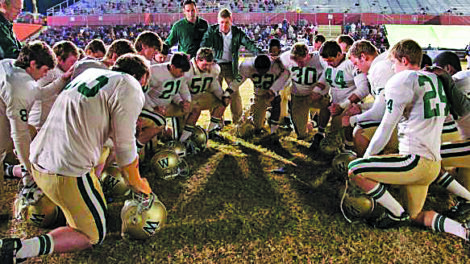
A scene from the movie ‘Woodlawn,’ starring Caleb Castille and Nic Bishop.
A sports movie built on a true story carries a different kind of weight, and “Woodlawn” leans into that responsibility with a blend of football grit, historical tension and a message about choosing unity when division feels easier.
What makes the film work is that it never forgets the power of the game itself. The football sequences are physical and sharply staged, the rivalries feel authentic and the stakes — on the field and in the community — are grounded in the real Birmingham of the early 1970s.
At the same time, the film is unmistakably a life-lesson drama, using the sport as the vehicle for a story about faith, courage, and transformation.
“Woodlawn” will be featured during free movie night at 6:30 p.m. Sunday at Reedsville United Methodist Church, 82 E. Logan St., Reedsville.
Football as the emotional engine
The film opens with a striking prologue: Bear Bryant, played with understated authority by Jon Voight, invites integrated USC to play in Alabama. It’s a symbolic gesture meant to ease racial tensions, and it sets the tone for a story where football becomes a cultural battleground. Three years later, Woodlawn High School is forcibly integrated, and the football team becomes a microcosm of the city’s turmoil.
Tony Nathan, portrayed by Caleb Castille in a confident debut, enters this environment as a gifted African-American running back whose talent is undeniable but whose presence heightens the tension in a divided locker room. The early football scenes are tight, bruising, and chaotic–reflecting a team that can’t find its identity and a coach, Tandy Gerelds (Nic Bishop), who can’t find answers.
The rivalry with Banks High School, led by C. Thomas Howell’s Coach Shorty White, adds a classic sports-movie edge. The film’s centerpiece — the real-life 1973 matchup that drew 42,000 fans –captures the scale and spectacle of high-school football in the Deep South. The game sequences are shot with clarity and momentum, giving the film a strong athletic backbone.
A transformation rooted in faith
The turning point arrives when Sean Astin’s Hank, a self-described “sports chaplain,” asks to speak to the team. His message–choose unity, choose love, choose Jesus–sparks a transformation that begins in the locker room and radiates outward. More than 40 players commit to the “better way” Hank describes, and the shift in their attitudes begins to change the team’s culture.
The film doesn’t shy away from the reality of 1973 Birmingham. Cross burnings, riots, and political resistance form the backdrop, and the players’ decision to embrace unity becomes a quiet act of defiance. One of the film’s most powerful scenes comes when Hank’s microphone is cut during the Lord’s Prayer before the big game, only for thousands of spectators to spontaneously recite it aloud. It’s a moment that captures the film’s belief in the unifying power of shared conviction.
The Erwins, who directed the film and whose father is the real-life Hank Erwin, occasionally push the religious messaging hard, and some scenes feel more symbolic than subtle. But the sincerity of the storytelling keeps the film grounded. The characters — especially Nathan and Gerelds — are portrayed with enough nuance to feel human rather than purely inspirational.
A sports film
with something on its mind
Woodlawn succeeds because it understands that sports stories are ultimately about people. The football action is strong enough to satisfy fans of the genre, but the film’s heart lies in its portrayal of a team — and a community — learning to choose unity over division. It’s a reminder that the lessons learned on a field can echo far beyond it, and that sometimes the most important victories aren’t measured on a scoreboard.
Rating: PG
Runtime: 123 minutes
Grade: A
•••
Greg Williams is a reporter and Weekend Editor for The Sentinel. A Mifflin County native, he has been writing for The Sentinel since 1991.
Local News
On gridiron and beyond, ‘Woodlawn’ scores inspirational win
A road trip through time
If you’ve ever wished you could time travel without giving up air conditioning or cupholders, Central ...
Professional Women to meet March 17
MIFFLINTOWN — The Juniata County Business and Professional Women will hold its March dinner meeting on Tuesday, ...
In the region
Employer workshop held March 31 at PA CareerLink LEWISTOWN — The Juniata Valley Employer Advisory Council will ...
Calendar
The Sentinel offers nonprofit and other community organizations an opportunity to promote upcoming events for free ...
VFW Auxiliary launches shoe drive to benefit veterans
From staff reports MOUNT UNION — The VFW Auxiliary to Post 5754 is collecting gently worn, used and new shoes ...