
Judge Imes brings courtroom to classroom
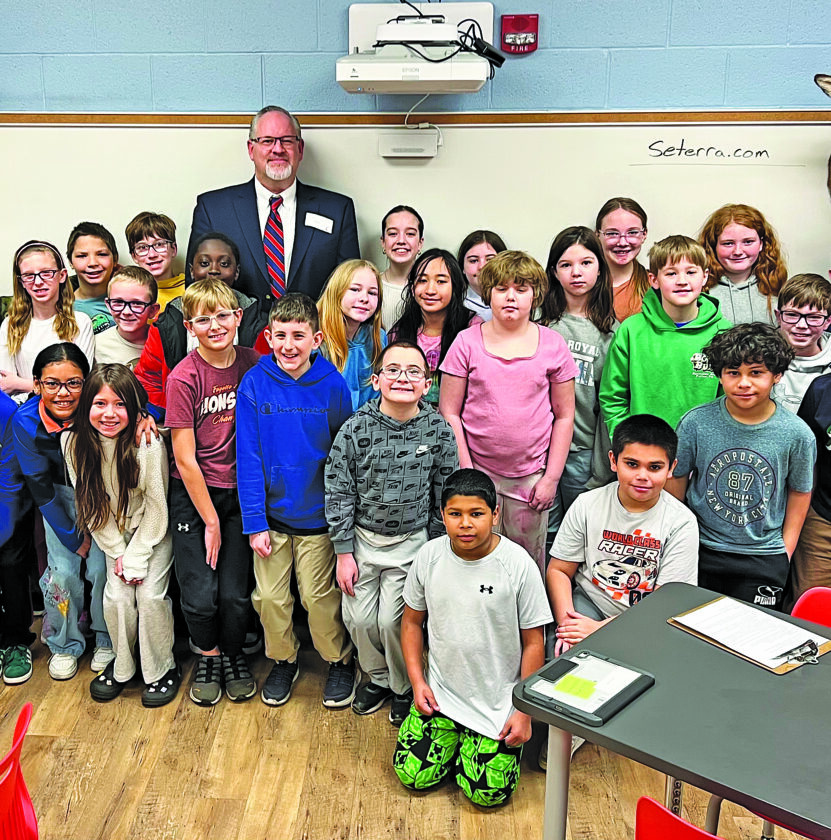
MIFFLINTOWN — When Magisterial District Court Judge Josh Imes walked into an elementary classroom this week, he wasn’t wearing a robe, sitting behind a bench or presiding over a hearing. Instead, he was greeted by wide eyes, raised hands and a room full of students eager to learn what a judge actually does.
And as it turned out, they already knew quite a bit.
Imes was invited to Jared Byler’s fourth-grade class at Juniata Elementary School in Mifflintown to speak about local county government and the different aspects of what a magisterial district court judge does. The students came prepared.
“The students were great and really knew their stuff about local government officials such as the DA, coroner, treasurer, and judges and what we did in our respective capacities,” Imes said. “Mr. Byler has done an excellent job with them.”
What followed was a lively, rapid-fire question-and-answer session that felt more like a spirited civics workshop than a formal presentation. Imes, who spent nearly two decades teaching social studies before becoming a judge, slipped naturally back into educator mode.
“The students had a lot of questions and were just surprised that a local official would come to their school and talk to them,” he said. “I reminded them that they are the citizens of this county and they are who we serve every day.”
From there, Imes walked the class through the wide range of responsibilities handled by a magisterial district judge — responsibilities that go far beyond what most fourth-graders imagine when they hear the word “court.”
“I discussed the different aspects of my job such as: officiating weddings, civil hearings, tenant-landlord hearings, truancy hearings, and preliminary hearings and arraignments,” he said.
But one topic captured the room’s attention more than any other.
“The students seemed to be most interested in what factors go into setting bail for an individual and what that entails,” Imes said.
Their curiosity didn’t stop there. The students wanted to know what the courtroom looks like, how people behave in it, and what kinds of safety measures are in place. Their questions grew more serious as they learned about the precautions taken in district courts.
“They also asked a bunch of questions about security measures that we have at the district court such as: metal detectors, armed security guards, bullet-proof windows and doors,” Imes said. “They couldn’t believe that someone would even think about hurting a judge.”
For many of the students, this was their first time speaking directly with a local official. The visit gave them a chance to connect the dots between what they learn in social studies and the real people who serve their community. It also gave them a glimpse into the everyday workings of local government — something Imes has always believed young people should understand.
Throughout the visit, he emphasized that even fourth-graders are part of the civic fabric of Juniata County. His message was simple: they matter, and their voices matter.
The visit also gave Imes a chance to reconnect with the classroom environment he spent so many years in. Though he now serves from the courtroom rather than the chalkboard, his passion for teaching hasn’t faded.
For the fourth-graders, the visit was more than a civics lesson — it was a chance to meet someone who grew up in the same county, walked the same school halls and now serves in a role many of them had only heard about in textbooks. They learned that judges aren’t distant figures in black robes; they’re neighbors, community members and public servants who care deeply about the people they serve.
Whether the students remember the details of bail hearings or the list of county officials, they will likely remember the day a judge came to their classroom, answered every question they threw at him and reminded them that they are already citizens with a role to play.
Local News
Judge Imes brings courtroom to classroom
Local Marine among 5th Division fallen heroes at Iwo Jima
IWO JIMA, Japan — No World War II battle represents the fighting spirit of the US Marine Corps better than Iwo ...

SHENANIGANS
police reports
Lewistown Police looking for truck involved in hit-and-run incident LEWISTOWN — Lewistown Police Department ...
calendar
The Sentinel offers nonprofit and other community organizations an opportunity to promote upcoming events for free ...
Blind taste test at Juniata County Library serves up snacks, surprises
MIFFLINTOWN — The Juniata County Library in Mifflintown is usually a calm place on an average Thursday night — ...