District program provides alternative to costly cyber charter schools
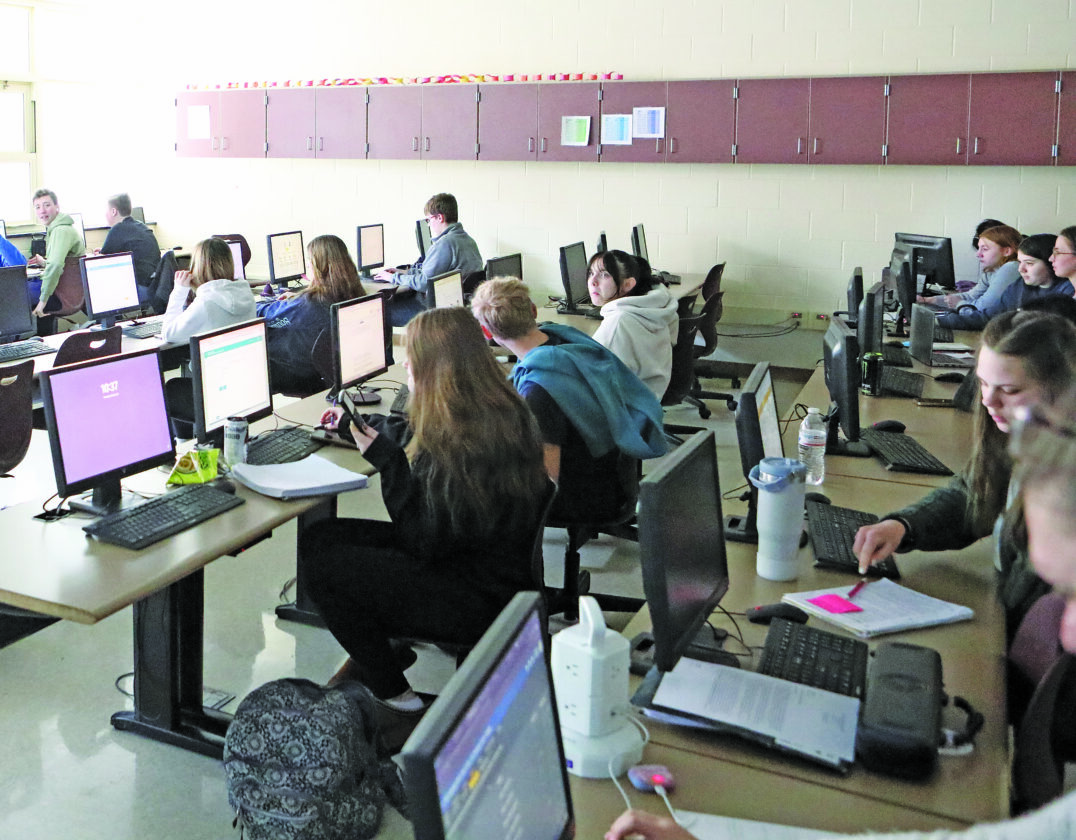
A view of one of several Mifflin County High School Alpha Program classrooms hard at work.
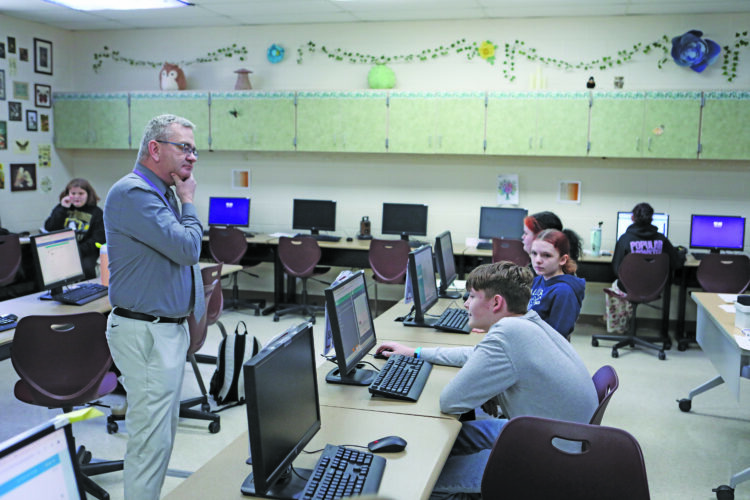
Mifflin County Middle School Alpha Program seventh-grader Dresden Amspacker, right, gets help from Chris Gill, the Mifflin County School District’s administrator of online programs, at the Mifflin County High School.
(Editor’s note: This is the first of a five-part series about the Mifflin County School District’s decorated Alpha Program, a district-run cyber education program designed to keep students local, supported and connected.)
LEWISTOWN — More than a decade ago, as cyber charter enrollment surged across Pennsylvania and public school districts watched millions of dollars leave their budgets, the Mifflin County School District made a strategic decision.
Instead of accepting the financial drain, MCSD built its own solution — a district-run cyber education program designed to keep students local, supported and connected.
“The Alpha Program was created as a district-led cyber education program of MCSD to save Mifflin County taxpayers’ money by providing an alternative to the cyber charter schools,” said Chris Gill, the district’s administrator of online programs. “We have grown into one of the largest district-led cyber education programs in Pennsylvania. Our growth is really a reflection of what we can provide students that the cyber charter schools cannot.”
That growth — and the philosophy behind it — earned statewide recognition last year when Alpha was named the 2024 Model School of the Year by the Capitol Area Online Learning Association, a network of 140 online learning programs across the Commonwealth.
But Alpha’s success didn’t happen by accident. It came from a deliberate choice not to imitate cyber charters, which Gill said have long struggled with academic performance.
“The short answer is we are successful because we have not tried to copy cyber charter schools,” he said. “Cyber charter schools have historically struggled with below-average academic achievement and student growth as well as low graduation rates. Currently, 13 of the 14 cyber charter schools are in the state’s highest designation for poor performing schools.”
Gill took over the Alpha Program midway through the 2014-15 school year and immediately began examining what was working — and what wasn’t. The data revealed a clear pattern: students who blended online coursework with in-person support significantly outperformed those who worked entirely from home.
“The data was clear that our hybrid students outperformed our full-time students,” Gill said. “Students who physically came into the Alpha classroom to work directly with our teachers did better than the students who worked entirely from home.”
Hybrid students also had better attendance, stronger connections to peers, and continued access to sports, band, clubs and counselors — all of which contributed to their success.
But at the time, most Alpha students were full-time online learners. The program’s location — an annex at the Academy — made it difficult to schedule students for both Alpha and traditional classes. That changed in 2015-16, when district leadership supported relocating Alpha to Mifflin County High School.
“Fortunately, early in the 2015-16 school year, with the support of former superintendent Jim Estep, current superintendent Vance Varner and former (high school) principal Mark Crosson, we were able to relocate to the Mifflin County High School,” Gill said. “This allowed us to provide greater support to students wishing to take online coursework.”
The move was transformative. With easier access to teachers, counselors and extracurriculars, Alpha began to grow steadily. Students could now take a mix of online and traditional classes without transportation barriers. The hybrid model became the program’s backbone.
Today, more than 500 sixth- to 12th-grade students take at least one online course through Alpha, and the majority also take at least one traditional class in the building. Fewer than five students are fully remote — all for documented health reasons.
Gill said the difference between Alpha and cyber charters is structural. “The core of the struggle for cyber charter schools is that, by design, they are limited in how they can support students and families,” he said. “When a student enrolls in one of PA’s cyber charter schools it is as a full-time student, for the most part working remotely from their assigned teachers. This model often lacks the necessary support for many students.”
As Pennsylvania continues to debate cyber charter reform — including the passage of Act 47, the most significant overhaul to date — Alpha stands as a homegrown example of what district-run online learning can achieve.
At the district level, Alpha represents more than a program — it represents a philosophy.
“The Alpha program reflects our commitment to meeting students where they are and preparing them for where they’re going,” Mifflin County School District Superintendent of Schools Vance Varner said. “As the program continues to grow, it is opening tremendous opportunities for students to learn in ways that best fit their needs — whether that’s entirely online or through a hybrid model that blends in-person connection with the flexibility of digital learning. This approach allows us to personalize education, expand access to courses, and ensure every student has a pathway to succeed.”
Gill said the program’s mission remains rooted in doing what’s best for students.
“Knowing the history of cyber charter schools’ poor performance, I was looking to see how we can do better for students who were interested in online learning,” he said. “Copying what cyber charter schools were doing did not seem to make much sense.”
What began as a cost-saving measure has become something much larger — a flexible, innovative, community-rooted program that continues to grow in ways its founders never imagined.
Local News
Public comment period opens for State College Area Connector project
From staff reports LEWISTOWN — Residents in central Pennsylvania — including those who frequently travel to ...

Juniata County students compete in state Poetry Out Loud contest
State College Spikes dispute Penn State lawsuit over ballpark
From staff reports STATE COLLEGE — The State College Spikes say they will defend themselves against a lawsuit ...
Calendar
Reserve Now: •Free Garden to Table workshop — 6:30 to 7:30 p.m., Tuesday, March 10, the LEAF, 131 W. Market ...
District program provides alternative to costly cyber charter schools