
How wildlife survives the cold
Wilt explains art of winter adaptation
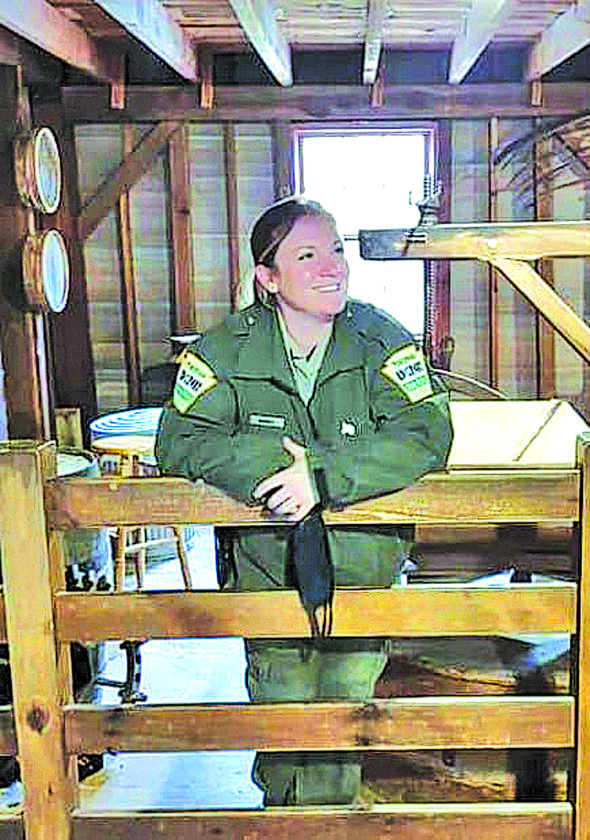
Photo courtesy of DCNR
Mindy Wilt has worked as an environmental education
specialist at Little Buffalo State Park in Newport since 2016.
LEWISTOWN — When the first real cold settles into the Juniata Valley and the last of the oak leaves skitter across the pavement, most of us begin the familiar ritual of preparing for winter.
We haul out heavy coats, stack firewood, and stock the pantry a little deeper than usual. But for the wildlife that shares our forests and fields, winter preparation is far more complex — and often far more remarkable.
That was the focus of a recent Towpath Naturalist Society of Mifflin and Juniata County program led by Mindy Wilt, an environmental education specialist at Little Buffalo State Park in Newport since 2016.
Wilt spoke at St. John’s Lutheran Church in Lewistown, presenting “Animal Physical Adaptations: Winter Survival,” a lively and detailed look at how Pennsylvania wildlife endures the harshest months of the year.
Wilt, who regularly visits schools, civic groups and nature clubs as part of her work, began by asking the audience to think about their own winter routines — and then imagine facing the season without the comforts humans rely on.
“Think about how you prepare for winter,” she said. “Now imagine doing all of that without a house, without heat, and without the ability to just go to the store. That’s the reality for wildlife.”
Challenges of winter
Winter brings a cascade of challenges: plunging temperatures, shrinking daylight, unpredictable precipitation and a drastically altered food supply. In some northern regions, Wilt noted, darkness can last for months. Even in Pennsylvania, the shift is dramatic enough to change the behavior of many species.
“People get worried when they see raccoons out during the day,” she said.
“But in winter, that’s completely normal. They’re just trying to find enough food to survive.”
Deer shift from browsing lush summer vegetation to scraping for leftover acorns and woody browse. In the northern tier, heavy snow can bury food for weeks at a time. In the southern counties, freezing rain and sleet create their own hazards, coating branches and sealing off food sources under layers of ice.
“All of these things present challenges for wildlife,” Wilt said. “And every species has to find a way to cope.”
Three main strategies
Wilt explained that animals generally rely on three major strategies to survive winter: migration, hibernation, or adaptation.
Migration is the most familiar — birds, insects, and even some mammals move to warmer climates where food remains abundant. Hibernation is another strategy, though fewer species truly hibernate than most people realize. And then there are the animals that stay put and adapt, changing their behavior, physiology or even their appearance to survive the cold.
Growing a winter coat
One of Wilt’s favorite examples of adaptation is the American bison. Although bison no longer roam Pennsylvania, they illustrate the dramatic seasonal changes many mammals undergo.
“In summer, their coats are relatively thin,” she said. “But in winter, they grow a very thick, heavy fur coat. People see snow piled on their backs and think, ‘Oh, that poor buffalo.’ But that snow is actually a sign of how well insulated they are.”
Their massive heads and necks also serve a purpose: acting as snowplows to uncover buried grasses. Wilt noted that many large mammals — from elk to moose — use similar strategies, relying on sheer strength and specialized anatomy to access food beneath the snow.
Changing color with the seasons
Closer to home, Pennsylvania’s three species of weasels — longtailed, shorttailed and least weasel — undergo one of the most striking winter transformations. In northern counties, they turn completely white, blending into snowy landscapes. But in southern Pennsylvania, where snow cover is less reliable, many remain brown year round.
“As winters get warmer and we see less snow, the white ones stand out,” Wilt said. “Predators pick them off. Over time, that changes the population.”
It’s a vivid example of how climate patterns can shape wildlife behavior and appearance in real time.
How birds keep their feet from freezing
Wilt also tackled one of the most common winter wildlife questions: How do birds’ feet not freeze? The answer lies in a remarkable vascular system called countercurrent heat exchange.
“Arteries carrying warm blood into the legs run right alongside veins carrying cold blood back toward the body,” she explained. “The heat transfers between them. The bird’s core stays warm, and the feet stay just warm enough to function.”
Birds don’t need dexterity in their toes, she added — just the ability to perch and walk. By allowing their feet to cool dramatically, they conserve precious body heat.
Masters of memory: the chickadee
Few Pennsylvania birds are as well adapted to winter as the blackcapped chickadee. These tiny birds survive brutal cold through a combination of strategies: caching food, roosting in cavities and even lowering their body temperature at night to conserve energy.
“Their memory section of the brain actually increases in winter,” Wilt said. “They have to remember where they stored hundreds of seeds. Their brain literally changes to help them survive.”
Chickadees also huddle together in tree cavities, sharing warmth on the coldest nights — a behavior that often goes unnoticed by casual observers.
Snowshoes and survival
Wilt also highlighted the ruffed grouse, Pennsylvania’s state bird, which grows comblike projections on its toes in winter. “They’re like natural snowshoes,” she said. “They help the grouse walk on snow and icy branches without slipping.”
The projections fall off in spring, returning the bird’s feet to their usual form.
The high stakes of hibernation
Bats, she noted, are among the few true hibernators in Pennsylvania. But their winter survival has been devastated by whitenose syndrome, a fungal disease that irritates bats during hibernation and causes them to wake too early.
“When a bat wakes up in January, the first thing it does is shiver to warm up,” Wilt said. “That burns precious fat reserves. And there are no insects to eat.”
Little brown bats have been hit hardest, though some populations are showing signs of adaptation.
“There’s a little bit of hope,” she said. “Some bats are moving deeper into caves or showing resistance. But it’s going to take time.”
A deeper appreciation
Wilt closed the evening by encouraging people to look more closely at the wildlife around them this winter.
“These animals are doing incredible things just to make it to spring,” she said. “Once you understand what’s happening out there, you’ll never look at a snowy field or a backyard bird the same way again.”
Local News
Calendar
The Sentinel offers nonprofit and other community organizations an opportunity to promote upcoming events for free ...
$383K grant targets intersection for safety, accessibility upgrades
LEWISTOWN — State funding aimed at improving traffic safety and accessibility is headed to Lewistown, with more ...

Plenty on tap for Valentine’s weekend
How wildlife survives the cold
Wagner returns to board of directors
MIFFLINTOWN — When Mark Wagner returned to the Juniata County School District Board of Directors in January, it ...
Outdoors calendar
Atkinson Mills Sportsmen’s Club • Meetings — held on the first Wednesday of each month at 7:30 p.m. The ...