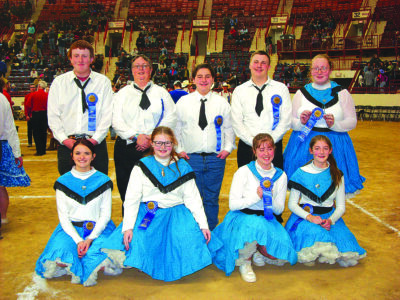
Local dancers take blue at farm show
-
-
Submitted photo
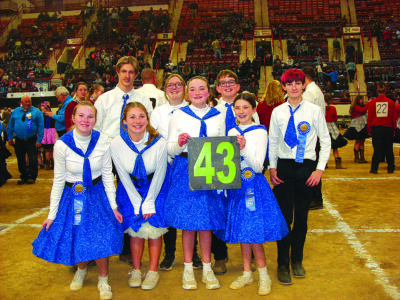
Pictured are Juniata County 4-H square dancers, front row, from left, Alivia Auker, Ella Zimmerman, Julie Campbell, Addison Stouffer; second row, from left, Christopher Brubaker, Madison Blewett, Houston Moore, and Nicholi Keiter.
-
-
Submitted photo
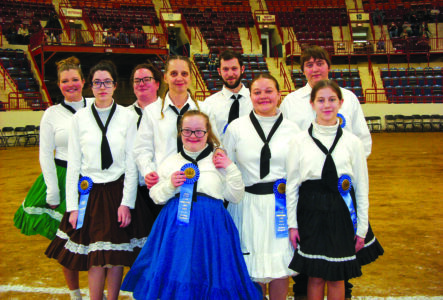
Pictured are Juniata County 4-H square dancers, front row, from left, Delorean Michael; second row, from left, Syvilla O’Donnell, Pam Michael, Chevelle Michael, Lily Michael; third row, from left, Leanna Campbell, Rachel Fry, Jacob Rayson, and Bryant Michael.
-

-
Submitted photo
Pictured are Juniata County 4-H square dancers, front row, from left, Ruth-Ann Bell, Glenda Fultz, Diana Zimmerman, Caisey McNaughton; second row, from left, Brian Bell, Jeff Rayson, Brent Yohn, and Canyon Moore.
Submitted photo
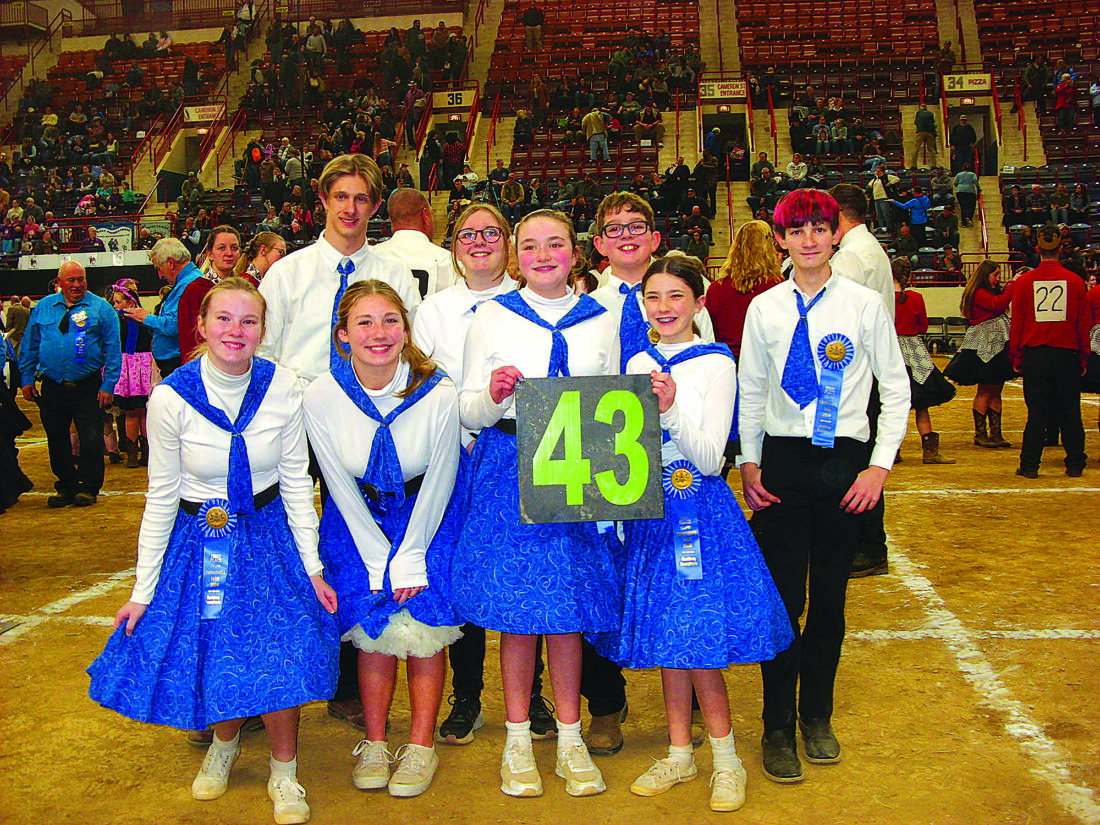
Pictured are Juniata County 4-H square dancers, front row, from left, Alivia Auker, Ella Zimmerman, Julie Campbell, Addison Stouffer; second row, from left, Christopher Brubaker, Madison Blewett, Houston Moore, and Nicholi Keiter.
HARRISBURG — On a cold Monday morning in Harrisburg, as livestock bellowed and frying oil hissed from food stands at the Pennsylvania Farm Show, the steady rhythm of fiddles and calls drifted from the small arena where a different kind of competition took shape.
Eight dancers, arms bent just so, hands joined, feet moving in practiced patterns, stepped in time to a voice calling “allemande left.” Around them, the crowd cheered, not with the roar of sports fans, but with the warmth of people who knew how much work goes into making joy look effortless.
They were from Mifflin and Juniata counties, two rural communities tucked along the Juniata River, where square dancing is more than a pastime. It is a tradition, a bridge between generations, and this year, both counties brought home blue ribbons from the Farm Show’s Department 25 Square Dance competition.
Joyce Krow, who leads the Juniata County 4-H dancers, has been at it long enough to measure time in eight-count steps. “We competed in the Square Dance competition on Monday, Jan. 12,” she said. “There were 41 teams competing in three divisions. My teams were all in Division 3, which is open to any age combination within the sets.” Her group, the Mixed Hillbillies and Senior Hillbillies, earned top honors in that open class, continuing a run that stretches back almost three decades.
For Krow, who started taking groups to the Farm Show 29 years ago, blue ribbons mean more than a score or a title. “A blue ribbon means they performed at a superior level,” she said. “They knew the calls, danced as a team, and danced to the calls at the same time. They did what the caller said, even if he made a mistake. Their blue ribbons give them pride in their ability to learn and prove that our program is worthy of the awards.”
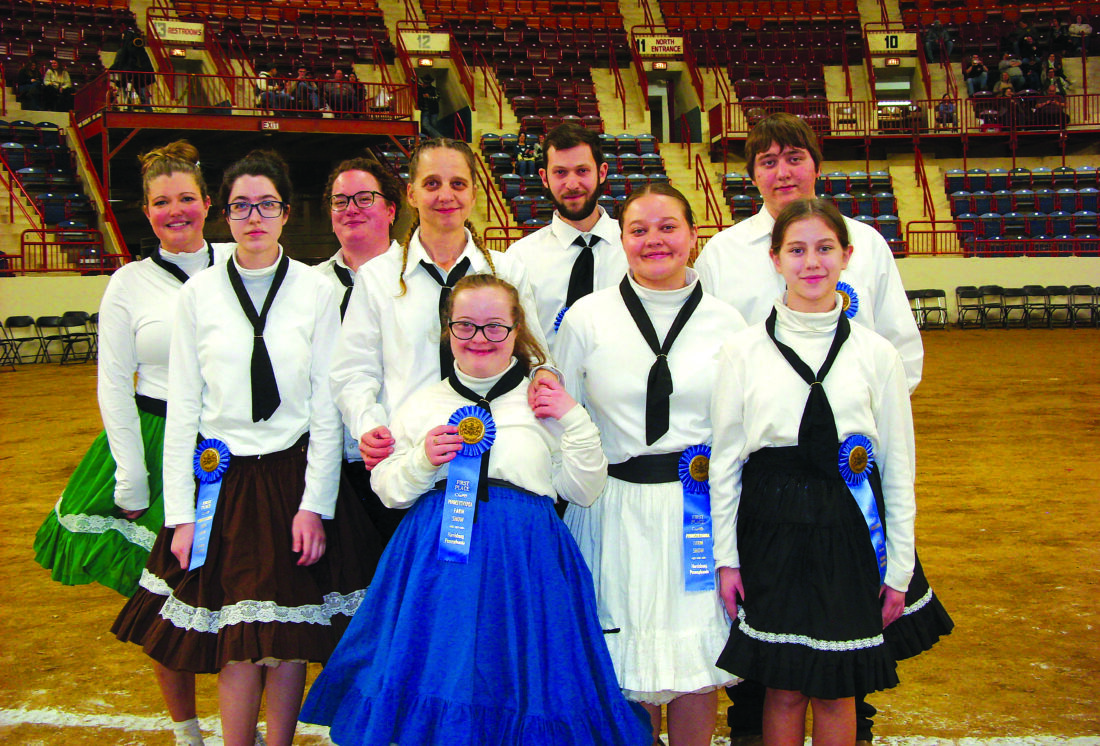
Submitted photo
Pictured are Juniata County 4-H square dancers, front row, from left, Delorean Michael; second row, from left, Syvilla O’Donnell, Pam Michael, Chevelle Michael, Lily Michael; third row, from left, Leanna Campbell, Rachel Fry, Jacob Rayson, and Bryant Michael.
That pride runs deep in Juniata County. Her dancers range in age from 10 to 67, a span that includes children, parents, and former 4-H members who return simply because the music still pulls at them.
“We accept anyone who’s willing to learn and has the time for our practices,” Krow said. “Our group starts to practice on the last Sunday of October and continues every Sunday until the Farm Show. We also do demonstration dances, like the Ice Festival in Lewistown.”
She said square dancing teaches more than movement. “Square dancing prepares the members with leadership, communication, and memory skills. Cooperation within the team is a large part of the learning process. Dancing is not a one-person event, so teamwork is very important.”
Across the county line in Mifflin County, Jamie White’s story follows a similar rhythm. He has been dancing for over forty years, first as a 4-H member and now as a leader for the county teams. When he talks about the Farm Show, his voice carries the same mix of exhaustion and satisfaction that comes from pulling off something meaningful with friends.
“We took two groups down this year from Mifflin County,” he said. “There were 18 dancers in total. Both sets won blue ribbons.”
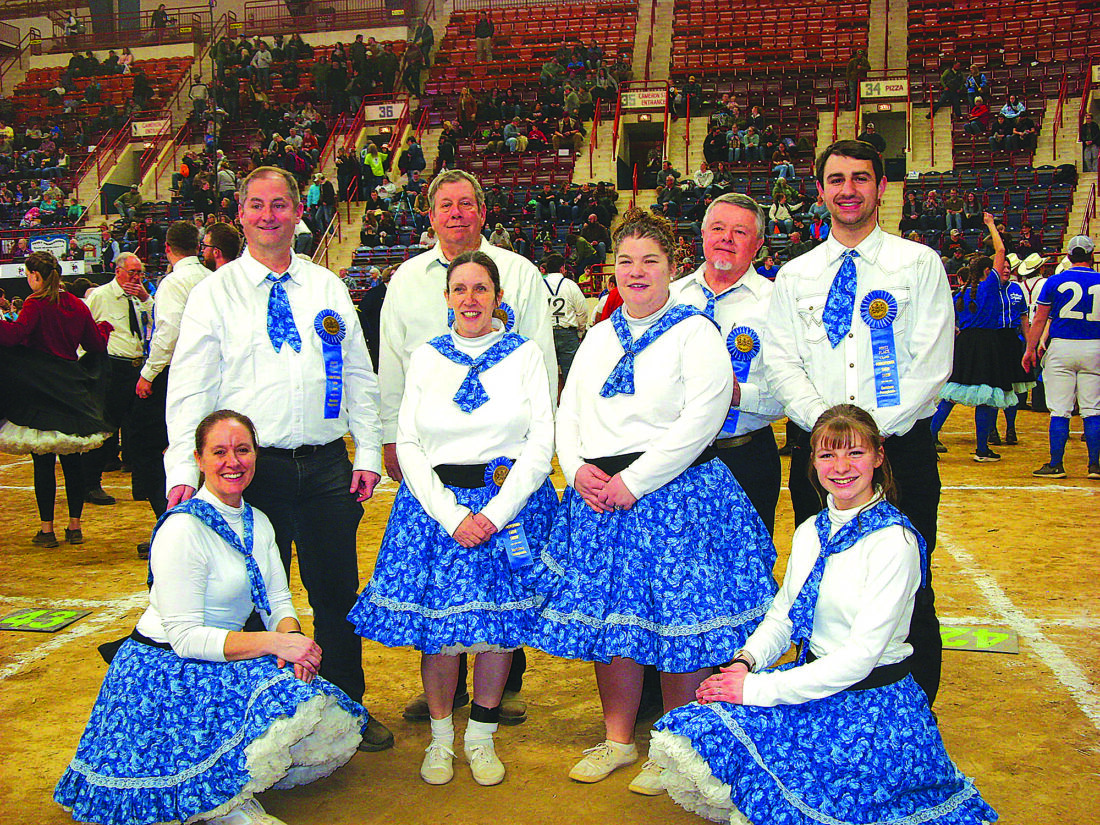
Submitted photo
Pictured are Juniata County 4-H square dancers, front row, from left, Ruth-Ann Bell, Glenda Fultz, Diana Zimmerman, Caisey McNaughton; second row, from left, Brian Bell, Jeff Rayson, Brent Yohn, and Canyon Moore.
Unlike some competitions, there are no gold medals or trophies in the Farm Show’s square dance division. “They don’t give out a single blue ribbon,” White explained. “It’s broken into three ribbon categories: blue, red, and white. It’s based on the judges’ opinion of your performance. Both sets that we took down got blue ribbons.”
That judgment doesn’t come easy. “It takes a lot of practice,” he said. “There’s a lot that goes into teaching the younger kids all the moves. You have to memorize what each move is and then put them in order. Teaching new people, or teaching younger people, takes time. You have to teach them to put the steps in the proper order. It’s a good feeling to win.”
His dancers practiced once a week for seven or eight weeks, sometimes more as the show approached. “Closer to the end, we were doing two, and some weeks, three practices,” he said. “It’s hard to get everyone together all the time. It takes eight people per set, so if you don’t have eight, you can’t compete. This year was the first time one of our sets hadn’t all danced together before the Farm Show. We were really happy to get a blue ribbon because we thought that was going to be a train wreck, but it wasn’t.”
In both counties, the challenges aren’t limited to choreography. “It’s hard to get people involved,” White said. “We really struggle to get enough guys to do it. We can typically get enough girls, but getting guys is a struggle.” Some of his dancers filled in opposite traditional roles to make the sets complete. “We had two females dance in the male position,” he said. “You do what you have to do.”
But what they do is more than nostalgia. It is a choreography of community. Square dancing keeps alive something that once anchored social life in towns across Pennsylvania: movement, music, cooperation.
“It’s just good, clean fun,” White said. “There are a lot of things to do out there that aren’t necessarily as good for you. One of our instructors used to say it teaches you how to treat a lady, to respect your partner. It teaches morals and things like that.”
That sense of purpose, of shared rhythm, threads through both counties’ efforts. Krow said that over the years, the Farm Show has been more than a contest. It’s a showcase of how traditions evolve.
“Some of our dancers take the skills they learned dancing western dancing to eastern dances at local community buildings and Grange halls,” she said. “The community sees these dancers having fun, and hopefully they’ll want to try square dancing in the future. We’ve gained many members who saw a demonstration and then wanted to try it. It’s for all ages, and anyone can learn.”
That last part might be the secret of the Farm Show’s square dance ring. In a world of flashing screens and instant entertainment, there’s something enduring about watching people link arms and move together in circles, all listening for the next call, trusting the steps will line up. The hall smells faintly of hay and funnel cake, the music quickens, and the dancers whirl until the lines blur into one.
Somewhere in that swirl, you can see the heart of two counties beating in time, Mifflin and Juniata, both small, both proud, both keeping the dance alive.
Local News
Board appoints Wagner as its new director
MIFFLINTOWN — A familiar face is returning to the Juniata County School District Board of Directors as former ...
Calendar
The Sentinel offers nonprofit and other community organizations an opportunity to promote upcoming events for free ...
In the region
Fremont Fire Department annual fund drive kicks off Feb. 2 MOUNT PLEASANT MILLS — The Fremont Fire Department ...
Police reports
Woman cited in domestic dispute RICHFIELD — According to a report filed by Pennsylvania State Police at ...
Hospital expands inpatient nursing care with new unit