‘Avatar: Fire and Ash’ finds new depth in grief, conflict
AP photo
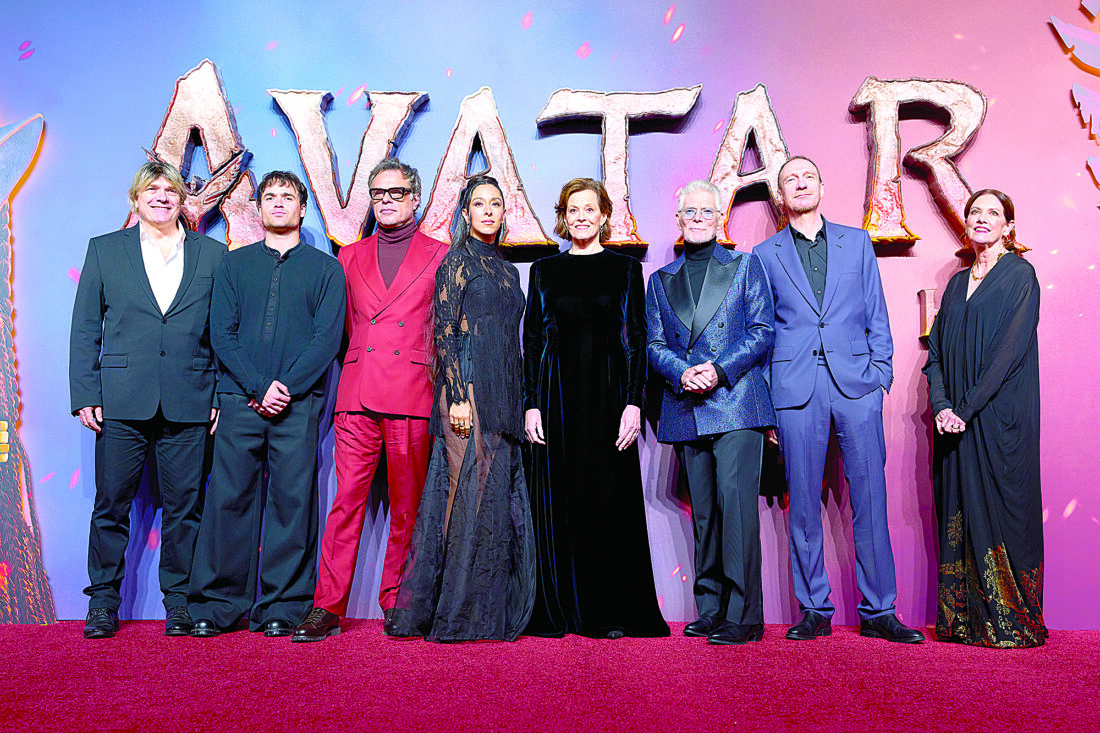
Simon Franglen, from left, Jamie Flatters, Jemaine Clement, Oona Castilla Chaplin, Sigourney Weaver, Stephen Lang, David Thewlis and Deborah Lynn Scott pose for photographers upon arrival at the UK premiere for the film ‘Avatar: Fire and Ash’ on Dec. 11 in London.
With “Avatar: Fire and Ash,” James Cameron returns to Pandora for the third chapter in his sprawling science-fiction saga, delivering a film that is at once visually volcanic and emotionally intimate.
The movie is characteristically massive, but beneath its scale lies a story driven by grief, cultural fracture, and the uneasy evolution of a world audiences thought they already understood.
Set after the events of “The Way of Water,” the film follows Jake Sully (Sam Worthington) and Neytiri (Zoe Saldaña) as they navigate the emotional fallout from the death of their son, Neteyam. Their family’s mourning is interrupted by the emergence of the Ash People, a new Na’vi tribe whose fiery leader, Varang, introduces a more morally ambiguous force than the franchise has previously explored.
Unlike the harmonious forest and reef clans of earlier films, the Ash People are territorial, hardened and shaped by a harsher environment — an ideological and visual contrast that becomes the film’s central tension.
Cameron has always excelled at world-building, but here he pushes Pandora into darker, more volatile terrain. The volcanic landscapes of the Ash People are a striking departure from the lush bioluminescent forests and ocean vistas that defined the first two films.
Working again with cinematographer Russell Carpenter, Cameron crafts a world of molten reds, ash-choked skies and glowing mineral caverns. The result is a visual identity that feels both alien and eerily grounded, a reminder that Pandora is not a monolith but a planet of ecosystems as diverse — and as conflicted — as our own.
The film’s emotional core rests on the Sully family, and the performances reflect that weight. Worthington delivers his strongest work of the series, portraying Jake as a father torn between duty and despair. Saldaña, always the franchise’s emotional anchor, brings raw intensity to Neytiri’s grief and simmering rage.
Sigourney Weaver continues to be a standout as Kiri, whose deepening connection to Pandora hints at the franchise’s long-term mythology. Stephen Lang’s Quaritch remains a compelling antagonist, though the film wisely shifts its focus away from human-versus-Na’vi conflict and toward internal Na’vi divisions.
Narratively, “Fire and Ash” is denser than its predecessors. Cameron and co-writers Rick Jaffa and Amanda Silver weave together family drama, tribal politics, ecological themes and large-scale action. At times, the film threatens to buckle under its own ambition. Subplots involving the younger Sully children occasionally feel underdeveloped, and the middle act lingers longer than necessary in exposition.
Yet the emotional throughline — grief, identity and the question of what makes a people whole — keeps the story grounded even when the plot sprawls.
Where the film truly excels is in its action. Cameron stages set pieces with a clarity and physicality rare in modern blockbusters. A mid-film chase across volcanic plains and a climactic battle that blends fire, water, and aerial combat showcase the director’s unmatched command of spectacle. Even at three hours, the film rarely feels static; its momentum builds steadily toward a finale that is both cathartic and ominous.
If “The Way of Water” expanded Pandora outward, “Fire and Ash” turns inward, examining the fractures within Na’vi society and the emotional cost of survival. It is darker, more introspective and more morally complex than the films that came before it. And yet, it never loses the sense of wonder that made the original Avatar a cultural phenomenon.
“Avatar: Fire and Ash” is a visually breathtaking and emotionally resonant chapter that deepens the franchise’s mythology while setting the stage for an even more ambitious future. It may be Cameron’s most thematically mature entry yet — proof that even after more than a decade on Pandora, there are still new worlds, and new conflicts, worth exploring.
Rating: PG-13
Runtime: 109 minutes
Grade: A
•••
Greg Williams is a reporter and Weekend Editor for The Sentinel. A Mifflin County native, he has been writing for The Sentinel since 1991.
Local News
‘Avatar: Fire and Ash’ finds new depth in grief, conflict
The Sentinel seeking photos, stories for JV magazine
From staff reports LEWISTOWN — The Sentinel is seeking photos and brief articles for the upcoming edition of ...
In the region
Library hours for New Year’s week adjusted LEWISTOWN — All branches of the Mifflin County Library will be ...
Calendar
The Sentinel offers nonprofit and other community organizations an opportunity to promote upcoming events for free ...
Borough votes to raise property taxes
LEWISTOWN — The Lewistown Borough Council Monday approved a 2026 tax ordinance to raise property taxes. The ...