
World War II: He died attempting to save the day
Trending
Editor's Note: This is a continuation of the 'Story Behind the Stars' article published in The Sentinel on Sept. 24, 2026.
WESEL, Germany -- As reported, Earl Geoge of Juniata Terrace was killed in action during the massive Operation Plunder during the Allied push into Germany on March 24, 1945. George was a Technician Fifth Grade assigned to the 131st Anti-Aircraft Artillery Gun Battalion. His unit landed on Omaha Beach on D-Day, fought through France, liberated Paris and suffered the hard fight in the Battle of the Bulge.
Operation Plunder involved over two thousand aircraft of various types- bombers, fighters, paratroopers, gliders and tow planes and equipment transport planes, ground artillery and troops. The 131st was in place on the west bank of the Rhine River close to the German front lines, to protect this armada from German fighter planes.
Further research has unraveled just how Earl George was killed in action.
From the Account of Pvt. 1st Class Frederick Kellerman Collection, National Archives:
A number of transports and bombers were hit by enemy gunfire. A B-24 bomber that crashed into an ammo dump nearby caught fire. Our Colonel and two others pulled the crew safely from the plane. The fire spread to the ammo dump, which exploded with a massive roar and fireball. Regrettably, three men from the 131st lost their lives.
According to a report from Headquarters June 1, 1945, there was 600 tons of TNT in the ammo dump. As fire and ammunition exploded from the B-24, men were frantically moving the TNT from harm's way when a section containing 75 tons exploded. Technician Fifth Grade Earl George perished in the explosion.
Since George was not killed by direct enemy fire, for whatever reason, he was not awarded a Purple Heart. As a result of these circumstances being revealed, application has been made to the U.S. Department of the Army, because he died as a result of enemy action.
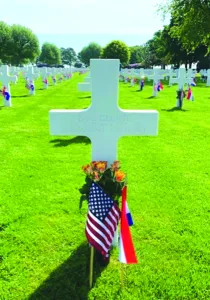
Earl George is buried at the American Cemetery in Margraten, Netherlands. Buried nearby is PFC Frederick Nye who was also killed in the same explosion. The 131st was part of the U.S. 9th Army which liberated the first city in Holland, Maastricht, from the Nazis on Sept. 14, 1944. It is located six miles from the American Cemetery at Margraten.
To this day, the citizens of Holland are eternally grateful for their freedom as a result of the 9th Army. All 8,300+ graves of American heroes are, to this day, cared for by Dutch citizens.
Technician Fifth Grade Earl George's grave is cared for by Frans Perey, who lives not far from Margraten.