
LIVING HISTORY: BMS eighth-graders bring museum to life
Trending
BELLEVILLE -- When it came to re-creating history, Ethan Renno wanted to be a Civil War general, Leah Reed chose an American journalist known for her worldly travels and Sadie Morgan selected a ground-breaking chemist from DuPont.
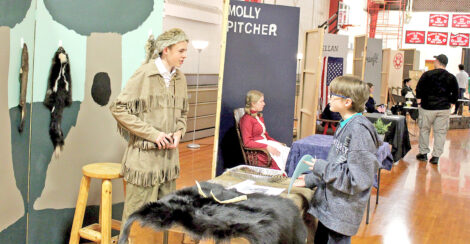
The historical figures were part of a state history project where eighth-grade students at Belleville Mennonite School created a Living Museum.
Instead of wax statue or replica figurine, this museum is full of 15 students dressed up as the character they chose to research in front of a ??-foot backdrop they created.
"The level of student creativity never ceases to amaze me," Belleville Mennonite School middle school teacher Jessica Geissinger. "They each seem to create a 'vision' and they make it happen. I have seen scenes where they create offices, stages, living rooms or even inside of ships. It is wonderful to see."
Students were asked to find a historical person of interest who was born in Pennsylvania, who made a lasting impact in their field. The only guidelines were that the person could not have been researched by another student within the last three years and they must have been dead for some time.
"Students seem to find a topic they enjoy and take the reins and run," Geissinger said of the annual project. "We have had military leaders, presidents, inventors, actors and actresses, writers, artists, all kind of topics," Geissinger explained. "I am always amazed about new people they choose."
Reed selected Elizabeth Cochran Seaman, who is better known by her pen name, Nellie Bly. "Her life story sounded interesting," Reed explained.
Seaman was widely known for her record-breaking trip around the world in 72 days in emulation of Jules Verne's fictional character Phileas Fogg, and an expose in which she worked undercover to report on a mental institution. She was a pioneer in her field and launched a new kind of investigative journalism.
"I enjoyed writing about her and painting my set," Reed said.
Reed painted a globe on her backdrop to represent Seaman's around-the-world journey. She sat at a desk as Seaman would have used during her journalism career and even styled her hair and dressed as her mentor would have.
Morgan chose Stephanie Kwolek, a chemist from DuPont who is known for inventing Kevlar. Her discovery of the first of a family of synthetic fibers of exceptional strength and stiffness earned her the nickname, the polymer queen.
"I chose Stephanie Kwolek because she was interesting and impacted the world," Morgan said.
Morgan painted the iconic DuPont logo on the backdrop and sat at a table filled with chemist tools such as flasks, test tubes and even a framed periodic table.
Students had to flair for design by creating their own sets, Geissinger said.
"Each student was given a wood "flat," which acted as their backdrop," she explained. "We actually worked at painting these during the school day. Students are responsible for coming up with a costume and set items, which we set up in the gym for their final presentations."
The eighth-graders studied Pennsylvania History for the first half of the school year then switched to Civics during the second semester.
Students began working on their projects just after Christmas. They were unveiled during the school's open house in March. They performed two presentations: one for the school and another for their families and friends.
"Students worked in class to research and wrote notecards during PA History/Civics class for about two weeks," Geissinger added.
Middle school teacher Kaytlin Young helped the students with creating an outline for their research paper. She also taught them about the basics for writing a research paper, including how to cite sources correctly.
"They were given time weekly to work in class in Civics, as well," Geissinger said. "Students then turned in a rough draft which Mrs. Young and I both read and edited. After the papers were returned, students had about two weeks for final edits."
Once the papers were written, Young also worked with students on memorizing their speeches.
"In my class, students began to paint and prepare their "flats," Geissinger said. "Students also created set sketches for ideas." Art Teacher Tami Peachey offered students some tips and suggestions for their sets.
"Students presented their speech to classmates and were graded before the final production," Geissinger said. "The last step was setting up the gym and presenting their speeches, dressed as the person in the set with a second final paper on display.
"They spent the evening speaking from a first-person perspective as people visited them in the Living Museum," she added. "This was a huge undertaking, and our students consistently do an incredible job with this project. I am so incredibly proud of my students."
Renno, who portrayed Gen. George B. McClellan said his favorite part of the class project was "painting and presenting."
McClellan was a United States Army engineer, railroad president and politician who served as a major general during the Civil War. McClellan was well liked by his men, but his reticence to attack the Confederacy with the full force of his army put him at odds with President Abraham Lincoln. Lincoln eventually removed him from command. McClellan went on to mount a failed presidential bid against Lincoln in 1864 and later served as the governor of New Jersey.
Renno selected McClelland because "I thought he was interesting." His space was decorated with American flags, and he sported a striking gold button jacket and hat.
Wyatt Strouse was inspired by American military officer John Frederick Hartranft, who read death warrants to the individuals who were executed on July 7, 1865, for conspiring to assassinate Lincoln.
"He had multiple achievements in his lifetime," Strouse said.
Hartranft achieved the rank of major general of the Union Army during the Civil War. He had also been awarded the U.S. Medal of Honor for his actions in the First Battle of Bull Run. Post-war, he served as the 17th governor of Pennsylvania from 1873 to 1879.
"I enjoyed the painting," Strouse said, who painted his research person's name across his backdrop in cursive letters. He also dressed the part with a military jacket from the period, complete with white gloves and shoulder board.