
Breathing through skin, surviving for millions of years: Wilt explores Pennsylvania’s hidden wildlife
Trending
LEWISTOWN -- Imagine spending your childhood breathing underwater through gills, only to emerge onto land and take your first breath of air. Or living your entire life without lungs, absorbing oxygen directly through your skin instead.
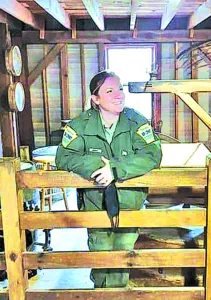
Those are not scenes from a science-fiction movie. They are realities for some of Pennsylvania’s amphibians, a group of animals that captivated members of the Towpath Naturalist Society of Mifflin and Juniata County during a presentation by Little Buffalo State Park Environmental Education Specialist Mindy Wilt on Nov. 10.
Wilt’s program, “Reptiles and Amphibians in Our Midst,” took attendees beneath the surface of ponds, streams and forest floors to uncover the complex lives of creatures that often go unnoticed despite living in their own backyards.
“A lot of people don’t realize that these two groups of animals are very different,” Wilt said as she explained the distinctions between reptiles and amphibians.
While both are vertebrates with backbones and internal skeletons, amphibians and reptiles have evolved along very different paths. Reptiles are characterized by scales, lungs and eggs laid on land. Amphibians, meanwhile, depend on water or moist environments for reproduction and undergo dramatic life changes as they mature.
Few transformations in nature are as remarkable as the journey from tadpole to frog.
Wilt described how a tadpole begins life underwater with gills, feeding primarily on vegetation. Over time, legs emerge, lungs develop and the animal’s tail is reabsorbed before it hops onto land as an insect-eating frog.
“Can you imagine being a baby and breathing underwater with gills for your whole childhood and then all of a sudden coming out on land, taking a breath and never going back again?” she asked those in attendance.
The audience learned that the timing of this transformation varies widely. Tiny toads may complete it in just a few weeks, while bullfrogs can remain tadpoles for more than a year before becoming adults.
Salamanders proved equally fascinating.
Pennsylvania sits within one of the most salamander-rich regions on Earth, with the Appalachian Mountains supporting some of the greatest salamander diversity anywhere in the world. Wilt said roughly two dozen species call Pennsylvania home.
Among them are mudpuppies, unusual aquatic salamanders that retain their feathery external gills for life, and eastern hellbenders, the state’s official amphibian. These ancient animals inhabit only the cleanest, coldest streams.
The hellbender’s lineage stretches back approximately 160 million years, making it one of the most prehistoric-looking animals still living in Pennsylvania today.
Some salamanders have evolved an even more surprising adaptation: they do not have lungs at all.
Instead, species such as the northern red salamander and slimy salamander breathe directly through their skin. Their bodies must remain moist to absorb oxygen, causing them to spend daylight hours hidden beneath rocks, logs and leaf litter.
That same permeable skin, however, makes amphibians extraordinarily sensitive to their surroundings.
Pollutants in water, soil and even air can be absorbed directly into their bodies.
“They are the true canary in the coal mine,” Wilt said.
Because of that sensitivity, scientists often use amphibian populations as indicators of environmental health. A decline in salamanders or frogs can signal ecological problems long before they become visible elsewhere.
Throughout the program, Wilt shared photographs of species commonly found around Little Buffalo State Park, including spotted salamanders, red-spotted newts, pickerel frogs, green frogs and American toads.
She also discussed the challenges many species face. Some salamanders depend on temporary spring pools known as vernal pools to reproduce. Others lay eggs in damp forest habitats that must remain moist for weeks. A dry spring can dramatically reduce survival rates.
Questions from audience members sparked conversations about breeding behaviors, egg development and the subtle differences between Pennsylvania’s American and Fowler’s toads.
Beyond the biology lessons, Wilt’s presentation offered a reminder that some of the state’s most extraordinary wildlife is often hiding in plain sight.
Whether tucked beneath a fallen log, basking on a streamside rock or calling from a wetland on a spring evening, reptiles and amphibians continue to fill important roles in Pennsylvania’s ecosystems while providing scientists with valuable clues about the health of the natural world.
For Towpath Naturalists members, the evening revealed that the creatures many people overlook might be among the most remarkable animals of all.
At the conclusion of the presentation, Wilt opened a surprise package she had with her. After reaching in to open a container, her hand emerged with a small northern water snake wound around her wrist. She explained that it is one of most common snakes in the United States, found in at least 36 states.
As Wilt walked around the room so that people could get a closer look, the audience had various reactions. While everyone found it interesting, some wanted a closer look, others wanted to touch it, and some headed in the opposite direction.
Next meeting
This was the Towpath's last meeting this fall. They will return in March 2027.