
Into the thickets: Lutz explains the hidden lives of grouse and woodcock
Trending
LEWISTOWN -- Clayton "Clay" Lutz has spent more than 25 years in wildlife conservation, including 19 with the Pennsylvania Game Commission, and he has learned that working with wildlife keeps you on your toes.
When he stepped to the front of the Towpath Naturalist Society of Mifflin and Juniata County on Sept. 8 to speak about grouse and woodcock conservation, he was introduced to the audience by the Towpath Naturalists' president, who had mentioned spotting a family of Cooper's Hawks in Lutz's neighborhood.
"As part of my job, I band mourning doves in my backyard," he told the audience, describing how he baits the birds and uses a small cage to trap them. "One of the tricks is not allowing the hawks to find your banding station," he said. The mesh cage keeps doves inside but offers little protection from a determined raptor. On the very last day of trapping, hawks discovered his setup, which sent him streaking through his yard to chase away the aforementioned family of hawks. The room laughed, and the ice was broken.
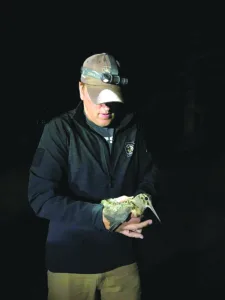
Lutz was invited to present "Grousing About Woodcock: Habitat and Conservation of Both," a program hosted by the Towpath Naturalists. What followed was a deep dive into the ecology of two birds that depend on the thickest, youngest, most tangled forests Pennsylvania can grow.
He began with the ruffed grouse, Pennsylvania's state bird and a species many residents have seen or flushed while walking through the woods. But familiarity doesn't mean security. Grouse populations have declined sharply across the state, and Lutz laid out the reasons with clarity.
One of the biggest challenges is habitat loss. Grouse thrive in young, dense forests, places where saplings crowd together, shrubs tangle overhead and visibility drops to a few feet. "They want it thick and tangly and nasty," Lutz said. "Something you can't really see in the woods." But across Pennsylvania, forests are aging. "They're just getting older, growing up, becoming more mature," he said, pointing to maps showing widespread declines in early successional habitat.
Grouse are also homebodies. "They have very small home ranges," he explained. "Two miles when they disperse, usually it's under two miles and it's in a random direction." That limited movement means they cannot easily relocate when habitat disappears. If the forest around them matures, they simply lose the cover they need.
The American woodcock faces similar pressures. Known for its skyward courtship flights and preference for moist, shrubby habitat, the woodcock relies on landscapes that are increasingly fragmented. Lutz described the species as one of Pennsylvania's "species of greatest conservation need," a designation shared by many birds and mammals that depend on early successional habitat.
But habitat loss is only part of the story. Lutz spent a significant portion of his talk discussing West Nile virus, which has had a severe impact on grouse populations. "We did a study and inoculated grouse with West Nile virus, 70% died," he said, citing research that revealed high mortality rates. The disease is transmitted by mosquitoes, and Lutz's team has spent years studying where those mosquitoes live and how they spread.
One of the most important findings is that mosquitoes are not evenly distributed across the landscape. "There are certain places that they live," he said. Elevation matters. "Sixteen hundred feet is a pretty good threshold," he explained, noting that mosquito presence drops sharply above 2,000 feet. Mosquitoes also prefer specific wet areas, especially rutted patches where water collects and vegetation dies back. "That's the sweet spot," he said.
Understanding these patterns has helped the Game Commission develop tools to identify areas where grouse habitat can be created with lower disease risk. Lutz emphasized that habitat management must be active and intentional. "We've got to be actively managing our landscape," he said. "We can't be hands-off."
That means timber harvests, non-commercial tree felling, invasive species control and prescribed fire, all practices that create the dense, diverse vegetation grouse and woodcock need. "We need diversity in our land use," he said. "It can't just be a birch monoculture or even an oak monoculture."
Throughout the evening, Lutz's message was clear: conserving grouse and woodcock requires embracing the dynamic nature of forests. Young forests must be created, maintained and protected from disease and invasive plants. It is work that requires long-term commitment and a willingness to reshape familiar landscapes.
For the naturalists gathered in Lewistown, the program offered a vivid look into the hidden lives of two birds that depend on the thickest, wildest corners of Pennsylvania's woods. And for Lutz, it was a chance to share the urgency, and the hope, behind the Game Commission's efforts.