
Strodes Mills man stresses hunter safety
Trending
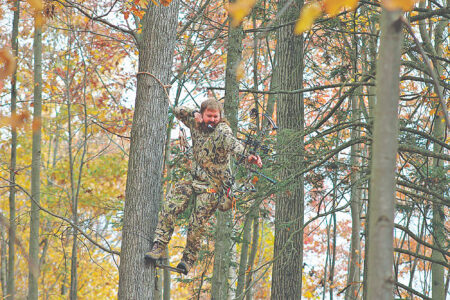
STRODES MILLS -- Brandon Michaels gets anxious every year for the start of hunting season. The Strodes Mills man can't wait to grab his gear, rush out of the house and hit the ground running.
As an emergency department nurse at Geisinger-Lewistown Hospital, Michaels also understands the value of sportsmen taking their time to be safe in the outdoors.
"It's more important to come home to your family than to (pass away) in the woods (from an accident)," Michaels said.
Michaels has seen firsthand what happens to hunters who haven't properly prepared for the season, including broken bones or even paralysis caused by falls from tree stands, heart attacks due to overexertion from long walks in the woods or hearing loss from not using ear protection when firing a rifle.
"We might talk to somebody who's been in an accident related to hunting, but prevention is not something that we think about," GLH Trauma Manager Alex Haines said.
Much like Michaels, Haines has seen the carnage that can happen during hunting season over the past 2 ½ years he has worked in the trauma program and 10 years in the Emergency Department. Sometimes hunters come into the ER after making a poor decision.
Perhaps, they climbed a tree that couldn't hold their weight or fell from a tree stand that wasn't secure. Haines said hunter safety should be more of a priority in the woods this time of year.
"It's important to develop a thought process leading up to hunting season," Haines said. "Before climbing a tree, take a minute and ask yourself, 'Should I be up here, or should I be up another one?'"
Here are other highlights that hunters need to remember:
S-T-E-P-S to reduce
tree stand accidents
Haines said the risk of experiencing a tree stand-related accident can be reduced by following proper S-T-E-P-S:
S -- Stands for safety harness or belt. Haines said safety harnesses and belts should always be worn when a hunter's feet leave the ground.
T -- Stands for tree stand maintenance. Check the condition of your tree stand before heading out to the woods for the first time. Look for any broken or missing parts as well as its overall condition, especially if it's an older model.
E -- Stands for evaluating the site and stand. Make certain the tree where you want to put your stand is alive and can support your weight when you climb it.
P -- Stands for plan and partner. You should always have a plan for where and when you are going to be hunting, and relay that information to a friend or family member. Remember there will not likely be any cell service where you are going hunting. Also, you should never hunt alone, so take a friend or family member with you.
S -- Stands for signal. Bring a whistle with you to use if you do experience any trouble. Blowing a whistle also uses less energy than yelling.
Know the signs
of trouble
The Juniata Valley consists of many wooded areas. Hunting, with walking, climbing and carrying heavy equipment, can be a strenuous activity. It's important to remain fit throughout the year and not overextend yourself during hunting season.
"It's like an athlete coming off the bench, who hasn't seen any playing time for a long time," Haines said.
Sometimes, the signs don't rear their ugly heads until hunters are out in the field.
"If you are climbing to the top of a mountain and feeling chest pains, you should not keep going," Haines said. "You should probably stop and go back."
Take a safety course
Since 1958, the Pennsylvania Game Commission has offered in-person or online education courses about hunter safety. According to statistics on their website, there's been an 80 percent decrease in accidental shootings since they've started offering those classes.
Taking a class, which is typically free, is important, Haines said. "It teaches you about hunter safety and how to survive in the outdoors. When you plan your hunt, you need to let someone know where you go, which allows them to help (if you get lost or have an emergency). It gives them a point to start looking at."
Wear proper attire
It's important to wear the proper amount of fluorescent orange. "You want to be seen and see the other person as well," Haines said.
During rifle season, it's also important to wear ear protection. "You are shooting a loud gun, and you need to have proper ear protection on," Haines said.
Additionally, hunters want to positively identify their target. "You should never shoot toward a sound or movement," He added. "Avid hunters should be very big on safety. We see the aftermath of when you fail to prepare properly."