
A century of music restored: Historic Steinway returns home to First United Methodist
Trending
LEWISTOWN -- Lauri Dulis once left a piece of sheet music on the Steinway piano at First United Methodist Church.
Jim Dulis found it.
He didn't immediately give it back.
"He found it and held it for ransom until I went out with him," Lauri recalled.
That was 1991. Before long, there would be a wedding, a life together, and years of music inside the church on Third Street. Jim directed choirs, taught music, sang in a baritone voice, and played the Steinway. Lauri accompanied him and, over time, became one of the musicians most closely connected to First Church.
Thirty-five years later, Jim is gone.
The Steinway is still there.
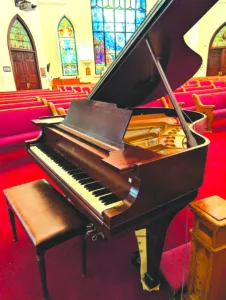
After 10 months away, the century-old piano that accompanied rehearsals, worship services, weddings, soloists, and countless ordinary Sundays has returned home following a $40,780 restoration.
The church will celebrate that return at 3 p.m. Oct. 18 with a Grand Celebration of Music featuring musicians with ties to Mifflin County and First United Methodist. The restored Steinway will share the sanctuary with another historic instrument, the church's 1933 Austin pipe organ.
For the congregation, the point isn't to preserve antiques for display. It's to keep using them.
"We're the generation whose responsibility has been to restore all those things and preserve all those things," said Dr. Charles Everhart, a church trustee who helped oversee the Steinway project. "I think this is just part of that tradition."
That tradition began long before anyone now sitting in the pews was born.
The church believes the Steinway was purchased around late 1911 and arrived in early 1912. The exact chronology remains uncertain, but its place in the sanctuary does not. It came first among a remarkable group of musical and architectural gifts assembled by earlier generations. Tower chimes followed in 1923. The Austin organ was dedicated in 1933. The sanctuary also contains its historic Tiffany stained-glass window.
For decades, the Steinway did what working pianos do. It accompanied congregational singing and choirs. It supported soloists and ensembles. Musicians practiced on it. Children grew up hearing it. People arrived, left, married, died and were remembered while the piano remained.
Eventually, all those years of playing showed.
Everhart said concern about the instrument's condition began around 2020, perhaps earlier. The hammers had been ground down so many times that church officials were told they needed replacement. A later inspection confirmed the problem and uncovered something the congregation hadn't known about: a sizable crack in the soundboard.
By 2024, the musicians didn't need an inspection report to tell them something was wrong.
"It's starting to sound not so good to us anymore," Everhart recalled them telling the trustees.
The church had a decision to make.
It could spend considerable money repairing an old piano. It could replace it with something less expensive. Or it could treat the Steinway as something entrusted to this generation by the ones before it.
The trustees chose restoration.
The work was arranged through Robert M. Sides Music Store in Williamsport, with the piano eventually sent to Steinway in New York. Much of the piano's internal mechanism was replaced or restored, including the hammers and related action parts. The cracked soundboard was replaced. The church deliberately chose not to refinish the exterior.
The worn finish had earned its place.
"We kind of felt that that was part of its charm and its history," Everhart said. "So we're not going to mess with that."
The price of preserving that history was $40,780.
The number gave the trustees pause. But Everhart said a comparable new Steinway would cost about $136,000. Suddenly, forty-one thousand dollars had company.
The congregation spent two years raising the money. Everhart estimated about $7,000 to $8,000 came from endowment funds. More than $5,000 came from sales by the church's Good Eggs. The Homespun turkey dinner contributed $4,500 over two years. Regular offerings from church members covered roughly 60% of the cost.
The congregation had done this before.
An original program from the dedication of the Austin organ on Sept. 24 and 25, 1933, tells of a congregation raising money during the Depression to bring another major instrument into the sanctuary. The choir established a New Organ Fund. A bequest helped. Charles M. Rice, chairman of the music committee, offered to pay half the cost in memory of his wife, Carolyn Hughes Rice, a former First Church organist.
The program described the Austin as a $20,000 instrument acquired for $10,500.
In 1933, people passed dollars and coins forward.
In 2026, people bought peanut butter eggs and turkey dinners.
The purpose wasn't much different.
The Steinway was supposed to be away for four to six months. It left in November 2025. Spring came without it. A celebration tentatively planned for April or May had to be moved.
By midsummer, Everhart and the trustees were getting nervous. They established deadlines. If the piano wasn't back at Sides by mid-August, they would consider canceling the October concert. Then came an Aug. 10 call: the Steinway was back at Sides and could be returned to Lewistown by late September.
The piano problem appeared solved.
Then the organ broke.
Days before the piano returned, a leather component in the 1933 Austin failed while Lauri Dulis was practicing. The church was already changing organ service companies. The repair was completed in about 10 days.
Everhart waited longer than instructed before anyone tested it.
Then, as the restored Steinway was being tried downstairs, the organ was switched on.
"I can't tell you the feeling I had, having just heard that beautiful piano and that the organ actually played like it should," Everhart said. "I was beside myself."
"The two of them combined are just something to behold."
Dulis knows that combination better than most.
She first played First Church's organ for a wedding in 1991 while still serving as organist at a Presbyterian church in Belleville. Jim Dulis, then First Church's music director, soon began what she jokingly called "a Methodist plot" to recruit her.
They married on Dec. 21, 1991.
By 1993, she was accompanying Jim's choir. Over the years, she shared organ duties with several others before becoming the church's sole organist in 2020.
She remembers Jim at the Steinway, working the choir through exercises and individual parts. She remembers him accompanying soloists. She remembers him writing music. She remembers him continuing to play piano solos at church even as Alzheimer's disease progressed.
"He always gave his best to God in worship and inspired his choirs to do the same," she said.
The piano carries those memories without displaying any of them.
Its keys are still ivory. Its exterior still bears the marks of more than a century of use. But inside, the instrument has been renewed.
Dulis immediately heard the difference.
"It is very responsive to every touch," she said. "It has a lovely, mellow sound."
She said even before the restoration, its sound surpassed the loaner piano the church used during the 10 months the Steinway was gone.
"We missed our piano desperately," she said.
Katie Becker, First United Methodist's music director, sees the Oct. 18 concert as both a celebration and a homecoming. Chris Ruble, Patty Loudenslager, Dulis, Becker, Fred Benner, Beth Myers, Joan Loewen, John Haubrick, Nancy Aurand, Ellen Miller, Josie Baughman and Joyce Ann Hutchinson are among the musicians scheduled to perform.
They include educators, church musicians, and community performers whose paths have crossed repeatedly through music in Mifflin County.
Becker said the goal is to celebrate more than one restored instrument.
"We are hoping, first and foremost, to glorify God, and to uplift and unify the community," she said.
Everhart believes the answer lies in the church's history.
The founders established the congregation over 200 years ago. Later generations built the sanctuary and provided the window, piano, organ, and chimes.
The current generation received a different assignment.
Preserve them.
"We feel it's our role, our duty to do that kind of thing for not only our church but the community," Everhart said.
On Oct. 18, the Steinway won't sit behind a rope or beneath a museum placard.
Someone will sit down at it.
And play.