
Promises broken for beloved Waterloo Chapel
 JUNIATA COUNTY HISTORICAL SOCIETY
 Trending
 JUNIATA COUNTY HISTORICAL SOCIETY
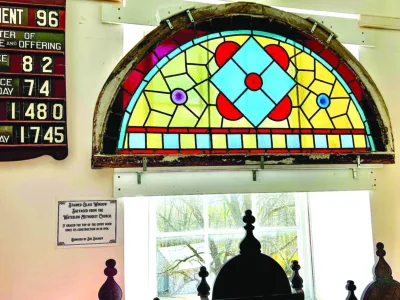
The stained-glass window belonging to the Waterloo Chapel now hangs in the Tuscarora Academy Museum in Mifflin.
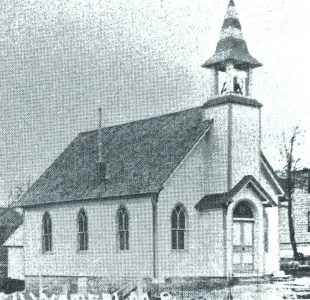
WATERLOO -- There are places where faith settles into the wood grain, where morning light through stained glass feels like a quiet hymn and where a small country chapel becomes more than a building.
For nearly a century, the Waterloo United Methodist Chapel was one of those places. Its bell called families from the fields, its windows cast warm colors across bowed heads, and its sanctuary held the whispered prayers of generations.
Even after the doors closed in 1973, the chapel remained a spiritual landmark for the western end of Juniata County, a reminder of the Sundays that shaped a community.
"It was a sacred space in every sense," said Jessica Eaton Guyer, president of the Juniata County Historical Society and curator of the Tuscarora Academy Museum. "People didn't just worship there. They grew up there. They carried its lessons with them."
Guyer first learned about the chapel's uncertain future in November 2009, when she read a detailed account of its demolition and the promises surrounding its reconstruction.
At that time, hope still felt possible. The chapel had been purchased by developer Robert Barr, who planned to dismantle it carefully and rebuild it as part of a large agricultural showcase centered around the famous Star Barn.
The project was ambitious, and the chapel was described as in "impeccable shape," with a unique bell tower and vaulted ceiling that made it a perfect addition to the planned complex.
"People were so grateful it wasn't being destroyed," Guyer said. "We were told it was going to be rebuilt with purpose, that its story would continue."
Demolition began in 2009, and the process was documented on DVD. The chapel's pieces were reportedly placed in storage, awaiting reconstruction. The projected opening was set for 2011. That was the promise.
But even as Guyer read in the 2009 account, trouble was already brewing behind the scenes. Headlines involving Barr's non-profit revealed shifting site plans, rising costs, and repeated delays. At the same time, accusations of neglect and investment mishandling surfaced at a premier thoroughbred horse farm he was involved with. The chapel, once destined for a new life, became collateral damage in a project quietly falling apart.
By 2014, Barr's venture collapsed. David and Tierney Abel acquired the Star Barn from Agrarian Country and began their own restoration. Their work was successful. The Star Barn Raising Festival in 2017 drew more than 4,000 participants, and the Abels built a beautiful estate with striking outbuildings that honored the barn's history.
But one thing never appeared on the grounds: the Waterloo Chapel.
Earlier this year, after receiving an inquiry from a former Waterloo resident, the Juniata County Historical Society sought closure. Guyer reached out to David Abel, who offered a frank explanation. When the Abels purchased the Star Barn, they were told about the remnants of the Waterloo Chapel. But when they located the stored materials, they found the wood had been left outside in the elements for five years.
"When they found the chapel's wood, it had been left outside with no protection," Guyer said. "The beams were rotted beyond saving. There was simply no way to rebuild it."
The Abels plan to construct a small chapel on their property, but it will not be the one from Waterloo. Then came the discovery that made the loss feel even sharper. In January 2023, the historical society received an eBay alert for a stained-glass window from the chapel.
A donor purchased it for the Tuscarora Academy Museum's church exhibit. During pickup, the seller mentioned that Barr had sold other windows as well. No one knew how many remained.
"If the chapel was supposed to be reconstructed, why were its windows being sold off one by one?" Guyer said. "Residents had no idea the project had fallen apart."
The realization was painful. The chapel's pieces had not been preserved. They had been scattered. No one knows where the rest of the windows went, or the bell, or any other salvageable features that might have been sold over the years.
What remains of the chapel's physical story has been lost to time and circumstance. But one piece -- the large arched window that once hung over the entry doors -- has been saved. Parishioners walked beneath it every Sunday, stepping from the outside world into a place of prayer.
Today, it hangs proudly at the Tuscarora Academy Museum, a final reminder of the faith community that shaped it. For Guyer, the story she first read in 2009 has come full circle. What began as a hopeful account of preservation has become a lesson in vigilance and trust.
"Trust matters," she said. "When it comes to saving the historic places that define our communities, we have to be careful who we rely on."
The Waterloo Chapel might never rise again, but its memory endures -- in the stories of those who worshiped there, in the window that still glows with color, and in the quiet faith of a county that refuses to forget.