
Penn State invests in Beaver stadium upgrades
Trending
Earlier this year, the Penn State Board of Trustees agreed to invest in a renovation of Beaver Stadium.
According to the board, Beaver Stadium was in need of repairs and maintenance upgrades to give Penn State the capability to host future College Football Playoff games.
This will grow revenue-generating opportunities, transform the fan and community experience, and fuel the future funding for all 31 athletics programs at Penn State.
The approved renovations will enable year-round use of Beaver Stadium with the help of the winterization installation they had done in June of 2023.
Winterization installation consists of installing insulation on pipes and other upgrades to allow the building to be occupied when temperatures are below freezing. Winterization will give Penn State the capability to host other potential events beyond Penn State football games in the winter months.
"On behalf of the Board of Trustees, I am delighted to share there is overwhelming support for the University's recommendation to renovate Beaver Stadium," said Board of Trustees Chair Matt Schuyler.
"I'm pleased that the renovation will benefit our student-athletes, elevate Beaver Stadium's significance in driving local and state economies, and ensure Beaver Stadium remains a premier facility in all of college athletics."
The renovations will bring in significant additional revenue to Intercollegiate Athletics, the university and the local community as the stadium is modernized and capable of being used in the winter months and for additional activities other than football as stated in their press release.
None of these costs will be paid by the university because Penn State Athletics is one of a handful of self-sustaining intercollegiate athletics departments nationwide, which means the department's revenues are equal to or exceed its operating costs.
The Intercollegiate Athletics budget is completely separate from the university's budget and this project will be paid for entirely by Intercollegiate Athletics, using no tuition dollars or funding from the educational budget.
Construction on the west side renovation is expected to begin in January 2025 and the project is hoped to be completed in advance of the 2027 season in August of that year.
Penn State takes great pride in having one of the largest stadium capacities in the world, which is one of the reasons they are pursuing a renovation rather than a rebuild.
Schuyler said a rebuild would have been more expensive and resulted in a facility with a much smaller seating capacity. Plus a renovation is more economical than a new build.
The stadium's footprint will not change, nor will the atmosphere or experience fans expect at a Penn State football game.
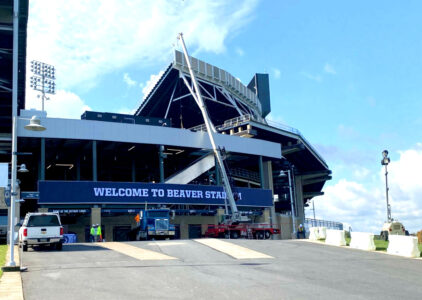
Since January 2024, when the initial expenditure of $70 million for the Beaver Stadium renovation was approved, steps have been underway at the stadium and will continue leading up to the 2024 college football season.
Initial construction has taken place prioritizing safety and accessibility by widening select concourses and installing new escalators, as well as field lighting performance and video board replacements.
"Many recognize Beaver Stadium as the best stadium in college football, and we want to preserve the atmosphere that our fans, alumni and community have come to expect while building on this history of excellence for generations to come," said Neeli Bendapudi, Penn State president.
"The renovations will have a wide variety of positive impacts on our community, help us remain a national leader by attracting top student-athletes, and continue serving as a symbol for belonging and pride for students across the Commonwealth." Bendapudi adds.
The project plans encompass three distinct phases over the course of the next three football offseasons and will offer a new mix of seating options and improved amenities, such as restrooms and concessions.
"With home football games averaging $16.2 million in tourism and economic growth in our region, the potential return on investing in a premier football stadium is significant," said Patrick Kraft, vice president for intercollegiate athletics.
"Beyond the increased ability to host major events year-round as we winterize the stadium and build inventory, the experience for our fans will be greatly enhanced while providing the facilities our football program needs to continue competing at the highest level. I am grateful for the support of President Bendapudi and Penn State's Board of Trustees in making this investment for the future of our university community and athletics programs."
A new welcome center is planned for the community with a 21,000-square-foot facility for events and many other uses.
Including the first stage of the Beaver Stadium renovation, which was approved in May 2023, the total project will cost no more than $700 million and will be completed before the 2027 college football season.
This multi-year project is financed and paid for entirely by Intercollegiate Athletics.
The entire project will be paid for through fundraising, concessions, naming opportunities, sponsorships and ticket sales, including new premium seating options to be added during the renovation.
Renovating Beaver Stadium eliminates approximately $200 million in major maintenance backlog costs that build up over time and achieves significant cost efficiencies.
Additional updates will be shared with the Penn State community as the renovation progresses at GoPSUsports.com/beaver-stadium-revitalization.