
Historic bridge sees reconstruction
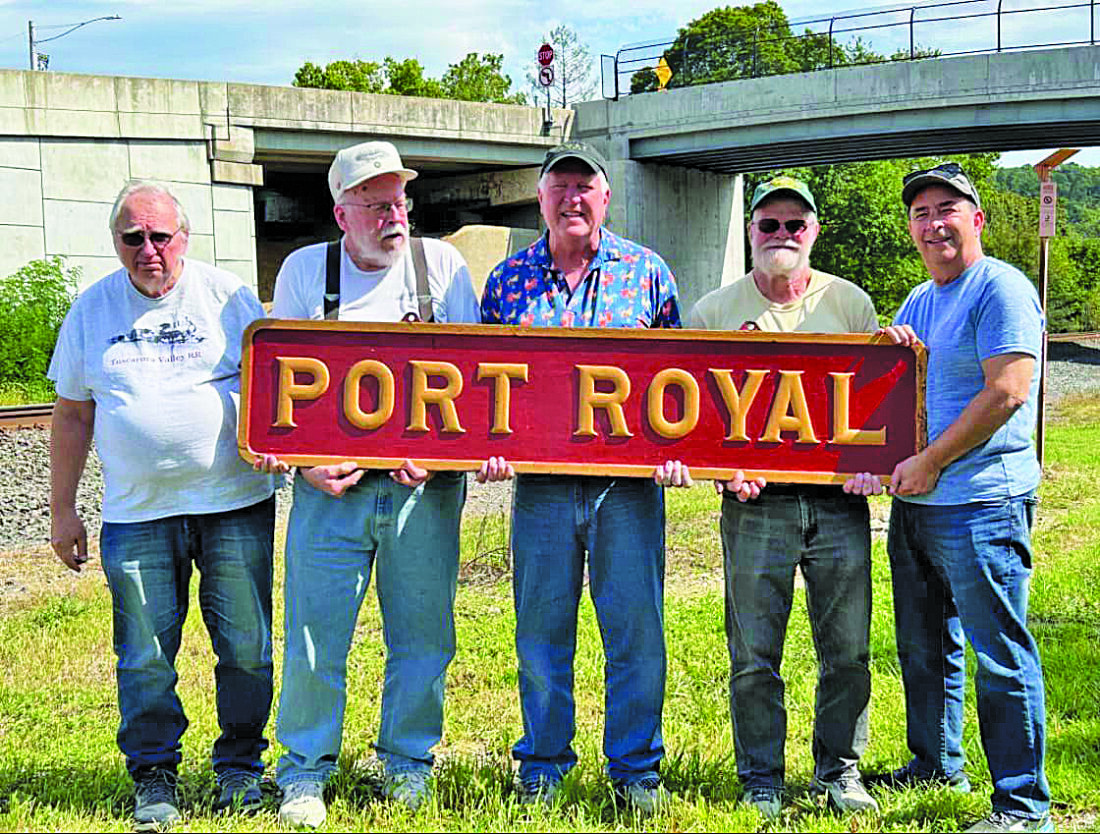
Photo courtesy of JUNIATA COUNTY HISTORICAL SOCIETY<br> George Pierson (second from left) donated the old Port Royal station sign to the Juniata County Historical Society. On Sept. 9, he and other friends and local dignitaries returned to the spot where the sign once hung for a photo. Pictured are John Massura (from left), Pierson, Mike McKenzie, Dean Smith and Craig Crombar.
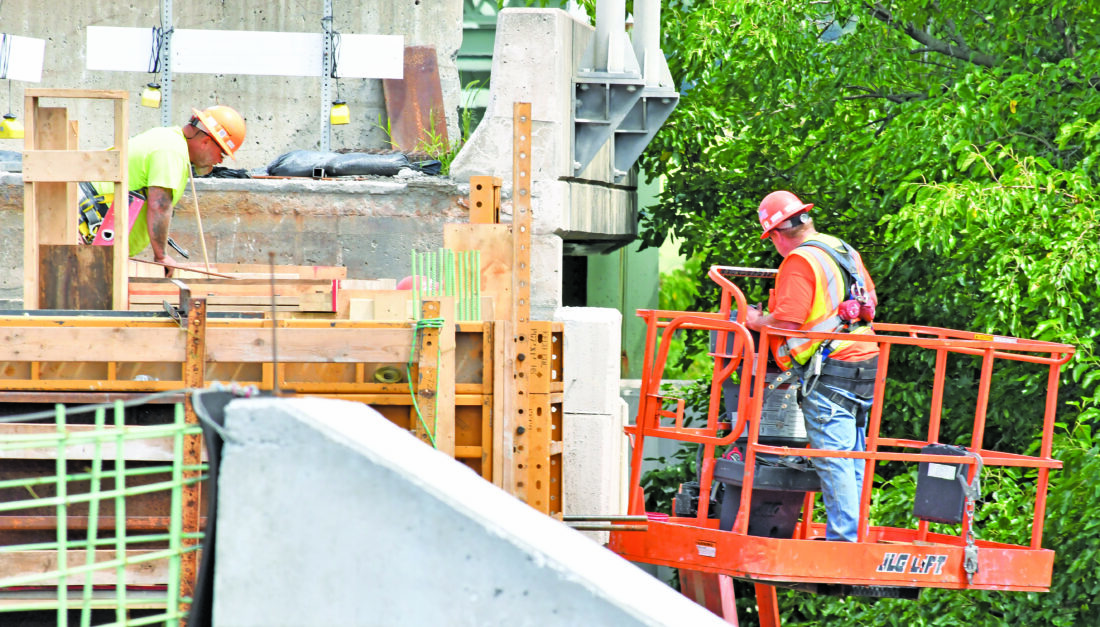
Photo courtesy of JUNIATA COUNTY HISTORICAL SOCIETY<br> Crews work on the recent construction project at the Juniata River Bridge at Route 75 in Port Royal.
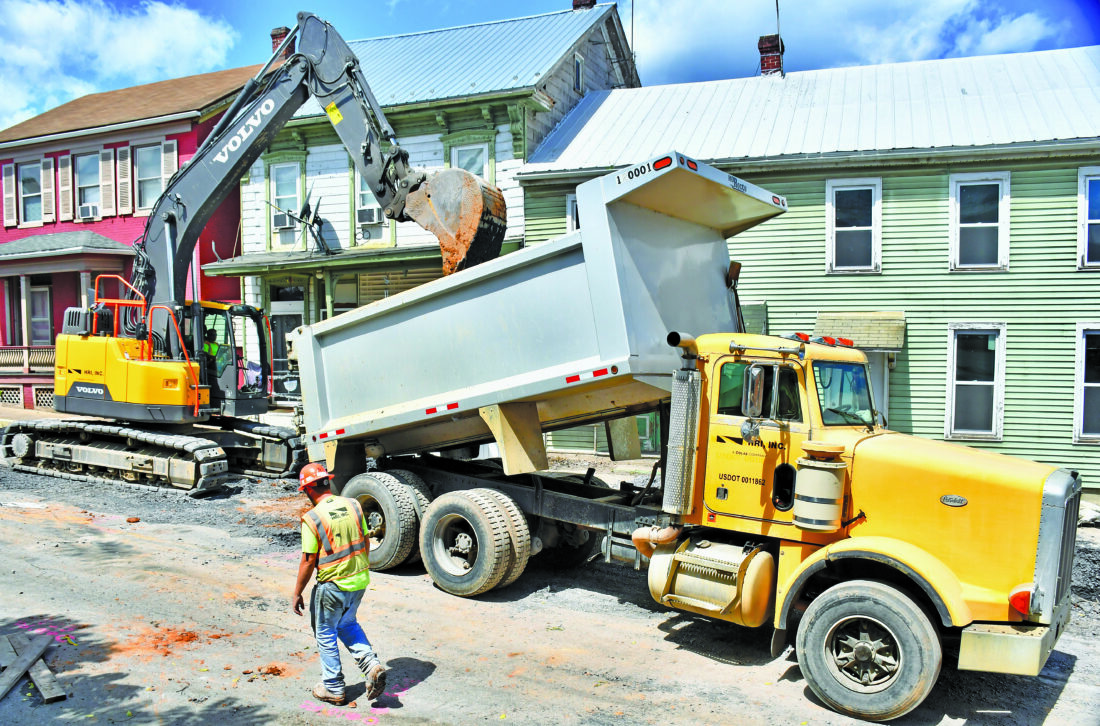
Photo courtesy of JUNIATA COUNTY HISTORICAL SOCIETY<br> Crews work on the recent construction project at the Juniata River Bridge at Route 75 in Port Royal.
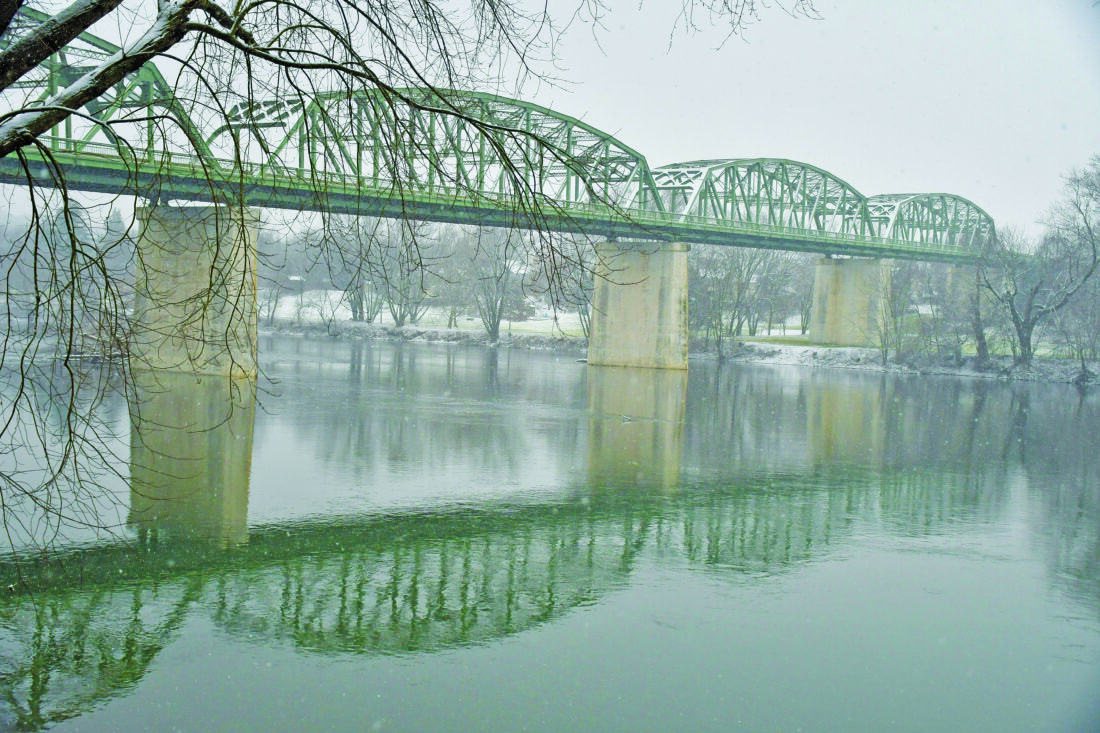
Photo courtesy of JUNIATA COUNTY HISTORICAL SOCIETY<br> The iconic Juniata River Bridge on a snowy day in January.
Photo courtesy of JUNIATA COUNTY HISTORICAL SOCIETY<br> George Pierson (second from left) donated the old Port Royal station sign to the Juniata County Historical Society. On Sept. 9, he and other friends and local dignitaries returned to the spot where the sign once hung for a photo. Pictured are John Massura (from left), Pierson, Mike McKenzie, Dean Smith and Craig Crombar.
Photo courtesy of JUNIATA COUNTY HISTORICAL SOCIETY<br> Crews work on the recent construction project at the Juniata River Bridge at Route 75 in Port Royal.
Photo courtesy of JUNIATA COUNTY HISTORICAL SOCIETY<br> Crews work on the recent construction project at the Juniata River Bridge at Route 75 in Port Royal.
Photo courtesy of JUNIATA COUNTY HISTORICAL SOCIETY<br> The iconic Juniata River Bridge on a snowy day in January.
Trending
PORT ROYAL _ The old Port Royal station is long gone from the Pennsylvania Railroad, but the sounds of the steel horses still rumble down its tracks.
Pieces of railroad memorabilia are all that remain from the station, which was positioned just below the Juniata River Bridge at Route 75 in Port Royal.
One of those relics - a cast iron sign belonging to George Pierson, who lives outside Chicago - was returned home to Juniata County in early September. The "Port Royal" station sign is quite heavy at 150 pounds. Pierson had it on display at his small museum set up for Port Royal's bicentennial in 2012.
Pierson had planned the September trip to lead a group of friends along the path of the former Tuscarora Valley Railroad, from Blairs Mills, Huntingdon County, to Port Royal. During his trip, Pierson also donated the historical sign to the Juniata County Historical Society.
Pierson also authored a book, "Tommy Varner's Red Rooster," about the Tuscarora Valley Railroad.
According to the Juniata County Historical Society, Pierson received the sign in 2004 from Gary Rauch, who told him that when the Penn Central Railroad was scrapping the smaller stations along the Middle Division around 1967, the various station signs were sold at $25 each.
Pierson said, "Collectors today would expect to add a few zeros to that number to buy a sign."
This was one of four signs that were mounted on the east and west ends of the station and the waiting room across the tracks. During his Sept. 9 visit, Pierson and a few others returned to the spot where the sign once hung to pose for a photo.
Fay Kreydatus, of Lewistown, commented on the historical society's post on social media about the former station, "Awesome place to watch trains. Mike, myself and our grandson, William, kept it mowed and trimmed about the bench. Put flags on the railing."
Other didn't reminisce as much, but loved seeing the old sign return to its home. "This is fantastic!" posted Jeffrey A. Henry, of Mifflintown. "Can't wait to see it."
Today, all that remains of that era is the Juniata River Bridge, which has undergone a major re-construction recently. It's been almost a year since the bridge reopened on Friday, Nov. 3, 2023.
Whirlwind reconstruction project
The bridge was closed for a whirlwind 13 months, taking a toll on drivers who maneuvered back roads through Juniata County.
The news from the Pennsylvania Department of Transportation that it had reopened the bridge, spanning the Norfolk Southern Railroad along Route 75 in Port Royal, couldn't have come soon enough for motorists.
Many were just as excited at the notion that the detours had also been lifted that had been implemented in the spring.
In August, PennDOT said it would try to accelerate the project when site conditions warrant to complete it as quickly as possible without sacrificing quality standards or the safety of stakeholders. However, acceleration was not possible due to project constraints.
HRI Inc., of State College, the contractor for the project, maintained access for homeowners near the bridge.
The $4 million project involved partial removal of the existing bridge structure and construction of its replacement, approach paving, drainage improvements, water and sewer line replacements, sidewalk and guide rail replacement, pavement marking and miscellaneous construction.
Preliminary work on this project started in mid-September 2022 by demolishing a two-story building on Second Street in Port Royal. PennDOT expected demolition of the bridge to begin in early January, but work coordination issues resulted in delays.
Effects on speedway and county fair
Area officials were concerned about the effects the bridge construction project would have on the Port Royal Speedway and the Juniata County Fair.
"PennDOT acknowledges the inconvenience this causes the community, particularly with the Juniata County Fair approaching, and thanked everyone for their continued patience as it works with all the stakeholders to mitigate the impact of this delay," explained Timothy Nebgen, safety press officer for PennDOT.
PennDOT worked diligently with all stakeholders to mitigate the impacts of this delay. During Juniata County Fair Week, additional flaggers were placed at the intersection of routes 35 and 333 as it has for events held at the Port Royal Speedway throughout the summer.
New round of closures
PennDOT recently announced another bridge closure, which started on Oct. 7, as restoration work on a truss bridge along a Route 75 bridge spanning First Street and the Juniata River in Port Royal. The project involves removing and replacing overhead structural members, painting, and other non-critical repairs.
"This bridge was struck in a crash at some point and the work being done is to repair the damage of that strike," Nebgen explained."
The contractor hopes to keep one lane of the bridge open for most of the project duration. PennDOT hopes that closing the bridges on Sunday will minimize traffic disruptions for motorists. It anticipates project completion after lifting the detour on Sunday, Oct. 20.
Locals speak their mind
Duane Hart has lived in Port Royal Borough long enough to know this wasn't the first time the Port Royal Bridge has been closed, and it most likely won't be the last.
"They've closed it a couple of times for a couple of months for painting and for maintenance, but this time they're tearing it out so it will be totally new," said Hart, a resident for nearly 60 years. "It's been closed before, and we've all lived to talk about it."
In addition to living in Port Royal, the construction project also impacted his work at the Port Royal Municipal Authority Water/Wastewater operator as well as the Friendship Fire Co. No. 1 chief.
The most trying part for motorists and locals was being detoured while the bridge was demolished and replaced.
"Road construction is always inconvenient to everybody," Hart said. "We just have to tolerate it and live with it. At the end of the day, the end of the project, it's going to be better. It's just going to be inconvenient for six months."
From the municipal authority standpoint, Hart said PennDOT is footing much of the bill for important water and sewage improvements.
Port Royal Speedway
The first checkered flag at Port Royal Speedway typically drops during the first weekend in March. Drivers and racers headed to the Juniata County oval will have to find a detour until the bridgework is completed.
Juniata County Agricultural Society President Seth Koser said the speedway's early-season schedule is often at the mercy of Mother Nature. Now, the construction added another obstacle.
"The ideal thing for us would have been if they had started now, they would have been down in April," Koser said. "The majority of our rainouts are in March and April. I remember back when they sand-blasted and painted the steel, it definitely impacted the races for sure."
The price of fuel and increased operating costs for racing teams caused a decrease in the number of drivers at Port Royal in 2023. There were also fewer fans in the stands.
"It's anybody's guess what's coming," Koser said.
Fortunately, those numbers have seemed to rebound.
Port Royal Speedway Promoter Steve O'Neal understands bridgework is necessary but said the livelihood of the racetrack and other businesses in the borough are always at stake.
"It definitely hurt the racetrack," O'Neal said of previous bridge closures. "Teams and fans had to drive out of their way to get here.
"It's a little bit of inconvenience," he added. "It hurt us some last time and it will hurt us some this time. We just hope all our fans and race teams have patience with the project and stick with us."
Previous bridge projects
According to books, records, clippings and photos from the Juniata County Historical Society, the only way to get in and out of Port Royal, to the east, prior to 1831, was by fording the Juniata River a short distance below the mouth of the Tuscarora Creek.
A fording was a shallow crossings through waterways residents used to get to where they were going.
A second fording crossed the river near the eastern end of the existing bridge by a farmhouse. Later, an approach was made to Milford Street.
Records indicate the bridge was replaced four times between 1831 and 1892. There is not much known about the first two bridges other than the timetables.
The first bridge across the river was built in 1831, but in 1839 a heavy snowstorm completely destroyed it. Another bridge was built in 1842 and served the area as a crossing until a flood took it out in 1847.
Four years later, the third bridge was built in 1851 and was located in front of a farm at the eastern end of the river at a more northerly direction from the existing bridge. The two small islands in the river are where those piers once stood. This was a toll bridge and a Powell family lived in the tollhouse at the time of the 1889 flood that destroyed the bridge and the house. The family lost all their property and only escaped with their lives.
The county build the fourth bridge in 1892 at a cost of $16,500. This was a wooden covered bridge about 700 feet long, built by contractor W.F. Goodman. It served travelers for a period of 45 years. On March 18, 1936 at 4 p.m., the St. Patrick's Day flood destroyed it.
The last person to cross the bridge in a car was S.G. Bashore, who found the road flooded on the east side when he tried to drive his Dodge car through. The water was too deep and it flooded the car's engine. He had to have it towed.
Accounts stated the flood carried away three spans of the bridge, leaving behind three stone piers and one span of the old wooden structure.
During the late spring and summer, the Pennsylvania Highway Department engineers made three distinct surveys of probable sites for a new bridge: one on Milford Street, another on Market Street and the last one on Tuscarora Street.
It was decided to use the old site and the necessary funds were immediately appropriated. Then, after further discussion with the town council and the Pennsylvania Railroad, the Market Street site was selected because it eliminated two very dangerous curves and a very steep approach.
Records show J.H. Wichersham and Co. of Lancaster was awarded the contract at $328,312. The groundbreaking came with little fanfare as on Jan. 22, 1937, a steam shovel started excavating at the site where the piers would be built.
On Dec. 20, 1937, the new bridge opened to traffic, although one of the two approaches on the southern end was incomplete. Public officials stated the main approach was expected to be completed in a few days and that the span is expected to be free of restrictions by Christmas as construction wrapped up in just over a year.
The eight-span, 1,087-foot-long bridge consisted of four Parker thru truss spans over the rivers, measuring 222-feet long each, a steel thru girder span over the street and two steel stringer and a reinforced concrete slab approach spans.
The deck was replaced in September 1975 when the bridge was closed until Memorial Day 1976. A new addition to the bridge included a three-way mirror, which enabled motorists to see traffic emerging from First Street (Water Street), and also gave drivers from that street a warning of approaching traffic crossing the bridge. The mirror has helped to cut down on accidents at that intersection, town officials said.
In 1982, the bridge was completely sand-blasted and covered with three coats of paint. Olympic Sandblasting and Painting, Inc., based in Havertown, Delaware County, did the work.
In June 2009, extensive renovations were started which closed the bridge. This rehabilitation project was funded by the American Recovery and Reinvestment Act. The project included deck, structural and concrete repairs and painting the structure. The cost was more than $4 million. During the repairs, traffic was rerouted onto Route 333.
In September 2009, the bridge was opened to one-way traffic with a signal installed at each end of the bridge. It was reopened during the winter months to two lanes. Again in April 2010, while construction workers were there, it was one-lane traffic with signals. Work was completed in 2010.
PennDOT rehabilitated the bridge in 2010 with a repair and repainting project. The First Street Ramp was also demolished and replaced.
With each construction project, it's hard to predict what the future holds for the historic bridge. With every project, it just keeps serving the surrounding communities.