
Rotary luncheon honors veterans, explores military history
Speaker highlights lasting impact of Whiskey Rebellion on nation's military
Trending
REEDSVILLE -- The Lewistown Rotary Club honored local veterans for their service Tuesday afternoon during its annual veterans luncheon at the Reedsville Fire Department banquet hall.
Rotarians gathered with veterans and their spouses for an afternoon of food, music and fellowship, sharing memories of military service and remembering those who have died.
"Thank you all for joining us in a luncheon in your honor, and thank you for your service," Lewistown Rotary Club President Jim Zubler said.
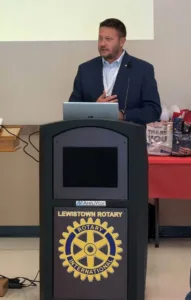
The event featured guest speaker Tyler Gum, western division chief for the Pennsylvania Historical and Museum Commission, who discussed the lasting influence of the Whiskey Rebellion on the nation’s military and the federal government’s authority to respond to domestic unrest.
Before joining the commission in his current role, Gum served as director of the state’s military museum. His professional background also includes work in corporate relations, legislative affairs and service as a park ranger with the National Park Service.
Gum opened his presentation by encouraging veterans to preserve their personal histories, emphasizing that firsthand accounts provide future generations with a better understanding of military service and its sacrifices.
"Write yourself down, remember your history and be proud of it," Gum said. "This includes your personal story because, from your perspective, (it) is what we as historians use to make sure you’re not forgotten."
He explained that historians have a responsibility to preserve the experiences of previous generations.
"To make sure that what we do here now is not forgotten. And more importantly, what you’ve done for your communities and for your nation is not forgotten," Gum said.
Gum then turned his attention to the Whiskey Rebellion, a violent tax protest that unfolded in western Pennsylvania from 1791 to 1794.
The uprising began in response to a federal excise tax on distilled spirits, particularly whiskey, which many western Pennsylvania farmers viewed as an unfair financial burden.
The conflict became one of the first major tests of the federal government’s authority under the newly ratified U.S. Constitution.
Gum explained that President George Washington issued a proclamation in 1792 condemning resistance to federal tax laws. Tensions continued to escalate, culminating in violent confrontations between protesters and federal tax collectors.
In July 1794, hundreds of armed protesters attacked the home of federal tax inspector John Neville near Pittsburgh, setting fire to the property and forcing Neville to flee.
The unrest eventually drew thousands of protesters, prompting Treasury Secretary Alexander Hamilton to urge Washington to mobilize militia forces to restore order.
Washington responded by assembling a force of approximately 13,000 militiamen from several states, including Pennsylvania, Maryland, Virginia and New Jersey.
The troops traveled west through Pennsylvania, with the expedition passing through communities including Lewistown and Huntingdon.
Gum noted that Washington’s involvement marked a significant moment in American history, as he became the only sitting U.S. president to personally lead troops in the field while serving as commander in chief.
The military response also demonstrated the authority granted to the federal government under the Militia Acts of 1792, which established procedures for calling militia forces into federal service.
Gum described how tensions escalated as protesters gathered near Pittsburgh, where local residents sought to prevent further violence.
With thousands of armed men threatening the community, residents provided food and alcohol in an effort to persuade the protesters to disperse.
The strategy worked, Gum explained, and Pittsburgh avoided widespread destruction.
Washington eventually traveled west to oversee the military response, stopping in Bedford, where he stayed at the Espy House and reviewed the troops before returning east.
The rebellion collapsed as federal forces advanced, and the government’s response established an important precedent for enforcing federal laws.
Gum also discussed the experiences of young men who participated in the expedition, including Meriwether Lewis, who later became famous for leading the Lewis and Clark Expedition.
During his presentation, Gum shared excerpts from a letter Lewis wrote to his mother describing his experiences in military camp.
"We have mountains of beef and oceans of whiskey," Lewis wrote, according to Gum’s presentation.
Gum used the account to illustrate how military service has long provided opportunities for personal growth, leadership and camaraderie, even amid difficult circumstances.
He suggested that many veterans in attendance could relate to those experiences, having developed lifelong friendships and valuable lessons during their own military service.
Gum concluded by connecting the Whiskey Rebellion to modern laws governing the military and federal emergency response.
He pointed to the Insurrection Act, the Posse Comitatus Act and federal military authorities under Title 10 and Title 32 of the U.S. Code as examples of the continuing evolution of the relationship between military service and civilian government.
While those laws developed at different points in American history, Gum emphasized that the Whiskey Rebellion helped establish an early precedent for the federal government’s use of military forces to enforce the law.
He also referenced the federal response to Hurricane Agnes in 1972, reminding attendees that military and emergency response authorities continue to affect communities during times of crisis.
Gum said understanding that history is important not only for veterans, but also for their families and future generations.
His presentation reinforced the importance of preserving military history and recognizing the contributions of those who have served.
For the veterans gathered Tuesday, the luncheon offered an opportunity to reflect on their own experiences while learning how military service has shaped the nation from its earliest years.