
National Teacher of the Year addresses retired educators
Crosson shares lessons from her year of service
Trending
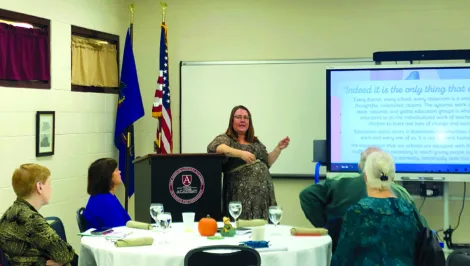
LEWISTOWN -- Retired educators from throughout the region heard firsthand how innovative programs across the country are addressing educational opportunities and teacher shortages when 2025 National Teacher of the Year Ashlie Crosson spoke at the Pennsylvania Association of School Retirees Region 5 meeting on Thursday.
The Pennsylvania Association of School Retirees Region 5 is made up of about 200 retired teachers and school staff members from Mifflin, Snyder, Union, Huntingdon and Blair counties. The organization is one chapter in a statewide network of retired educators who continue to support public education and their communities.
Crosson’s role as National Teacher of the Year included stepping away from the classroom for a year to complete a national “year of service.” During that time, she traveled throughout the country, speaking at conferences, participating in advocacy efforts and policy work in Washington, D.C., and working alongside preservice teachers completing their college degrees.
“I got the chance to see what education looks like across the country and learn how the voice of a teacher can help elevate the voice of every teacher and every student across America,” Crosson said.
Among the programs that stood out to her was one led by Hawaii’s Teacher of the Year. Students there created a traveling makerspace, allowing students to engage in project-based learning using tools such as 3D printers and other science, technology, engineering and mathematics (STEM)-related materials.
Crosson noted that Mifflin County students are fortunate to have access to these spaces in all local schools.
Crosson also highlighted New Mexico’s Teacher of the Year, the first Indigenous recipient of the honor, who works on a Native reservation and leads programs designed specifically to support reservation students.
Another example came from Montana, where the state’s Teacher of the Year, an art teacher, guided students in creating community murals that reflected their heritage, from ranching traditions to the Rocky Mountains.
“Another thing we are doing here in Mifflin County that makes me so proud,” Crosson said. “We need to make sure our school systems celebrate the community.”
Crosson also spoke about the impact travel had on her own life. She said experiences outside her community during high school helped shape her future and inspired her to lead a travel club for Mifflin County students.
Recognizing that travel opportunities can be difficult to access for students from lower-income backgrounds, Crosson said she has focused on finding ways to make those experiences more attainable.
Her guiding question, she said, has been: “How do we turn opportunity into equity? How do we make global experiences more approachable and accessible no matter the income or background of a student?”
She said Education First invited her to Boston to discuss ways to make educational travel more affordable. Those conversations led to the development of co-op opportunities that help students save for travel experiences while learning valuable budgeting skills. Participants can set aside portions of their paychecks toward future trips while learning to plan for both immediate expenses and long-term goals.
Crosson also addressed the nationwide teacher shortage and shared examples of programs she encountered while traveling.
In Maryland, students interested in becoming teachers can enter academy programs beginning in kindergarten through 12th grade. The programs are partnered with universities, allowing students to earn college credits toward education degrees while still in high school.
“So they’re saving some of that college money and already building into their profession,” Crosson said.
In Washington state, she shared emergency-certified teachers receive guidance from experienced educators through a program overseen by the teachers’ union. Those entering classrooms without traditional teaching backgrounds are mentored by master teachers currently working in the profession.
In Tennessee, multiple certification pathways encourage educators to pursue high-need teaching areas.
Crosson also highlighted Pennsylvania’s student-teacher stipend program. Approximately 3,000 students have been approved to receive $10,000 stipends to help cover expenses during student teaching. Recipients agree to teach in Pennsylvania schools for five years or repay the funding.
Crosson concluded by emphasizing the importance of continued investment in education.
She said funding, resources, updated curriculum and support systems give educators the ability to meet individual student needs while helping young people build meaningful lives of their own.