
From folklore to fear: The cursed beast and macabre tales
Trending
Every small town has a story, a bone-chilling tale that will make you turn on all the lights at night.
Lewistown and other local haunts in Mifflin and Juniata Counties contain legends of witches, spirits, and the macabre.
Local historian Forest Fisher of the Mifflin County Historical Society expertly retells local legends rooted in history, including a witch's curse, footsteps heard on an unoccupied floor, the clip-clop of ghostly hooves, and a skeletal hand reaching from the abyss.
The Beast of Bixler Gap
Fisher explained that a skilled herbalist and healer known as Mrs. Bixler, capable of both good and evil, lived in Bixler Gap in the late 17th century. She lived in the area, nestled in the historic Lewistown Narrows, with her son, whom she cared for deeply.
For three days, her son encountered a black cat while tending the family cow. On the third day, he took a hay knife and swung it at the cat, lopping off its ear.
Later that day, Mrs. Bixler's son saw his mother with a bloodied bandage over her ear; some say she shapeshifted into the black cat he saw.
For his misdeed, Mrs. Bixler cursed her son into a half-man, half-wolf form, condemning him to roam the narrows for eternity. "And during the full moon, those who lived there claimed to hear the howling of what sounded like a wolf," Fisher said.
Ghost of the Historic Mifflin County Courthouse
Fisher said local lore suggests the Mifflin County Courthouse, built in 1843 on Monument Square in Lewistown, was the site of a ghostly encounter. Some have reportedly heard footsteps roaming the courthouse halls but found no explanation for their origin.
Those who believe in the courthouse haunting suspect the reported spirit could be a Civil War veteran serving as a county messenger who collapsed and died on the courthouse steps on his way to deliver information to the courtroom in the early 1900s. Does he continue to deliver his "spectral messages" after hours?
Another possible candidate is the ghost of Frank Lee, who was convicted of first-degree murder and sentenced to death by hanging in 1911; his was the only murder case in Mifflin County resulting in local execution. According to Fisher, locals speculate that "it is Frank Lee walking from the defendant’s table to the witness chair to deliver his plea for mercy."
The third candidate for the courthouse ghost is that of attorney Paul Fetterolf, who spent endless hours working on the appeal of Dr. Samuel Lawrence Woodhouse, who was convicted of murdering his 16-year-old daughter in the 1950s. Fisher said that, according to the doctor's defense, the daughter had an incurable disease and Woodhouse believed it was a mercy killing. Fetterolf's appeal was ultimately denied, resulting in Fetterolf taking his own life. Perhaps he still works tirelessly to plan Dr. Woodhouse’s appeal.
"Mad" Anthony Wayne's Lost Bones
A local legend in both Mifflin and Juniata Counties is the gruesome tale of General "Mad" Anthony Wayne. Fisher said the Revolutionary War general was a confidant of George Washington. After the Revolution, Wayne was assigned to the army fort in Erie that overlooked the entrance to Presque Isle Bay.
The Wayne family originated from Chester County; their father, a Major-General, died at the Erie fort in the early 1800s from complications with gout, according to multiple online sources.
Our story begins at the end.
According to Fisher, Wayne's family decided they wanted to return their father's remains to the family burial plot in Radnor Township in southeastern Pennsylvania. So, they sent his son to Erie to disinter General Wayne. "And when they did, they discovered not bones in his coffin, but a darn near perfectly preserved body in the uniform," Fisher said.
According to the Hagen History Center of Erie, the son ordered the body rendered, meaning boiled; the pot used for this eerie process is still on display there.
Fisher said Wayne's flesh was then reburied at the original gravesite in Erie, and his son transported the bones back to Radnor.
The trip from Erie to the Wayne family's burial plot roughly follows today's US 322. Along the way, "Mad" Anthony Wayne's son lost some of the bones to the journey.
Now, every New Year's Day on Wayne's birthday, Fisher said you can supposedly hear the clip, clop, clip, clop of "Mad" Anthony Wayne's horse on old US 322 as he searches for his missing bones.
The Legend of Cotter's Hole
In the Juniata River Valley lies the story of a murderous trapper, Judas Cotter.
Fisher said in the colonial days, "Cotter was a ruthless, semi-evil person who didn’t hesitate to wield his tomahawk against his enemies."
Cotter was known to enact his vengeance against the indigenous people who lived in the area.
"One dark, moonless night, his enemies took their revenge and tomahawked him along the Juniata River around Lewistown, somewhere in the general vicinity of where they believed Fort Granville was located," Fisher said.
His enemies then threw his body in what was considered the deepest fishing hole in the river, "a place where the largest muskies dwelt, where eels would feast upon his bones," Fisher said.
According to legend, fishermen avoided the site of the grisly murder of the vengeful trapper Judas Cotter.
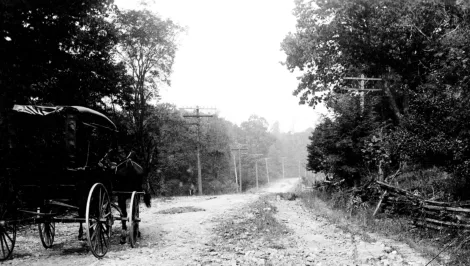
Years later, a young couple traveled home along the river road in their buggy from a fall harvest dance. As the moon shone on the river, the couple rode past Cotter's hole.
All of a sudden, a gust of wind came whooshing down the mountain and blew leaves and debris, spooking the horse and twisting the buggy so that the back wheel slid down the embankment and slightly into the water.
The couple scrambled into the water to get a foothold, but neither saw a spectral skeletal hand reaching from the depths.
"About the time the young man got a foothold but his love did not, he looked down and saw this bony hand break the water," Fisher said.
The man pushed his wife as far as he could up the bank and threw a rock toward the hole; the hand vanished, the swirl of water dissipated, and the couple scrambled up to the wagon road, got the horse under control, and left the spot.
"And to his dying day, he never told his wife how close they were to what he believed was the rotted skeletal remains of Judas Cotter, for whom the hole was named," Fisher said.
Today, on Halloween night, keep your ears open for the howling of the beast of Bixler Gap; you just might hear his cry as he roams the Narrows.