
Training for the minutes before help shows up
Community learns emergency response and rescue techniques
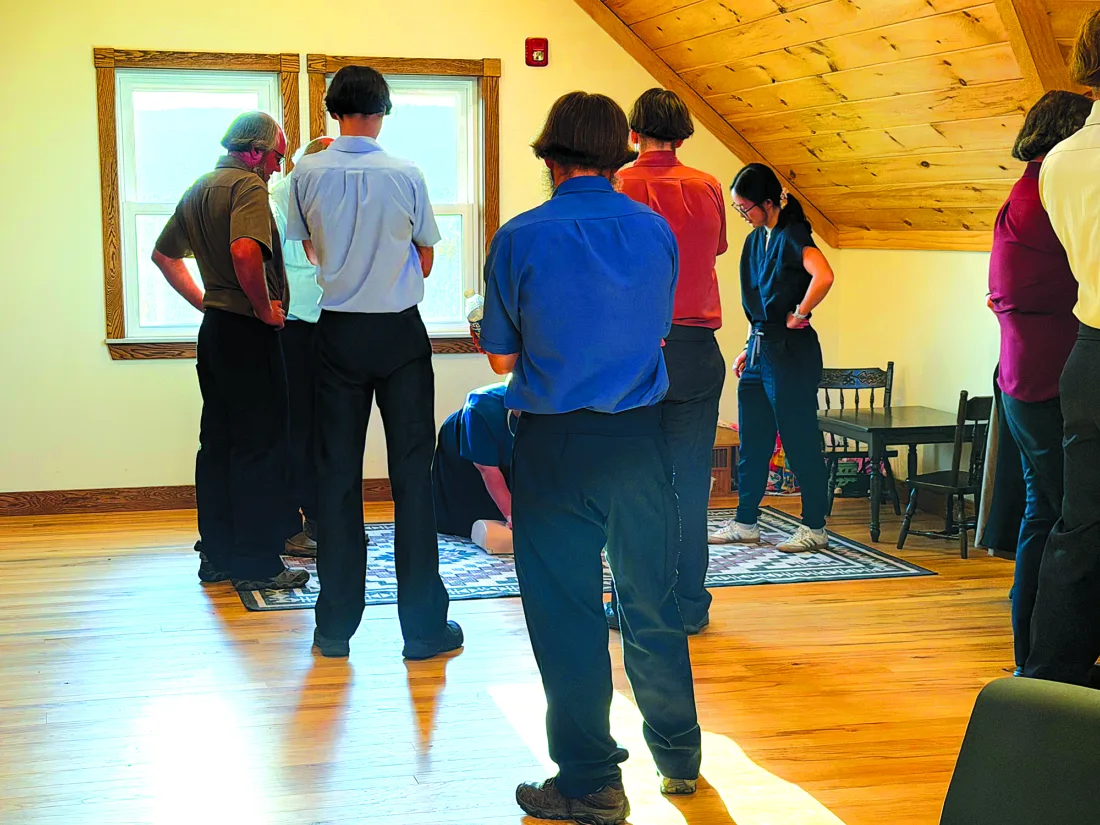
Submitted photos<br> Amish and Mennonite residents participate in the Rural Response and Rescuer Training program at the Central Pennsylvania Clinic for Special Needs Children and Adults in Belleville.
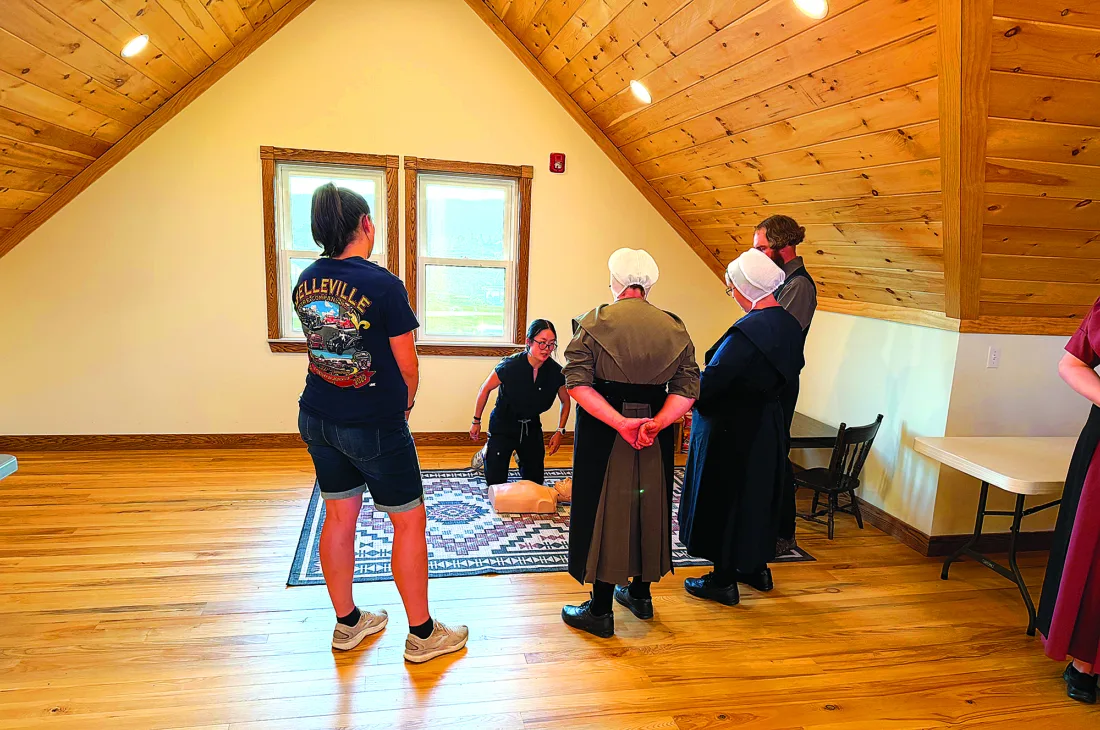
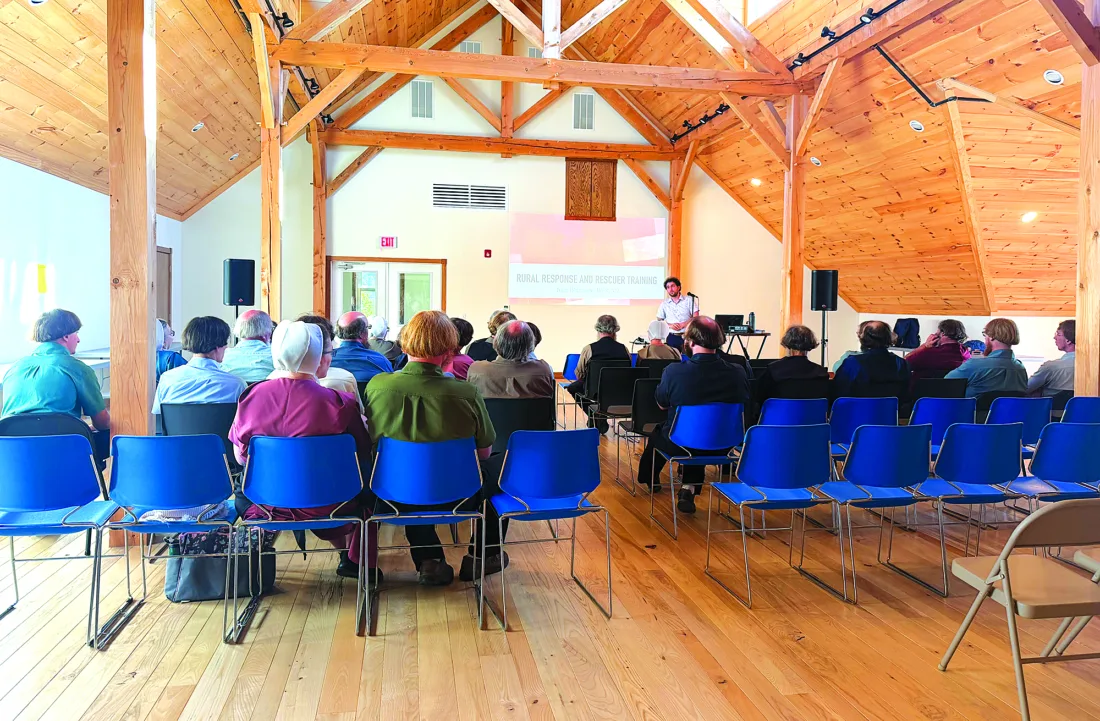
Submitted photos<br> Amish and Mennonite residents participate in the Rural Response and Rescuer Training program at the Central Pennsylvania Clinic for Special Needs Children and Adults in Belleville.
Trending
BELLEVILLE -- The people who came to the Central Pennsylvania Clinic for Special Needs Children and Adults weren't there to watch someone demonstrate what to do in an emergency.
They got down on the floor.
They practiced CPR. They rotated through hands-on stations. They learned how to use an automated external defibrillator, stop severe bleeding, and respond to choking, severe allergic reactions, and opioid overdoses.
Louise Yoder wasn't sure how that part would go.
"I was actually pleased and surprised that they were willing to do, like, the CPR training, you know, get on the floor and do the hands-on part," said Yoder, executive director of the clinic. "I didn't know how the community would respond to that, but they were very, very engaged and very willing to participate."
For the 42 people who attended the free Rural Response and Rescuer Training program in Belleville, the point was simple: When something goes badly wrong in a rural community, the first person who can help may already be standing there.
Isaac Weitzman, a Geisinger Commonwealth School of Medicine student, helped create the program with Mandy Maneval, MD, PhD, after seeing what can happen when people face an emergency and don't know where to begin.
Before coming to central Pennsylvania, Weitzman had trained people without medical backgrounds in hands-on emergency response. After arriving here, he heard about accidents in rural communities and talked with residents affected by them.
"There felt like a gap in knowledge that wasn't addressable, that I could actually make a difference on," Weitzman said.
The need can be greater in rural areas, where farms, sawmills, hunting, and outdoor work can produce serious injuries, and professional help may have farther to travel. Yoder said the clinic has seen patients with cuts, broken bones, and other injuries connected to physical labor in the area.
The training tried to answer a hard question with practical instruction: What should you do during the minutes before EMS gets there?
Weitzman starts with recognition.
A bystander first has to recognize an emergency and determine whether the scene is safe. Then the bystander needs to consider what help and resources are available.
Then comes the medical assessment.
"Is there a major bleed happening? Is the patient breathing? Does the patient have a pulse or a heart rate? And is the patient conscious?" Weitzman said. "Those are the big questions that I want the bystanders to answer."
Those questions help separate injuries that need treatment from conditions that can kill within minutes.
"If somebody has a broken arm, that's not urgent," Weitzman said. "That's not something that they're going to die from within minutes."
Severe bleeding, stopped breathing, or the loss of a pulse are different. A person nearby may have only a short window to act.
That is where the training becomes less about memorizing medical information and more about giving people the confidence to act.
"The biggest problem is when people don't have any idea where to start, don't know what to do," Weitzman said.
Participants rotated through stations covering CPR, AED use, Stop the Bleed techniques, choking, anaphylaxis response, and opioid overdoses. Volunteer EMTs, physicians, residents, and medical students provided the instruction. The materials drew on guidance from the American Heart Association, American Red Cross, and Wilderness Medical Associates.
The clinic provided a familiar setting for the training, especially for Amish and Mennonite residents.
Yoder said Maneval approached the clinic about hosting the session. One reason, she believes, was the clinic's established relationship with Plain community families and its familiar setting.
That familiarity matters.
Yoder said some Plain community families view health care providers as a last resort. The clinic's mission centers on treating children and adults from the Plain community who have genetic disorders. It also houses a family practice clinic.
"The more they're in here, the more they look for cohesiveness," Yoder said. "They don't want to have to go over the mountain for this and, you know, down the valley for that."
Receiving more services in a place families already know can help build trust, Yoder said.
For Weitzman, that relationship was one of the most important parts of the project.
He grew up among the farmland and mountains of rural western Massachusetts; terrain he said resembles central Pennsylvania. The communities are different, but the problem of distance and emergency response isn't.
What stayed with him after the Belleville session wasn't the attendance number. It was the curiosity.
Participants asked questions and shared stories about accidents, including what it felt like to face those moments without knowing what to do.
"I was so impressed with just how curious everyone was and how interested they were in learning these skills," Weitzman said.
The program may grow.
Weitzman said organizers want to take the training to other rural communities in Mifflin and Juniata counties and possibly beyond. He also wants to make it an annual program.
Future sessions could become more intensive, including full-day training on farms or in wooded areas. Participants could learn how to build improvised litters from tree branches or farm equipment. Training could also cover extracting injured people from hard-to-reach places.
Yoder said the first session drew mostly Juniata County residents, leaving room to reach more Amish church groups and families in the Big Valley.
Weitzman also hopes future Geisinger medical students will carry on the project as he continues his education.
For now, the result of the first session can be measured in something simpler than a program or curriculum.
Forty-two people walked into a room in Belleville and practiced what to do when someone's life may depend on the person standing closest.
The ambulance may still be miles away.
But now, someone may know where to start.