
Franklin’s life, legacy focus of DAR program
 Submitted photo
 Trending
LEWISTOWN -- Members of the General Thomas Mifflin Chapter of the National Society Daughters of the American Revolution learned about the life and legacy of Benjamin Franklin during the chapter's July meeting.
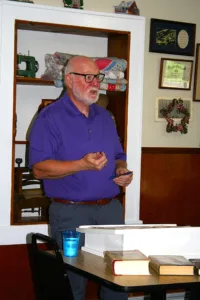
Darwin Seiler presented "Benjamin Franklin, A to Z," exploring Franklin's life, character, influence on the Pennsylvania frontier, historic documents and lasting legacy.
Seiler, a Reedsville native who lives in Blue Ridge, is a retired social studies teacher and a board member of the Monterey Pass Battlefield and Museum.
Seiler described Franklin as one of the most accomplished men of his time, tracing his life from his birth in Boston in 1706 through his career as a printer, inventor, scientist, diplomat and statesman.
Franklin came from common Puritan origins and eventually made his way to Philadelphia, where he established his own printing business. Seiler described Franklin as a "people-person," organizer and joiner who became involved in efforts to improve life in Philadelphia.
Franklin also served as a diplomat to England and France on behalf of the colonies and became involved in politics and community affairs. According to Seiler, Franklin believed in living usefully and did not patent his many inventions because he wanted them available for others to use.
Seiler also discussed Franklin's connections to Pennsylvania's frontier. Franklin traveled to Carlisle to meet with Native Americans and later supported the Militia Act of 1755, which provided funding to construct forts along the frontier.
Franklin's role in some of the nation's most important founding documents was also highlighted. He was the oldest signer of the Declaration of Independence and also signed the Treaty of Alliance with France, the peace treaty ending the American Revolution and the U.S. Constitution.
Seiler said Franklin's insatiable curiosity led to numerous inventions and scientific discoveries. Among the inventions associated with Franklin are the Franklin stove, street lamps, batteries, the glass armonica, bifocal glasses and an odometer.
Franklin also helped establish civic and cultural institutions, including a fire company, lending library, the University of Pennsylvania and Pennsylvania Hospital, and played a significant role in development of the postal system.
His scientific work included studying ocean currents, the Gulf Stream and weather patterns, as well as conducting experiments involving electricity.
Seiler said Franklin's legacy remains visible throughout the country, with numerous counties, towns, colleges and high schools bearing his name.
Franklin died in 1790 at age 84. According to Seiler, about 20,000 people gathered for his funeral, making it one of the largest such gatherings of its time.