
The Calvin‑guided trilogy of Matthew D. Meiser
From suffering to freedom

Photo by KARI SWEIGART<br> Matthew D. Meiser painted all artwork in his books, including the covers.
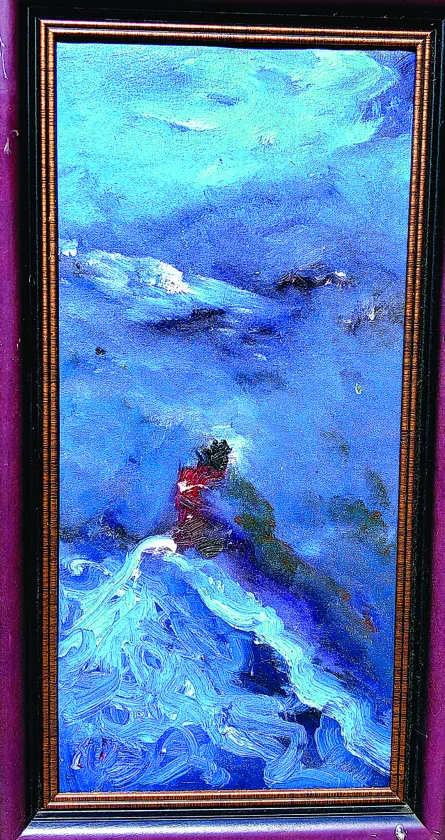
Photo by KARI SWEIGART<br> “Beacon of Hope,” 2023 (oil on linen) by Matthew D. Meiser: A figure is perched atop a scenic mountain, overlooking the lands and gazing toward the heavens.
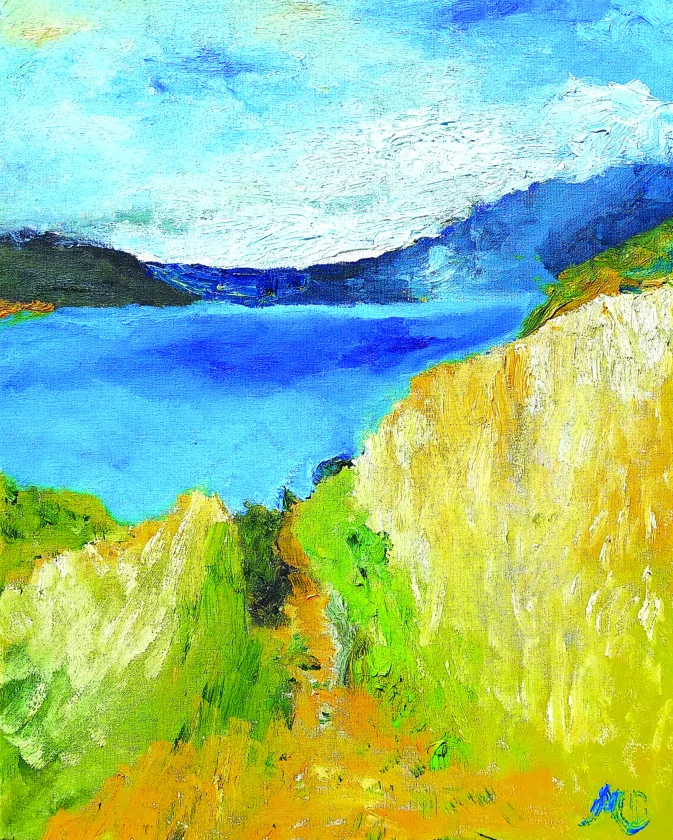
Photo by KARI SWEIGART<br> “All the Riches,” 2026 (oil on canvas) by Matthew D. Meiser: Meiser’s artwork reflects this movement.
Photo by KARI SWEIGART<br> Matthew D. Meiser painted all artwork in his books, including the covers.
Photo by KARI SWEIGART<br> “Beacon of Hope,” 2023 (oil on linen) by Matthew D. Meiser: A figure is perched atop a scenic mountain, overlooking the lands and gazing toward the heavens.
Photo by KARI SWEIGART<br> “All the Riches,” 2026 (oil on canvas) by Matthew D. Meiser: Meiser’s artwork reflects this movement.
Trending
RICHFIELD -- Richfield native Matthew D. Meiser has completed a three‑volume series of poetry based on the sermons of John Calvin, the French theologian and central figure of the Protestant Reformation. Each volume contains numerous original paintings created by Meiser in his home studio, reflecting the scriptural material and historical themes explored in the text.
Meiser earned his bachelor's degree in forestry at SUNY, the State University of New York, and has worked in the field ever since, developing his writing and painting alongside his career. During his senior year, he met a Presbyterian minister who introduced him to the writings of the magisterial reformers, Martin Luther, John Calvin, Heinrich Bullinger and Martin Bucer, whom Meiser referred to collectively as "the cream of the crop." Through this influence, he became increasingly interested in the Protestant Reformation, most notably the work of John Calvin, and eventually became "reformed."
In the Reformed tradition, particularly within Calvinism, God is understood as completely sovereign over the universe and every detail of life. Humanity, by contrast, is seen as entirely corrupted by sin and unable to choose God without divine intervention. Calvin described this condition starkly: "A man is a worm, an ingrate, and a wretched sinner, and apart from the grace of God, he is lost." Salvation, in this tradition, is understood as unearned grace, something given freely rather than achieved. Imagine carrying a trillion‑dollar debt that is impossible to repay. Human effort is like trying to settle that debt with a single penny. It accomplishes nothing.
Unearned grace is the billionaire who steps in, wipes the entire debt clean, and asks for nothing in return. Predestination follows from this idea: God chose those who would be saved before the world was created. The Bible serves as the final authority for belief and practice, shaping how believers understand God, themselves and the world.
Meiser began writing at the beginning of 2025 after reading Dante Alighieri's "The Divine Comedy." Alighieri, a 14th-century Italian poet, philosopher and political figure, is known as the "Father of the Italian Language." Within the first few seconds of reading Dante, Meiser felt compelled to write. He said he immediately thought, "I can do this. I can write in Reform what Dante was trying to do, and by using Dante's template." Inspired by Dante's structure, Meiser organized his own trilogy to follow a similar ascent, moving from suffering, to restoration, to ultimate freedom.
To understand the structure of Meiser's trilogy, it helps to look briefly at Dante's own design. "The Divine Comedy" is divided into 100 cantos--short, self-contained sections similar to chapters arranged in three parts, Inferno, Purgatorio, and Paradiso. Dante wrote the poem in terza rima, an interlocking rhyme scheme of three‑line stanzas that creates a continuous, forward‑moving rhythm. Each canto is built on this pattern, using a meter inspired by classical pentameter to give the poem its distinctive cadence. This tight, architectural style shaped not only Meiser's writing but also his artwork, the triplet structure, the upward movement through suffering, cleansing, and illumination, and the disciplined rhythm of Dante's verse all informed the way Meiser organized his own cantos, composed his lines and painted the imagery that accompanies each book.
In "Dante's Divine Comedy," the poet Virgil serves as Dante's guide through the Inferno and the Purgatorio, leading him out of darkness and up the mountain of purification. But when Dante reaches Paradiso, Virgil can go no farther. Beatrice becomes the guide who leads Dante into the realm of divine light. Meiser saw a parallel in this structure. Just as Dante relied on Virgil and then Beatrice to ascend from suffering to ultimate joy, Meiser believed he could write with John Calvin as his own guide through becoming reformed. By using Calvin's sermons and theology as the guiding voice, Meiser structured his three books so that Calvin guides him through the "Inferno" of Job, the "Purgatorio" of Isaiah, and the "Paradiso" of Acts--and then Meiser's trilogy guides the readers through that same ascent.
The first volume, Beacon of Hope, draws from John Calvin's sermons on the Book of Job. Meiser described the work as "an explanation of God and Job directed toward myself," a personal wrestling with suffering and divine sovereignty. In Dante's structure, Job becomes Meiser's Inferno, the descent into anguish, confusion and the raw confrontation with human limitation. Calvin's voice functions as the guide here, the Virgil‑figure, interpreting Job's suffering not as chaos but as the arena where God's sovereignty is most sharply revealed. Meiser pairs this theological descent with original paintings that reflect Job's anguish and endurance. This book is the beginning of the ascent, the darkness before the climb.
If Beacon of Hope is Meiser's Inferno, the descent into suffering, then Peace becomes his Purgatorio: the climb, the cleansing, the slow upward movement toward clarity. The second volume turns to Calvin's sermons and lectures on Isaiah, focusing on the humiliation, crucifixion, resurrection and ascension of Jesus Christ. Calvin preached on Isaiah from 1556 to 1559. Only seven sermons survived, newly translated by Robert White. Meiser uses these texts to explore themes of repentance, cleansing and spiritual renewal. Calvin's theology shifts from confronting suffering to explaining purification, making him the Beatrice‑like guide who leads not only through hardship but toward restoration.
The third volume, Freedom, is based on John Calvin's sermons on Acts 1-7, using Rob Roy McGregor's translation. Here Meiser writes, "The whole of Scripture leads us to come to one point: knowing Jesus Christ as our only saviour and only mediator between God and us." This final book represents the culmination of the ascent, illumination, clarity and the joy found in the early church's proclamation of Christ.
If Beacon of Hope is Meiser's Inferno and Peace his Purgatorio, then Freedom becomes his Paradiso, the realm where the ascent reaches its highest point. Calvin's theology shifts again here, from suffering, to cleansing, to proclamation, becoming the guiding voice that leads upward into the radiance of Christ's ascension and the birth of the church.
The tones brighten. The compositions open. Light dominates the canvases -- radiant whites, bright yellows and expansive space -- echoing the theological clarity and joy that define Acts. Everything in Freedom is oriented toward illumination: the Spirit's arrival, the boldness of the apostles and the freedom found in Christ's mediation.
Now that the trilogy is complete, Meiser says he feels a deep sense of closure, as though the work he was meant to do has been done. He believes there will be more books in the future, but not immediately. For now, he finally has the space to spend more time with family and friends. Meiser said he feels that God gave him a gift to write, and that the noble thing is to use that gift.
"Matter of fact, it would be wrong not to write," he said.
Meiser's books are available at Amazon.com. Meet the author on Friday, Aug. 14, 2026 at 9 a.m. at the Juniata County Library, 498 Jefferson St., Mifflintown.