
Functional food science lab changing how students learn
Trending
LEWISTOWN -- A new kind of lab is reshaping how students think about agriculture -- and it doesn't look like a farm. Inside the Mifflin County Academy of Science and Technology in Lewistown, students are stepping into a growing field where food safety, science, and innovation meet.
When Agricultural Sciences instructor Nicolette Cusate arrived at the Academy in the fall of 2023, she saw a gap -- and an opportunity.
Students understood how food was grown, but far fewer understood what happens after harvest: the science, safety and systems that move food from field to fork. Cusate set out to change that by introducing food science as a core part of the program.
What started as an idea quickly evolved into a full-scale initiative.
With input from the Agricultural Sciences Occupational Advisory Board, Cusate pursued specialized training through the Curriculum for Agricultural Science Education Food Science and Safety program. Over the course of an intensive professional development institute, she worked through an entire year-long curriculum, preparing to bring hands-on, industry-relevant lessons into the classroom.
At the same time, the school began transforming a traditional classroom into a functional food science lab. Maintenance staff installed equipment designed to meet both instructional needs and real-world safety standards, with more upgrades -- including stainless steel prep tables and a three-basin sink -- on the way.
The result is a space that mirrors modern food processing environments and introduces students to one of agriculture's fastest-evolving sectors.
"This lab gives our students early exposure to one of the most innovative and in-demand areas of agriculture," said Academy Administrative Director Laura Hicks. "It strengthens their technical skills while helping them see clear connections between their education and local career opportunities."
That connection is already taking hold.
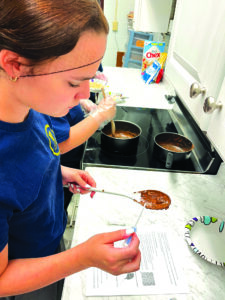
Inside the lab, students aren't simply cooking -- they're investigating. They test fat content in foods, analyze contamination risks and design safety protocols used across the food industry. The work is equal parts science experiment and real-world training.
For sophomore Ava Neff, the experience has been eye-opening.
"At first, I thought food science was like culinary, and we would just be cooking and eating," she said. "I didn't realize we would be testing things, drawing fat out of foods, and learning how to handle food safely."
One of her most memorable labs involved creating and executing a Hazard Analysis and Critical Control Points plan. The assignment required precision as Neff prepared a sandwich, her classmates observed closely, ensuring every step followed strict safety guidelines.
"I learned all of the steps people working in the food industry need to follow to make sure consumers are safe," she said. "There's a lot more to it than people think."
That shift in understanding is exactly what Cusate hoped to inspire.
"This year, I taught the first level of the Food Science and Safety curriculum, and the reception from students was remarkable," she said. "They were asking questions and beginning to think critically --not just about where food comes from, but how it's processed and how it gets to the shelves."
Those lessons extend far beyond the lab itself. Students are exploring food marketing, consumer behavior and the broader importance of agricultural literacy. They are learning to make connections between science, industry practices, and everyday decisions.
For sophomore Chloe Fisher, one of the most meaningful milestones came at the end of the course: earning her ServSafe Food Handler Certification.
"Earning the certification was my favorite part," she said. "It gave me a sense of accomplishment and really got me interested in learning more about food science."
The certification covers essential industry standards, including personal hygiene, time and temperature control, allergens, cross-contamination and sanitation. For students, it serves as both a confidence boost and a credential with real workforce value.
Programs like this reflect a broader transformation within agriculture itself. Today's agricultural landscape extends far beyond planting and harvesting--it includes sophisticated systems of processing, quality control, distribution and regulation. Food science plays a central role in ensuring that food is not only available, but safe, consistent and trustworthy.
By bringing that reality into the classroom, the Academy is preparing students for careers that are both local and global in scope.
But even for students who pursue different paths, the impact remains meaningful.
"Adding food science to our program was a great decision," Cusate said. "It helps students realize that our local, national and global food system is detailed and complex."
That understanding carries into everyday life. Whether students go into agriculture, business, healthcare or another field entirely, they will all interact with the food system. They will shop, cook, read labels and make decisions that affect their health and their communities.
With this program, those decisions are no longer made blindly.
This innovative classroom has become something much more than a lab. It is a place where science meets daily life, where curiosity turns into skill and where students begin to see food not just as something they consume -- but something they can understand, question and even help shape.
And for many of them, that realization is just the beginning.