
Shaffer to speak at Towpath meeting
Forest Ranger to discuss ‘Golden Eagle Project’
Trending
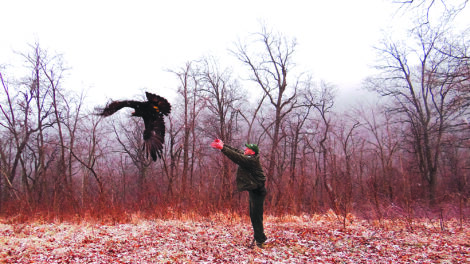
LEWISTOWN -- For 20 years, Forest Ranger Steven Shaffer has been helping to monitor wildlife activity in Tuscarora State Forest, which spans 97,000 acres across six counties.
The Pennsylvania State forest ranger hasn't encountered too many projects that have captured the interest of wildlife enthusiasts like the recent Golden Eagle Project, whose research is intended to grow knowledge about the species and further understanding of their behaviors.
"The Golden Eagle Project started in 2011," said Shaffer, who is stationed in Blain, Perry County. "A coyote hunter had deployed a trail camera in a small forest opening and captured two birds of prey fighting for scraps bait. He forwarded the picture to us for identification, and they turned out to be a pair of Golden Eagles.
"At the time, I didn't know we had Golden Eagles," he added.
Shaffer will talk about his experiences with the project to the Towpath Naturalist Society of Juniata and Mifflin Counties at its meeting at 7 p.m. today at the St. John's Lutheran Church, 120 N. Main St., Lewistown. Attendees are encouraged to use the rear entrance. Shaffer's presentation is called the "Golden Eagle Project."
Shaffer connected with researcher Todd Kratzer of the University of West Virginia and joined a study to help identify the migratory travel ways of Eastern Golden Eagle populations.
The Tuscarora Forest site was one of a number of camera trap sites in several states. The study consisted of the deployment of trail cameras over road-killed deer carcasses placed in a wildlife opening. Most sites only incorporated one motion activated still camera to record the presence of Golden Eagles. The number of cameras grew at the Tuscarora site over time - to 8 to 10 at one point -- so additional videos and photos were taken. Many of the images found their way on social media, garnering the attention of wildlife enthusiasts everywhere.
"We took it and ran with it here utilizing more cameras and recording videos in addition to stills," Shaffer added the project concluded several years ago when the uncertainty of Chronic Wasting Disease, or CWD, and the movement of road killed deer carcasses became increasingly risky.
"Even though the project has officially come to an end, many of the photos and videos can still be found on the Tuscarora State Forest Facebook page," Shaffer explained.
Of the more than 60 species of eagles found around the globe, the Golden Eagles have the largest home on the range. They inhabit four continents in the northern hemisphere, including North America.
Experts say Golden Eagles are primarily found in the western half of North America in the mountains and deserts southwest. However, recent observations of the past 25 years have changed their naturalists' understanding of these raptors. Their migratory populations now spend the winter months in portions of the eastern United States.
"Golden Eagles in the east don't nest in the lower 48 states," Shaffer said. "They migrate down from Canada beginning in September and migrate back up around April."
Migratory Golden Eagles migrate south each winter from their nesting territory upwards of 2,000 miles away in northern Canada, just below the Arctic Circle.
Naturalists use the images collected from the trail cameras to identify individual birds that are recorded. Images of other wildlife were captured too including bobcats, fishers, black bears, bald eagles, owls, porcupines and a multitude of other raptor, songbirds, and small mammals.
"There were bobcats, fishers, foxes ... you never know what you were going to get on the cameras," Shaffer said. "They were like a highlight reel, a who's who of state forest wildlife, and became very popular when they ended up on our Facebook page."
At their next meeting, Mindy Wilt, environmental education specialist at Little Buffalo State Park in Newport, will speak on "Invasive Species" on Tuesday, Nov. 14.
The Towpath Naturalists always welcome new members and guests. Annual dues are $10.
For more information, call (717) 248-0883. The Towpath Naturalists are also working to create a Facebook page.