
Trending
LEWISTOWN -- Time might heal all wounds, but it also relegates history to textbooks and academic discourse.
For the students in the Mifflin County School District, the Sept. 11, 2001 terror attacks are a chapter in a history book, far removed from the visceral emotion that gripped the nation on that fateful day.
It raises the question: How do educators convey the magnitude of an event their students did not live through but continues to reverberate in American life?
Robert Lepley, a social studies teacher and assistant athletic director at Mifflin County High School, shares his perspective on when these discussions should start.
“In my opinion, I do not think there is a specific grade level where the discussions should begin. With that being said, I think the older students are, the more in-depth teachers can cover the tragedies of that day in our history,” Lepley said. “Since I am not an elementary teacher, I cannot comment on what they would understand or what would be appropriate at a certain age. I teach juniors and seniors and let the questions and discussions in class that day drive the direction of the topic. It is a sensitive topic with extreme importance in our nation’s history.”
In the years right after the 9/11 attacks, when the wounds were still fresh, the educational lens focused sharply on the key players: Al-Qaeda and Osama bin Laden. Classroom discussions were replete with questions about the causes and immediate consequences of the attacks and the geopolitical complexities that led to the tragedy.
The collective memory was still active, and students had at least some recollection of the day, even if only through the experiences of adults around them.
However, the focus evolved over the years to better suit an audience with no firsthand experience of the event.
Today, the classroom demographic has shifted significantly. With students born after the fateful day now filling seats, teachers adapted their approach to be more comprehensive. The narrative expanded to include the events of the day and the indelible changes it imprinted on the American way of life.
Like many historical events, the 9/11 terror attacks are a sensitive topic, and teachers take a respectful and compassionate approach in their discussions.
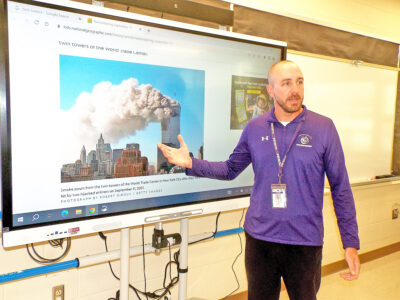
Teachers in the district often begin by sharing their own experiences of where they were on Sept. 11, 2001. The aim is to humanize the event and bring a personal connection to a history that might otherwise feel abstract to young minds.
Lepley elaborates on his teaching methods for 9/11.
“I explain that day’s events and share my experience, where I was, who I was with and my overall feelings. After I share that information, students begin to ask questions and the class drives everything,” he said. “On the Internet, there are recorded news segments that show the timeline. I will show these and allow students to ask more questions and share their feelings and thoughts.”
The lessons extend to how 9/11 shaped contemporary life. Teachers use concrete examples, such as heightened security measures at airports and sporting events and implementing the terror-level alert system, to illustrate the ongoing impact.
But the lessons also delve deeper, encouraging students to think critically about how the past informs current and future policy decisions, including issues as timely as cybersecurity and emerging technologies like drones and self-driving cars in regard to protecting the American people from terrorism.
While revisiting the horrors of 9/11, teachers also underscore the resilient spirit demonstrated in its aftermath. They recount heroic rescue efforts, queues to donate blood, and strangers embracing in the streets. Teachers emphasize how citizens united across party lines during one of the nation’s darkest moments.
Lepley underscores the importance of teaching this generation about 9/11.
“I think it’s important to teach the current generation about 9/11 because they are growing up in an America where there is a complete division in politics. The middle ground has disappeared, and people have trouble agreeing to disagree on a topic,” he said. “I always, every year, talk about how united America was during that time, regardless of their political side. I tell the students everything was canceled: concerts, sporting events, colleges closed, etc. The strangest thing I remember was looking into the sky and not seeing a single airplane for a couple of weeks after it happened. I want students to know that America has the potential to be united again, like it was back in 2001, without tragic events occurring.”
The goal is not only to educate but to prepare. By understanding the intricacies of an event that shaped the world they were born into, students are better equipped to navigate the complexities of a world still grappling with the aftermath of 9/11.
As educators in Mifflin County adapt their approach, they face the challenge of making a distant past relevant to a generation born into a post-9/11 world. But it is a challenge they meet with thoughtfulness and a deep sense of responsibility.
Mifflin County teachers carry the solemn obligation of educating students about that tragic day and its enduring consequences. They aim to inspire students by honoring the memories of those lost and cultivating hope for the future.
As another Sept. 11 rolls around, it is clear the educators in the Mifflin County School District will ensure the lessons of that day, both painful and inspirational, are passed on to a new generation. And in doing so, they contribute to a broader, more nuanced understanding of a day that changed America forever.