
Klingensmith was Lions’ top running back in 1963
Former coach was part of ‘Running Back U’
Trending
UNIVERSITY PARK -- Penn State might be known as "Linebacker U" for producing top-notch linebackers over the years, but the Nittany Lions also seem to have a penchant for churning out running backs.
In fact, 60 years ago this season, a household name to local football lore actually was Penn State's top ground-gainer.
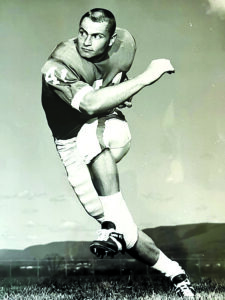
Legendary Juniata High School head coach Gary Klingensmith, who suited up in Happy Valley from 1961-64, led the Nittany Lions in rushing and all-purpose yards during the 1963 campaign.
"When I played, we had three decent running backs in the backfield, and we all shared the ball around the backfield," recalled Klingensmith, now age 80. "We had a left halfback, right halfback and fullback. "We had a good football team."
A junior at the time, Klingensmith was one of several locals to suit up for the Nittany Lions, along with Ralph Baker, Harold "Junior" Powell and Dick Gingrich.
Penn State's Wing-T offense was run-oriented and designed to wear down opposing defenses. In 1963, Klingensmith carried the ball 102 times for 450 yards and three touchdowns for Penn State, which went 7-3 overall and finished No. 16 in the Associated Press poll. He also caught 14 passes for 173 yards and one score.
In the 1960s, there wasn't a college football playoff. The Nittany Lions played as an independent as talk of joining the Big Ten Conference was still decades away. Heck, despite a 7-3 mark, Penn State didn't get a bowl game invite.
"There are so many bowl games now," Klingensmith added. "In those days, it was tougher to get a good bowl. We were disappointed we didn't get into a bowl game that year, but it was different times."
Times have certainly changed in the college football landscape since Klingensmith played.
"It's more passing and a speed game than in those days," he said. "It was a tough-guy game in those days. You were depending on the ground game and defense more so. Now, it's more spread out and passing all over the place, When the quarterback threw 20 times back then that was a lot. Now, he's throwing 40 passes a game."
A graduate of Brownsville High School, roughly 50 miles south of Pittsburgh, Klingensmith made his mark for the Nittany Lions, first under head coach Rip Engle. Joe Paterno served as Engle's assistant for Klingensmith's first three seasons and was promoted to associate head coach as Engle's top assistant in 1964.
Ironically, the Nittany Lions opened that season with future Big Ten foes Oregon and UCLA.
Engle unveiled a brand-new offensive formation, dubbed the "Swing-T," where an open-end position swung from one side of the line to the other side. The Ducks weren't expecting it as Engle had been using the same offensive formation - a Winged T - for years.
The offense was led by quarterback Pete Liske, who had been selected in the NFL and AFL drafts the previous December and went on to play a dozen seasons in pro football.
The Nittany Lions had four powerful backs at their disposal - Jerry "Bud" Yost, Tom Urbanik and Klingensmith, described by the Eugene Register-Guard as "who's nearly deaf and has to get his cues by reading Liske's lips."
Liske always made sure Klingensmith knew the call.
"The quarterback made sure I knew the play," he said. "There were very distinct, certain words and numbers that Pete had to say for me to know."
After the Oregon game, reporters quizzed Klingensmith about what happened when he jumped offside early in the game and knocked over an opposing linebacker. "I just told them I wanted to make sure they knew the deaf halfback was coming to town."
The ground game also opened up the air attack as receiver Don Caum hauled in a 40-yard pass for some insurance in the 17-7 win.
Rice traveled to Beaver Stadium, which had a capacity of 46,284 at the time, and became the Nittany Lions' third win to open the season.
Penn State struggled offensively in back-to-back losses to Army and Syracuse. They got back on track with four-straight wins over West Virginia, Maryland, No. 10 Ohio State and Holy Cross.
Klingensmith posted some big rushing numbers against the Buckeyes that season when he ran for 81 years, including a 27-yard touchdown in Penn State's 10-7 victory. Klingensmith said Baker also racked up about two dozen tackles and Powell intercepted two passes against the Buckeyes.
The Nittany Lions ended the season with a tough 22-21 loss to rival Pitt, ranked fourth in the country. The regular season finale was postponed for two weeks following the assassination of President John F. Kennedy.
Klingensmith later turned down a free agent offer from the New York Jets in 1965 to coach at Gallaudet University, a school for the deaf.
After three seasons, he found his way to Mifflintown where he went on to coach for six decades at Juniata High School. After 50 years and 302 victories, Klingensmith retired in 2018. During his final campaign, Klingensmith became the 17th coach in Pennsylvania history to reach 300 wins.
Counting Juniata's 1987 undefeated team that won a District 3 Class 2-A title, the first District 3 football title for any Tri-Valley League program, Klingensmith has amassed an overall mark of 302-213-6 since taking over the head spot in 1969.
Playing for Engle and Paterno also left a serious imprint on the football-serious Klingensmith.
"I've tried to learn from every mistake," Klingensmith admitted. "I can't sit here and tell you too many things I did right, but I remember everything that went wrong. And I can tell you things from 30 years ago that we tried, and it didn't work."
Klingensmith certainly played with legends as well, including Pro Football's Hall of Fame Dave Robinson. Klingensmith was in the crowd at Robinson's induction in Canton, Ohio, in 2013. Klingensmith and Robinson were teammates at Penn State in 1962.
"I was there. I went out there," Klingensmith recalled. "Dave Robinson was a great player. Coming out of (the Philadelphia area), he was just absolutely fantastic, a physical specimen. He could do everything you needed to do to be a great football player.
"I think his induction into the Hall of Fame was long, long overdue. And it may have been the fact that he's the 12th Green Bay Packer from that great dynasty team to get on. I think had they not had so many on, he'd have been in there maybe 20 years ago. I was happy to be there for him and I went to his reception after the ceremony.
"My first experience with Dave was when I was a sophomore (in 1962), and he was a senior. At that time, they had me playing fullback and they had all the fullbacks lined up, there were about eight of us. And they had all the defensive ends lined up -- at that time Robby was a defensive end -- and I was about seventh in line.
"And there were like five ends over there and five over there, and we'd switch up one at a time. One guy went to the right and this guy to the left," Klingensmith added. "Sure enough, when my time came to get up front, I was gonna hit this All-American in Dave Robinson over there.
"So, I really go with everything I've got, and I put my helmet right in his chest, but he had the best forearm in football -- and he was known for the best forearm in the NFL. He brought that forearm up under me, and when I came out my helmet was turned sideways, and I was looking out of the earhole."
Also remarkable is the fact that Klingensmith underwent a medical procedure which restored his hearing in 2017. He lost his hearing at age 5.
Throughout his illustrious career, he never heard fans cheering for him on the field.
"The crowd never bothered me," Klingensmith said. "I could hear a little bit of them as I heard background noise. I didn't wear hearing aids (at the time but he does now), but I could hear certain sounds. I learned to use them as best as possible."