
Varner discusses teacher shortage on TV
MCSD Superintendent speaks on MSNBC’s ‘Morning Joe’
Trending
LEWISTOWN -- Vance Varner believes he's got the best job in the country, working as the superintendent of schools for the Mifflin County School District. And he made certain a national television audience knew it.
"There's a little bit of negativity with education right now, and I couldn't disagree with that more," said Varner, who has served as Mifflin County's superintendent since September 2021. "I think it's a great profession. We have an incredible staff here in the district and I'm so proud of them. And I'm proud to be a part of that team to provide a great quality education. I just wish it'd be like that, and everybody knew how great this profession could be."
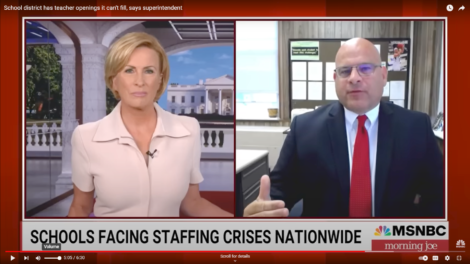
Varner appeared on MSNBC's Morning Joe Monday to discuss the staff crises that schools are facing nationwide. According to a new report, Pennsylvania's teacher shortage continues to worsen, and districts have been pressed to fill open positions by hiring under qualified educators.
Varner was interviewed by Morning Joe co-hosts Mika Brzezinski and Jonathan Lemire. He spoke candidly about the struggles Mifflin County has faced during the six-minute segment, while certainly promoting education as a rewarding and fulfilling career path.
Varner said Wednesday that NBC Nightly News is coming back today to expand on an article that was also posted on their website.
As millions of American students head back to school, educators are once again sounding the alarm about staff shortages nationwide. In Kentucky's largest public school district, parents say their kids didn't arrive home until after 9 p.m. last week when a new bus route plan intended to solve the driver shortage went awry.
In North Carolina, a bus driver shared that a typical day often includes finishing his morning route then filling in as a teaching assistant then substituting for a different class before being asked to pick up more bus shifts at the end of the day.
And, for the first time in Pennsylvania history, the number of people applying for emergency teaching permits has exceeded the number of recent college graduates applying for teaching certificates.
Varner joined the morning broadcast as the head of one of those Pennsylvania districts struggling to fill classrooms with teachers -- not students. He spoke virtually from his office in the district's Administration Building.
"It's an emergency situation," Varner explained. "Five to seven years ago, we would have had 25 to 30 applicants for a typical position, especially at the secondary level. Now, we're looking at two to three applicants.
"Right now, I have four openings that we cannot fill or have not filled yet. School for us starts Aug. 30 for the students. Right now, we have two of those positions. We don't have a qualified, certified teacher that has applied."
That's extremely concerning for Varner and his administration.
Across the state, there was a 7.7 percent increase in the number of teachers who left their jobs last year. "I would say in the last few years it's become progressively worse," Varner said of the teacher shortage.
Since 2010, there's been a 66 percent decrease in the number of people applying to the state to become a certified teacher. At the same time, the average public school teacher salary has also dropped from $70,235 in 1999 to $66,397 in 2022.
"That's scary," Varner explained. "Two-thirds less people apply to be a teacher. Just this past year, and we have seen in it in this county, in the Mifflin County School District, we actually had almost 50 percent of our teachers that we hired were under emergency certified status, so what that means is we may have a great person and most of them are - we hire great people - but they may not have had a class in college or any major related to education.
"They may have been an English major or journalism major and they get out or they're working in a local newspaper or somewhere and they find out, 'Hey, the Mifflin County School District has an opening as a teacher for English. And they're like, you know what, I've always wanted to be a teacher,'" he added. "So, we hire them -- they interview, they hire, they knock our socks off. They have a great personality, and you see they're going to connect with kids; however, what we're finding is there's that little bit of that learning curve. They've never student-taught, they've never had a methodology course, ethics in education. They come on, they join our ranks and they're doing a great job. But you want to take them from that good to great level, so it takes a couple years to get them there and the frustration is while they're doing that because they're underneath emergency certification, they have to take nine college graduate credits each year to continue to work toward permanent certification."
While Varner outlined economic reasons for the teacher shortage, there have also been other issues that have strained the profession. From the pandemic-related issues which politicized wearing masks in classrooms to the appropriate way of handling behavioral issues, these have created an extraordinary series of challenges.
"In the Mifflin County School District, we just want to show our staff that we support them," Varner said. "I think that's very important. I do think - at least in Pennsylvania - we have a lot of professional educators, administrators, custodians, cafeteria workers, paraprofessionals and teachers that when they reach the age of 55 or they have 30 years' experience in, they're leaving education early. When they're taking early retirement, and they're leaving."
Varner and others in the district have seen that scenario more since the pandemic.
"In the past, everyone tried to get their 35 years in, or work until they're 60 or 62, and we don't see that happening right now," he said. "Then we don't have that bullpen or availability for young professionals to step into it. So that's where we are a little bit frustrated as well."
And there isn't a pipeline pumping recent graduates into the workforce to replenish it.
"I do think right now if we do have somebody graduate from Mifflin County High School and they're going to college, we're telling them, 'Hey, we're going to have a need for teachers in four years," Varner said. "But we're not seeing a lot of kids majoring in college in education."
And therein lies the problem.