
Love of the Game
Tomahawks owner passionate for football
Trending
LEWISTOWN -- Brian Rodgers never dreamed of owning a football team, let alone the semi-professional Mifflin County Tomahawks.
A Huntingdon native, the 53-year-old Rodgers grew up rooting for the NFL's Pittsburgh Steelers. When Rodgers played running back in youth leagues and through high school, he donned No. 32 for Steeler great Franco Harris.
Rodgers developed quite an admiration for the Rooney family, who owned the Steelers. He and Art Rooney, often referred to as "the Chief," had little in common beyond their love of football.
"We both love cigars," quipped Rodgers, who has owned and operated the Tomahawks for more than a decade. He has served as the Tomahawks' head coach since 2012.
Rooney was the founding owner of the Steelers from 1933 until his death in 1988. Like Rooney, Rodgers has been around since day one.
The Mifflin County franchise is one of 14 teams in the Great Eastern Football Association, which spans eastern and central Pennsylvania. Founded in 2011, Mifflin County is the third oldest franchise in the league.
The Tomahawks played one season in Centre County as the Millheim Fighting Dutchmen. "The original owner had them wear blue and white to resemble Penn State," Rodgers recalled. "They were getting more players from Mifflin County than Millheim to play on the team, so the following year he brought the team over to Mifflin County."
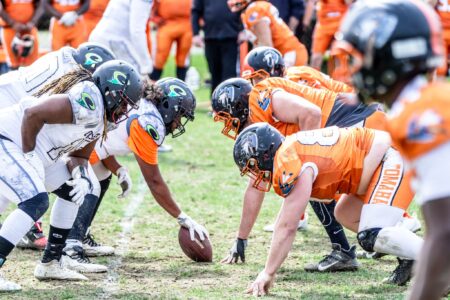
The team was rebranded as the Tomahawks and changed its colors to orange and white. This year marks the 11th year for the team, which called Lewistown's Rec Park home for much of its existence. This past season was the Tomahawks' first year at Kishacoquillas Park. They also played at Jamboree fairgrounds in Burnham in the early days.
Rodgers played noseguard for the team's only season in Millheim. He described that inaugural season "as more of a pick-up game," he said. "We used pads and a basic set of rules. Back then we'd have someone from the other team ref the games. It was a very small backyard football-type thing."
Curiosity was the only reason he discovered the league. He had seen a newspaper ad where the former owner was looking for players for 8-on-8 football. "I've been involved in football my whole life," Rodgers said. "My dad was a football coach and coached the (Mifflin County) Huskies for four years.
"I drove over the mountain to see them (Millheim) play as a spectator," he added. "The next thing I know I'm playing noseguard. It was almost a freak accident. Here I am 38 years old and playing semi-pro football. But that was normal for the league at the time. It was all but a beard league."
The GEFA certainly didn't have the caliber of players that it has today. "It's come a long way in that time," said Rodgers, who ranks third in league history in wins and guided the Tomahawks to back-to-back championship games in Keystone Bowls XXII and XXIII.
He never imagined that a decade later, the league would be on solid ground. "I'd have said it was impossible," Rodgers said, alluding to how far the league has come.
"There has been a lot of turnover," Rodgers said. "We were as high as 22 teams. Now, we're back down to 14. Things are starting to progress, especially after COVID.
"Getting owners is very, very difficult," he added. "You're asking people to send a lot of money and not getting anything really in return for it. Finding owners in towns that would support a team is a big challenge for us."
And a big challenge for Rodgers, who said operating a team in the GEFA costs roughly $10,000 annually. It's a bargain because players in the league are not paid. Salaries would easily add another $50,000 to $60,000 to the team's budget, pricing out many owners. "That's a whole different ballgame," Rodgers said.
The league opted for that amateur operating model to keep insurance costs down.
"We budget about $1,000 per home game, plus about $5,000 for equipment and other upgrades - water bottles, belts, uniforms," Rodgers said. "Money from sponsors helps to chip away at that number. Plus, we have a food booth and donations. Rarely, does it cover what you put into it."
Starting up a new franchise would cost even more - "possibly double that figure to start," Rodgers said. "You figure one helmet is $300, and you need 30 helmets and uniforms. Once you're established, you can manage that number a bit better.
"I just spend $150 on snacks for the food booth and clips for helmets," he added. "It's always something."
Insurance costs are the biggest expense for the league and its member teams. Rodgers served as league president for three years.
Rodgers and his son, Jesse, own and operate Tomahawk Construction in Lewistown. They've been flipping houses and renting properties for 12 years now.
Jesse, a former all-state defensive tackle for the Huskies who played at Division I Saint Francis University, now serves as one of his dad's assistant coaches.
Time might be the biggest commitment. Attending film and practice sessions means sacrificing family time. Rodgers appreciates the support of wife Kelly and his daughters, Elizabeth and Emily.
He is also thankful for fans turning out for Tomahawk games. "I think our county has supported the team as well as any team in the league," Rodgers said. "Pre-COVID, we had 700 people at a playoff game at Rec Park. We were leading the league in attendance by far.
"After COVID, moving from Rec Park to Kish Park last year, I think people are still figuring out where we play," he added. "Our attendance is starting to grow back up again. It's tough especially if it's 33 degrees out and snowing."
Through it all, the Tomahawks trudge on.