
Academy students gain experience, try to fix automotive tech shortage
Trending
LEWISTOWN - While school field trips are meant to be educational, a group of 20 students from Mifflin County Academy of Science and Technology discovered they also had the opportunity to address a real-world issue.
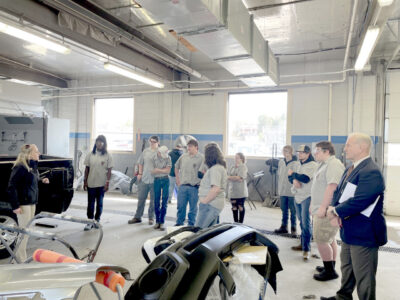
Thanks to the Lake Dealerships in Lewistown, students in the Academy's collision repair program had the chance to tour Lake's Collision Repair Center on Tuesday, April 25.
Currently, there is a critical shortage of automotive technicians around the country. It's a perplexing dilemma considering the number of individuals working from home has increased dramatically and should have eased the demand for automotive, diesel and collision repairs.
Experts and industry leaders have been predicting this shortage since at least 2012. Estimates called for at least 76,000 technicians between 2020 and 2026, just to keep pace with demand.
A 2020 report estimated the industry would be short by roughly 642,000 technicians by 2024. That's why the field trip was such an important outing.
"Students had demonstrations on plastic welding, painting, painting techniques and estimating," said Mifflin County Academy of Science and Technology Administrative Director Barry King, who joined the students on the tour.
The students were hosted by manager Nikki Wieger and estimator Greg McGinnis from Lake's Collision Repair Center. Lake also donated a 2015 Ford Focus for the students to use as part of the instruction for panel repair.
The Academy has developed partnerships with area businesses, such as the Lake Dealerships, to help students foster relationships that could eventually result in full-time employment.
This experience was invaluable, especially in an economy where there is an extreme shortage of automotive technicians. Dealerships around the country are searching for technicians to join the workforce.
The reasons for the worker shortage seem simple:
• The aging baby-boomer technician workforce is retiring in larger numbers each year, with some estimates as high as nearly nine percent annually.
• Relatively high turnover, with 31 percent annually in the younger generations.
• Fewer technicians are graduating with post-secondary automotive degrees.
• The number of female technicians is extremely low, with 1.5 percent of all technicians in the United States being female.
The tour gave the Academy students an important insight into working conditions. The experience is difficult to duplicate in a classroom environment.
"Vehicles are loaded with sensors, thousands of computer chips and controlled by software," King said. "With the onset of cameras and the advancement of driver assistance systems which keep cars in their lanes or detect blind spots requires collision repair technicians to calibrate the sensors and reset the cameras.
"Electric and hybrid vehicles are fast becoming a significant portion of the vehicles we will be seeing," he added. "The EV battery and electric cables present a lot of challenges in the future and technicians will have to be trained. It is a very complex industry."
Experts suggest the following strategies to fix the problem:
· Training in the industry. The Academy's program gives students the opportunity to be a repair technician, detailer, disassembly specialist, estimator, painter, paint preparation technician or unibody frame technician.
• Repair companies around the country are trying to improve or create training and career path programs to encourage potential technicians to join them.
• People in the workforce who find themselves unhappy and are looking for a career change need to be directed to the collision repair field.
Perhaps, the biggest obstacle is a stigma about the job. When trying to recruit new talent, experts said collision businesses are perceived as dirty, greasy places to work. The reality: Those days are long gone.
That's what the group of Academy students discovered.