
For kids with COVID-19, daily life can be a struggle
Trending
WASHINGTON (AP) -- Eight-year-old Brooklynn Chiles fidgets on the hospital bed as she waits for the nurse at Children's National Hospital. The white paper beneath her crinkles as she shifts to look at the medical objects in the room. She's had the coronavirus three times, and no one can figure out why.
Brooklynn's lucky, sort of. Each time she has tested positive, she has suffered no obvious symptoms. But her dad, Rodney, caught the virus when she was positive back in September, and he died from it.
Her mom, Danielle, is dreading a next bout, fearing her daughter could become gravely ill even though she's been vaccinated.
"Every time, I think: Am I going to go through this with her, too?" she said, sitting on a plastic chair wedged in the corner. "Is this the moment where I lose everyone?"
Among the puzzling outcomes of the coronavirus, which has killed more than 6 million people worldwide since it first emerged in 2019, are the symptoms suffered by children.
More than 12.7 million children in the U.S. alone have tested positive for COVID-19 since the pandemic began, according to the American Academy of Pediatrics. Generally, the virus doesn't hit kids as severely as adults.
But, as with some adults, there are still bizarre outcomes. Some youngsters suffer unexplained symptoms long after the virus is gone, what's often called long COVID. Others get reinfected. Some seem to recover fine, only to be struck later by a mysterious condition that causes severe organ inflammation.
And all that can come on top of of grieving for loved ones killed by the virus and other interruptions to a normal childhood.
Doctors at Children's National and multiple other hospitals getting money from the National Institutes of Health are studying the long-term effects of COVID-19 on children.
The ultimate goal is to evaluate the impact on children's overall health and development, both physically and mentally -- and tease out how their still-developing immune systems respond to the virus to learn why some fare well and others don't.
Children's has about 200 kids up to age 21 enrolled in the study for three years, and it takes on about two new patients each week. The study involves children who have tested positive and those who have not, such as siblings of sick kids. The subjects range from having no symptoms to requiring life support in intensive care. On their first visit, participants get a full day of testing, including an ultrasound of their heart, blood work and lung function testing.
Dr. Roberta DeBiasi, who runs the study, said its main purpose is to define the myriad complications that children might get after COVID-19 and how common those complications are.
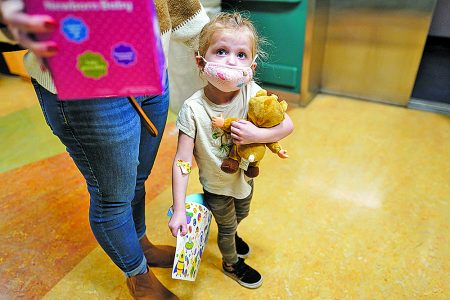
Brooklynn is one study subject. So is Alyssa Carpenter, who has had COVID-19 twice and gets strange fevers that break out unexpectedly, and other unusual symptoms. Alyssa was just 2 years old when she started the study and has since turned 3. Her feet sometimes turn bright red and sting with pain. Or she'll lie down and point her little fingers to her chest and say, "It hurts."
Her parents, Tara and Tyson Carpenter, have two other daughters, 5-year-old Audrey and 9-year-old Hailey, who is on the autism spectrum. As for many parents, the pandemic has been a nightmare of missed school, unproductive work, restrictions and confusion. But on top of all the anxiety so many parents feel lies the concern for their toddler. They don't know how to help her.
"It was just super frustrating," says Tara Carpenter, who is quick to add that no one's to blame. "We're trying to find out answers for our kid and nobody could give us any. And it just was really frustrating."
Alyssa would wail in pain from her red burning feet or whimper quietly. She'd come down with a fever, but suffer no other symptoms and be sent home from school for days, ruining Carpenter's work week. But then in ballet class, with her pink tights and tutu, she'd seem totally normal.
In the past few months, symptoms have started to subside and it's giving the family some relief.
"After the fact, what do we do about this?" asks Tara Carpenter. "We don't know. We literally don't know."
For some families in the study, the child suffering from long COVID is the easy one during the hospital visits.
One recent day, another family finds that it's the older sister Charlie who dissolves into tears because she doesn't want blood drawn while younger sister Lexie, used to being prodded by nurses and doctors, hops up on the table. The family dynamics of COVID-19 are tough: The sibling with the illness may get more attention, which can create problems for the others. Exhausted parents struggle with how to help all their children.
In their work-ups, the children receive full medical check-ins. They also receive a full psychological assessment, run by Dr. Linda Herbert.
Herbert asks the kids about fatigue, sleep, pain, anxiety, depression and peer relationships. Do they have memory concerns? Are they having a hard time keeping things in their brains?
"There's this constellation of symptoms," she said. "Some kids are incredibly anxious about getting COVID again."
She said psychological symptoms are among the most common, and it's not just the kids with COVID-19, it's their siblings and parents, too.
Danielle Mitchell feels the stress. She's a single mother working full time, grieving the loss of her partner and trying not to seem too depressed in front of her daughter. The decision to enroll her daughter Brooklynn in the study was motivated by wanting to draw attention to the need for vaccines, particularly in the Black community.
"My baby keeps getting it," she said. "Can't the people around us try to protect her?"
Brooklynn whimpers when she hears she has to get blood drawn: "Do you have to?"
"Yes, baby," the nurse says. "It's so we can figure all this out."
"If her daddy was here, he'd take her to Dave & Busters after this," Mitchell says, before lowering her voice so her daughter can't hear what she's going to say. Her longtime partner, Rodney Chiles, wasn't vaccinated.