
To hospital heroes, helping others is a rewarding job
Trending
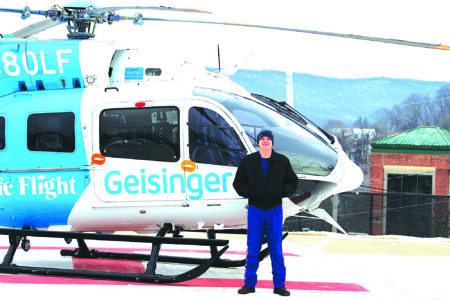
LEWISTOWN - It's not every day a car crash victim is life-flighted from your backyard. But young Matt Miller turned that last impression into his life-long profession.
In 2008 - when Miller was just a teen - a neighbor struck a telephone pole near his house during the early morning hours and had to be flown by helicopter to the hospital. The helicopter landed in the field behind his house.
"They picked him up and I was like, 'That's what I needed to do,'" said the now 34-year-old-Miller, who lives in Sunbury, Northumberland County. "I was hooked."
Miller was studying mechanical engineering at Penn State at the time but decided to take a break from his studies.
That fateful day started what has become a love affair with working as a Life Flight pilot. For the past two years, he has worked for Geisinger Health, serving hospitals throughout central Pennsylvania including Geisinger Lewistown Hospital.
Miller finds working as a pilot to be stressful at times, but it's a responsibility he takes very seriously. "Being able to help people out when they are going through one of the worst times in their lives is very rewarding," he explained.
Miller has worked for several different agencies over his 15-year career. The job has remained basically the same.
Working as a pilot has turned out to be the career, he thought it would be from that fateful day where the crash victim was airlifted from his backyard. A couple months later, he enrolled in flight school in Connecticut.
"The flying has pretty much been exactly what I thought it would be at the end of the day," Miller said. "I always thought about flying, I just never put it into motion."
Miller has always been fascinated by vehicles - the ones on land and air alike. "I've always been a motorhead," he said.
It's probably why he is part-owner of an auto body shop in Sunbury.
Miller's profession isn't for everyone, especially the grueling hours. He works 12-hour shifts every other week. His shifts are 7 a.m. to 7 p.m. during the first half of the week then it switches to 7 p.m. to 7 a.m. for the latter half.
There are four pilots at his base for coverage 24 hours, seven days a week. "Personally, I love it," Miller said. "We all work one week on then one week off. It’d be hard to go back (to 9 a.m. to 5 p.m.)."
Miller said a Life Flight copter is basically an ambulance that flies. It carries a pilot, nurse and a paramedic, at all times. While transporting patients is what pilots do much of the time, Miller has also transported supplies and orders as well as doctors and specialists.
Based at Penn Valley Airport in Selinsgrove, most of his flights take him to Lewistown, Danville, Philadelphia, Hershey and Pittsburgh. "We can go anywhere in like a 150-mile radius," Miller said. "We're like the workhorse of the fleet because we are so close to (Geisinger) Danville."
A full tank of fuel lasts about two to three hours for Miller. His work seems to come in "big waves." Miller averages three flights in a 24-hour period. "Some days you walk in the door and do four or five flights in a day. Flights can average two to three hours.
"Other days, you won't turn a blade in three days," he added.
Miller couldn't imagine doing anything else at this point in his career. "I probably wouldn't be quite as happy," he said. "I wouldn't have the same schedule."
His flying career has allowed him to travel the continent, working in Las Vegas and Alaska before returning in 2016. "I bounced around for a while," Miller admitted.
Now, he's back piloting the skies above central Pennsylvania.
Denny Yohn, security officer
Security officer Denny Yohn keeps a watchful eye over the grounds at Geisinger Lewistown Hospital. Before they were called officers, security officers were called watchmen because they watch over and protect a specific person, group, or in the instance, a place. But these watchmen do much more than just observe.
One of the essential functions of an officer is to remain visible. Sometimes, the very presence of an authoritative figure who is meant to protect is enough to keep people in line and prevent crime.
Security officers, like Yohn, also have a job that's different than most, in that they must always be on point. They must be diligent in their surroundings at all times, and also have a keen sense of sight, hearing and smell to aid in their vigilance. Officers also must be able to act quickly and efficiently.
Even though their job is to protect, officers often have to act in other capacities, like in guest services. People often ask them questions like where the bathroom is or the snack shop. In those instances, they have to multi-task, keeping their senses alert. That's why they are trained and prepared to handle anything and everything.
Abby Minck and Trisha Graybill, ER nurses
ER nurses like Abby Minck and Trisha Graybill work specifically in the Emergency Room. Typically, they treat patients who are facing traumatic or severe, often life-threatening medical conditions.
From fractured bones to car accidents, heart attacks to gunshot wounds, ER nurses see it all.
An ER nurse's primary responsibility is to identify medical issues, determine severity and provide immediate support to minimize negative long-term effects and, if necessary, sustain life. An ER nurse is one of the first responders when a patient is admitted to the ER.
While doctors and specialists might perform emergency surgeries, nurses are often the first to see a patient. ER nurses must be capable of assessing a dire situation quickly and making the right decision. They might also be tasked with managing triage, ensuring the most critically affected patients receive care first. No day is ever the same for nurses in the ER.
Rachel Rothrock, Alyvia Elliott, Alicia Garner and Lisa Semple, Imaging Department
Patients who come to the Imaging Department at Geisinger Lewistown Hospital are greeted in registration by staff members Rachel Rothrock and Alyvia Elliott, who are also mother and daughter. They work in an imaging clinic or radiology center, handling multiple roles. Their first duty is to handle general clerical options, such as scanning and uploading of images to a computer or organizing files in an orderly manner. They are also required to schedule appointments, collect data of patients and send out electronic copies of scanned images via email.
The most essential skill for an imaging staff member to carry out their responsibilities is communication. This is important because they have to explain policies and procedures clearly to patients and the public. Many imaging staff members' duties rely on integrity. They process and handle confidential information, so it's important that it's handled properly.
Imaging members are also known for their interpersonal and organizational skills, which are critical to their duties. These skills are pertinent to their responsibilities because these individuals work with patients and must understand and communicate information clearly and effectively. They must also retrieve information quickly and efficiently.
The Imaging Department is often called radiology. Team members like Alicia Garner, who is a CT scan technologist, and Lisa Semple, a diagnostic medical sonographer, provide the imaging services.
Garner is responsible for operating equipment to perform radiologic exams and preparing and calibrating the equipment. She also explains the process to the patient, positions them for the scan and helps them remain calm during the procedure.
As a sonographer, Semple uses imaging equipment and soundwaves to form images of many parts of the body, known as ultrasounds. They are trained to acquire and analyze these sonographic images, which doctors use to help diagnose and treat many medical conditions.
Scott Gantz, LIFE Geisinger transportation driver
If there's one thing that transportation drivers, like Scott Gantz, are known for, it's dependability, initiative and customer service. LIFE Geisinger patients rely on these drivers to get them to appointments and other places on time.
To carry out their duties, drivers must show up for work and get patients from Point A to Point B in a timely fashion. Their role and responsibilities require that "customers rely on taxi drivers, ride-hailing drivers and chauffeurs to pick them up on time and quickly transport them to their destination."
Many transport drivers also rely on initiative, working with little or no supervision, so they must self-motivate and take the initiative. Customer-service skills are also critical as they frequently interact with patients and have to remain positive and ensure passenger satisfaction on their ride.
Hand-eye coordination is essential to driver responsibilities because they must watch their surroundings and avoid obstacles and other hazards while behind the wheel. Finally, don't underestimate the importance of patient transportation driver responsibilities, especially when dealing with unexpected delays or difficult passengers.