
Trending
The check was for the garbage bill.
I sat in the recliner at my desk in the den, pen in hand, trying to do something I had done thousands of times. I only had to sign my name.
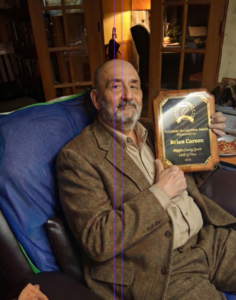
Brian Carson.
The letters came out crooked, barely recognizable. My signature made a doctor's handwriting look beautiful.
I stared at the signature. I've spent most of my life writing columns, features, and news stories. I've covered Friday night football and wrestling tournaments in packed gyms. Diabetes had damaged the nerves in my hands so badly that I could no longer sign my name.
These days, I type with my two index fingers. I have trouble holding a fork or spoon. I need a Hoyer lift to get out of bed and into my chair. I depend on my wife, Maria, to handle the household work and help me use the bathroom.
I haven't walked in two years. I haven't stood in a year and a half. I lost my right leg below the knee and every toe on my left foot.
That's what diabetes has cost me.
I was diagnosed in 2017, when I was 50. Maria noticed a spot on my left foot. When the doctors cleaned the wound, they found a hole that went through the bottom of my foot and out the top. My blood sugar was 400, and I lost my left pinky toe.
It should have changed my habits.
Instead, I went back to them.
I kept eating badly and failed to manage my weight or blood sugar. I treated the first amputation as a crisis that had passed instead of a warning.
Diabetes doesn't care what you tell yourself.
After I recovered, I began noticing numbness in my fingers and toes. It spread through my hands and feet. I first noticed the foot drop one day while leaving Dollar General. My foot didn't lift the way it should, and I tripped and fell.
The nerves continued to deteriorate. Walking became harder. Eventually, I needed a walker. I could no longer drive or take a walk. Every movement required thought.
By late 2024, I had infected open wounds on my toes and feet. Maria wanted me to go to the hospital. I refused.
I can be stubborn. That trait has served me at times. A journalist needs persistence. You keep calling and asking questions. You keep writing when the words won't come easily.
This time, stubbornness cost me.
Had I gone to the hospital sooner, I might have saved my leg. I've been angry with myself about that. Maria saw what was happening and tried to get me help. I wouldn't listen.
I can't change that decision now. I can only tell the truth about it.
I spent Thanksgiving and Christmas 2024 and January 2025 at Geisinger Medical Center in Danville. Doctors performed 14 operations trying to save my legs. I was discharged with a PICC line pumping me with antibiotics, then returned in March 2025.
By then, the bottom of my right foot had no skin left. You could see the bones.
The remaining toes on my left foot developed gangrene. Doctors removed them. Then the orthopedic surgeon told me they would have to amputate my right leg below the knee.
My mind went blank.
I lay awake that night wondering how I would get around and what would remain of the life I knew.
Doctors amputated my right leg below the knee in April 2025. I don't remember the exact date.
On the day of the surgery, I was nervous, so I reached for humor. I asked the surgical team whether I could take the amputated leg home.
Afterward, I woke up without pain because the neuropathology had already destroyed so much feeling. I looked down and saw nothing where the lower part of my right leg had been.
I knew my life had changed for good.
The loss shows up in ordinary moments. I can't sign a check or hold a fork properly. Maria has to do work that once belonged to both of us.
For more than a year, she has carried most of the household responsibilities while we've waited for my prosthesis. Insurance authorization requirements have delayed the process. My next step is a trip to Danville, where the orthopedic surgeon must clear me for the prosthesis.
I've completed one round of physical therapy, and I do leg exercises now. Once I receive the prosthesis, I'll begin another round.
Maria and I don't talk much about whether I'm a burden. I know caregiving has strained her. We both believe I'll regain some mobility. That gives us something to work toward.
Until then, writing keeps me moving.
I sit in the recliner at my desk in the den and write every day. Some of it gets published. Some doesn't. I don't care about that. I write anyway. I must write. No matter what.
When I write, time disappears. I focus on the sentence in front of me instead of the lift or the missing leg.
My condition has made me a better writer
Writing keeps boredom and frustration from taking over. I spend more time with the work and listen harder to the rhythm of a sentence. I stick with a story longer.
I love writing, and I still get a charge when someone tells me they liked something I wrote. That response connects me to readers and to the person I was before the hospital stays and surgeries.
Writing also keeps me connected to sports.
The last event I covered in person was the PIAA Individual Wrestling Championships in 2023. I miss Friday night football, especially opening night, when every team is undefeated, and every town carries a fresh season into the stadium. I miss wrestling even more. It was my first love as a sportswriter.
I haven't seen Donald M. Chapman III Stadium at Mifflin County High School. I want to.
Returning to a live game or match would mean the world to me. I miss the athletes and fans, along with the parents and athletic directors who make local sports run. I miss the journalists and radio personalities I've met through the years. I love this county because its people make local athletics matter.
Wrestling has always felt different. Once you're involved, you become part of a large, loving family. I miss that family.
My faith hasn't disappeared, and I'm not angry with God. In my case, God didn't cause this. Much of what happened grew out of my own choices. I ignored my diabetes. I failed to improve my nutrition and resisted going to the hospital when Maria warned me.
Faith helps me face that responsibility without surrendering the rest of my life.
Most people don't know how resilient they are until life demands it.
For me, resilience means patience and faith over time. I do the exercises and wait through the insurance process. I accept Maria's help while working toward needing less of it. Then I sit down at my computer and type the next sentence with two fingers.
I hope people with diabetes learn from what happened to me. Don't ignore the disease. Don't dismiss numbness or the early signs of neuropathy. Cut back on sugar. Exercise and check your feet regularly. Ulcers and infections can develop there, and the damage can grow before you understand how serious it has become.
Listen, when the people who love you say something is wrong.
I didn't, and I paid a heavy price.
My story is still being written. I'm waiting for the surgeon's approval and the prosthesis that may help me stand again. I'm working toward the day I can enter the new Mifflin County stadium, find my place near the field and feel the noise of another Friday night.
I believe that day will come.
Until then, I'll be in the den, writing from my recliner.
Two fingers are enough.
…
Brian Carson is a reporter for The Sentinel.