
A jar full of history: The pickled beet and egg tradition
A family recipe rooted in immigration, endurance
Trending
MOUNT UNION -- Some recipes are written down. Others are memorized. And a rare few are lived. This pickled beet and egg recipe belongs firmly in that last category.
It is a dish made long before modern kitchens and conveniences, carried to the United States by immigrants in the early 20th century, and still prepared today -- more than 100 years after it first took root in American soil.
The tradition traces back to Rhonda (Nickoloff) Jenkins' grandparents who emigrated from Eastern Europe, from Poland and Russia, during a period of upheaval and opportunity. Born in Poland in 1898, her grandmother Mary Mazur, fled Poland as a young teen with her two sisters into Austria. In 1912, she and her two sisters left Austria and came to America.
Her grandfather Crist Nickoloff, was born in Russia in 1890. At some point he fled Russia to Bulgaria. In 1915, he left Bulgaria and came to America.
"My grandma was a housekeeper at a boarding house near Pittsburgh," Rhonda shared. "My grandpap worked in the steel mill in Pittsburgh and stayed in the boarding house where my grandma worked. That's where they met, fell in love and got married."
Crist and Mary Nickoloff eventually made their way to Mount Union where they settled down. The town was shaped by industry, where the Brickyards provided work and demanded strength, discipline and persistence. Her grandfather found work there.
Like many immigrant families, they brought little with them except what mattered most: language, customs and food knowledge refined over generations. Cooking was not decorative or experimental. It was essential. Meals had to be filling, economical, and familiar in a new and often difficult environment.
Polish food anchored the household and shaped family life. The table regularly featured baked ham, kielbasa, halupki (stuffed cabbage), halusky (fried cabbage, noodles and bacon), and pierogi made by hand. Alongside these dishes, jars of pickled eggs -- stained a deep, unmistakable pink from beets -- were a constant presence.
As granddaughter Rhonda, who lives in Mount Union, recalled, "There was a lot of Polish food." These meals were not reserved for special occasions; they were daily sustenance, cultural memory made edible.
At the center of this tradition were the pickled eggs. They were prepared days ahead of time, especially for holidays such as Easter, Thanksgiving and Christmas. The method was deliberate and patient: eggs preserved with beets, vinegar, sugar and time. The result was dependable food that could be counted on when families gathered and tables grew crowded.
Everything else came second.
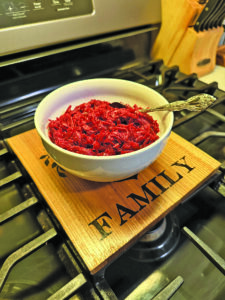
In kitchens shaped by thrift and respect for labor, nothing useful was ever wasted. Once the eggs had been eaten, the beets remained -- deeply colored, flavorful and far too valuable to discard. Those beets were shredded and transformed into a vivid, sharp condiment known in Polish households as Ćwikła (pronounced chveek-wah), or beet relish.
The relish was simple but bold. Prepared horseradish was mixed in gradually until the flavor struck the right balance--bright, pungent, and unmistakable. There were no fixed measurements. Taste determined when it was finished, just as it always had. The relish was served cold alongside ham, turkey or sausages, cutting through rich meats with confidence.
This two-part tradition -- first the pickled eggs, then the beet relish --reflected a way of life built on practicality and intention. What began as necessity became habit. What became a habit turned into tradition. "To prepare grandma's beet relish, start by first making pickled eggs with beets," Rhonda shared.
The recipe was never formally written down in its early years. It was passed the way many heirloom recipes are: by watching, helping and repeating the process until it became second nature. "Beet Relish should be prepared just before serving the meal," Rhonda added.
Knowledge moved from grandma Nickoloff to her son, Lou, onto his daughter Rhonda, and onward to another generation with her children with families of their own. Each custodian of the recipe added nothing and removed nothing, understanding that consistency itself was a form of respect.
"I remember my daddy (Lou) always saying, "It could use a little more horseradish!" Rhonda laughed. "No matter how much horseradish we added, it was never enough."
Even after the passing of the original cook, the ritual remained. The hands preparing the food changed, but the steps did not. The jars still appeared at family gatherings in Mount Union, unannounced and unquestioned. Their presence alone signaled continuity.
For more than a century, this pickled beet and egg recipe has endured because it still serves its purpose. It feeds. It connects. It remembers.
This is not simply a recipe. It is immigration preserved in vinegar, resilience sealed in glass, and history kept alive through repetition. Every time a jar is opened, it affirms that some of the strongest family stories are not written in books -- they are shared at the table, one careful batch at a time.
Pickled Eggs with Beets
The Foundation of the Tradition
Prep Time: 30 minutes
Resting Time: 4-5 days
Yield: 1 dozen pickled eggs
Keeps: Up to 2 weeks, refrigerated
Ingredients
1 dozen eggs
2 cans red beets (sliced or quartered, with juice)
1 cup white vinegar
½ cup water
½ cup sugar
Optional: whole cloves or 1 cinnamon stick
Instructions
Hard-boil the eggs. Allow to cool, then peel carefully.
Place the peeled eggs into a clean jar or container that seals tightly. "I prefer to use a glass jar but plastic will work if that's all that's available," Rhonda said.
In a saucepan, combine beets, beet juice, vinegar, water, sugar, and optional spices.
Bring the mixture to a boil, stirring until the sugar is fully dissolved.
Carefully pour the hot beet mixture over the eggs, ensuring they are completely covered.
Seal the jar tightly and refrigerate for 4-5 days before serving.
Serving Notes
Eggs may be served whole or sliced.
Commonly served alongside holiday meals such as Easter, Thanksgiving, and Christmas.
Best enjoyed within two weeks.
Beet Relish (Ćwikła)
The Second Gift from the Same Jar
Prep Time: 10 to 15 minutes
Timing: Prepare just before serving
Ingredients
Pickled beets from the egg recipe
Prepared horseradish, to taste (approximately one 4-oz. jar)
Instructions
Remove the beets from the pickling liquid.
Shred the beets using a grater, food processor, or meat grinder.
Gradually mix in prepared horseradish, tasting as you go until the desired sharpness is reached.
Place in a covered glass dish and refrigerate until ready to serve.
Serving Suggestions
Serve chilled. Rhonda added, "It is a popular, pungent addition to roasted meats like turkey, ham, beef, sausages and sandwiches." A small portion goes a long way.
Family Note
This recipe should be prepared in sequence.
Pickled eggs always come first.
The beet relish is made afterward using the same beets--honoring a tradition of thrift, care, and respect for ingredients that has endured for more than 100 years.