
Major Miller’s influence: Glenn Miller’s legacy lives on
Trending
LEWISTOWN -- Lewistown Community Band is currently rehearsing music for our nation's sestercentennial (or semiquincentennial) celebration this July. Some of the tunes include great songs from World War II.
These songs are very familiar to me. My father loved big band music of the 1930s and 1940s. I remember listening to big band records over and over as a youngster. Dad particularly enjoyed the great trumpet player Clyde McCoy effortlessly playing the famous "Sugar Blues," his theme song. Mom occasionally sang "The White Cliffs of Dover" as she baked bread or otherwise puttered in the kitchen. She also enjoyed belting out "We'll Meet Again," the English singer Vera Lynn's trademark tune. These were, of course, World War II songs which meant something very hopeful to my parents. This was the music I listened to because, well, it was there in our home. As I grew older I discovered Simon and Garfunkel, the Beatles, the Carpenters and other popular artists of my teen years. Creedence Clearwater Revival was big...very big...in my world. But music of the mid-20th century is truly America's songbook.
There were some songs which simply defined the big band sound. Music of the '30s and '40s typified the "swing era" and most big band music was composed for spirited dancing although there were more than a handful of slow tunes such as Glenn Miller's signature song "Moonlight Serenade." His soulful rendition of "A String of Pearls" is another slower tempo tune which exhibited the popular swing style.
In 1942, the great composer and arranger Glenn Miller volunteered to serve in the United States Army Air Forces as a bandleader. He gave up about $20,000 per week (in 1942 dollars). He was commissioned and left his civilian orchestra in the capable hands of Harry James, a contemporary bandleader and superb trumpet player. A classic big band of the 1940s consisted of four trumpets, four trombones, four or five saxophones, percussion, piano, a rhythm guitar, one upright bass and usually a couple of singers. Miller's newly-formed military band added strings and a solo clarinet and it took a big stage for their full and rich sound.
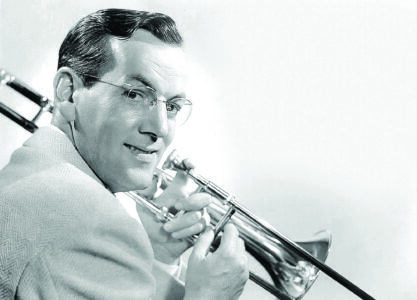
There was no better big band during WWII. Glenn Miller, an excellent trombonist, was perhaps the one bandleader during the war who understood the power of music which could, and did, positively influence a country craving camaraderie and unity during wartime. His precise and harmonic arrangements helped shape and define swing and people loved the high-energy sound of his orchestra. Glenn Miller had 16 number one records during his short career.
Why was he so special to the war effort? Miller formed "The Captain Glenn Miller Army Air Forces Orchestra" and was sent to Europe in 1944 after several years stateside. In England, General James Doolittle, Commander of the 8th Air Force, attended a Miller concert in July 1944. He declared, "Captain Miller, next to a letter from home, your band is the greatest morale booster in the European Theatre."
His influence is still being felt today as Glenn Miller's legacy lives on. The Marine Corps All-Star Jazz Band, the Navy Commodores, the U.S. Army Blues, and the Air Force Airmen of Note are swing and jazz bands in our various military services today. The Airmen of Note, stationed at Bolling Air Force Base near Washington, D.C., was created in 1950, a mere six years after Major Miller was gone. These orchestras are a living tribute to Major Glenn Miller.
Newly promoted Major Miller unfortunately died in 1944 in an Army Air Forces UC-64 aircraft accident, on his way to France after D-Day. He was only 40 years old. His headstone in Arlington National Cemetery records him as Missing in Action. Carved into the white marble stone is a trombone and "Bronze Star Medal." Although Glenn Miller was a non-combatant, his patriotism and dedication to his country and his craft were unquestionable.
Appropriately, the Air Force has a swing band in Europe, the Ambassadors, at Ramstein Air Base. They keep "The Major Glenn Miller Army Air Forces Orchestra" alive by performing big band classics. Yes, the influence of Glenn Miller is far reaching indeed. His inspiration is still felt 82 years after he died. In the music he left, the feelings of goodwill he created, and the patriotism he displayed, we shall never forget the morale-boosting Major Glenn Miller and the big band era of WWII.
Incidentally, one of the biggest hits of the Glenn Miller Orchestra was "Pennsylvania 6-5000." The song was named after the actual phone number of the Pennsylvania Hotel in New York City. The Miller band, along with many other big bands, played in the hotel's Café Rouge ballroom.
•••
Joseph Walk is a retired USAF Lt Col. He and his wife, Nancy, reside in Belleville.