
Local WWII Carrier Pilot lost life attacking Honshu, Japan
Trending
OTSU, Japan -- William Boyd Hall was born on Nov. 1, 1921 in Burnham to Keystone State natives Ralph Newton and Bessie May Hall. He had one younger sister, Sarah Jane. Their father supported the household employed as a foundry coremaker and, later, in the grocery business. Their mother was a homemaker.
Hall's entire upbringing occurred in Burnham. He attended four years of high school. Hall registered for the draft in Lewistown on Feb. 16, 1942. He worked for C. I. McCardle in Lewistown. Hall enlisted in the Navy Reserve in Philadelphia on Sept. 26, 1942. He was selected for aviation training and completed pre-flight school as an Aviation Cadet at Chapel Hill, North Carolina. In August 1943, Hall transferred for additional training to Naval Air Station Olathe, Kansas. In November 1943, he received further training at Naval Air Station Pensacola, Florida and Naval Air Station Corpus Christi, Texas. Hall qualified as a Naval Reserve Ensign and a pilot of heavier-than-air aircraft on May 1, 1944.
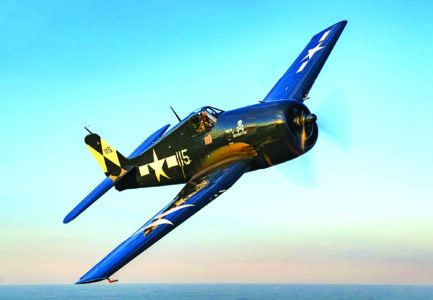
Hall was assigned to Fighter Squadron 31 (VF-31) in the Third Fleet where he piloted the F6F-5 Hellcat. The squadron was the highest scoring light carrier squadron and had the highest kill ratio per pilot of any squadron in the Navy. Hall and his air group were deployed to the Pacific Theater of Operations and were taken aboard the light carrier USS Belleau Wood (CVL-24) on June 16, 1945 at Leyte, Philippines.
Belleau Wood was commissioned on March 31, 1943, arrived at Pearl Harbor, Hawaii on July 26, 1943, and earned 12 battle stars for her service during World War II. The carrier saw extensive action in the Gilbert and Marshall Islands campaigns, the Mariana and Palau Islands campaign, the Philippines campaign, and the Battle of Leyte Gulf. She lost 92 of her crew in a Kamikaze attack on Oct. 30, 1944. In 1945, Belleau Wood supported the invasion of Iwo Jima and operations against the Japanese Home Islands.
Fighter Squadron 31's missions during the last two months of the war were against targets in Japan's Home Islands. On July 24, 1945, Hall piloted his Hellcat to attack an enemy airfield near the entrance of Nagoya Bay. Since the target already was under attack by other squadrons, Hall's group targeted a seaplane station at Otsu, Honshu, Japan.
Hall was killed in action on July 24, 1945 near Otsu, Japan when the fighter he was piloting crashed and exploded during a combat mission against a seaplane station. His remains were not recoverable. Hall is memorialized on the Tablets of the Missing, Honolulu Memorial, Honolulu, Hawaii. A cenotaph was placed in his honor at Mount Rock Cemetery in Lewistown. Hall posthumously received the Distinguished Flying Cross, the Air Medal and the Purple Heart.
•••
Stories Behind the Stars memorials are accessible for free on the internet and via smart phone app at gravesites and cenotaphs. The non-profit organization is dedicated to honoring all 421,000 fallen Americans from World War II, including 31,000 from Pennsylvania. To volunteer or for more information, contact Kathy Harmon at kharmon@storiesbehindthestars.org or visit www.storiesbehindthestars.org.