
Beyond the annuals: Gardens provide color, structure and food
Trending
October typically brings the first hard frost in Pennsylvania. For most gardeners, this can feel a little depressing, but late-season gardening (September to late October) is still often ignored. We remove the annual plants, mentally install a "garden is closed" sign, and we don't think about it again until the seed catalogs begin arriving the following year. With some planning, our gardens can still provide color, structure and food and habitat for late-season pollinators and other wildlife.
There are several deciduous shrubs that are both ecologically beneficial and provide fall color, beginning with native Virginia Sweetspire (Itea virginica). It has a modest growth habit at 3 to 6 feet and does best in sun to part shade and wet to moist soil, to the point where it will tolerate periodic flooding. We planted three Itea virginica in our demonstration garden at the Mifflin County Library, but they are competing for water with a full-grown Sweet Gum tree, and struggling a bit as a result. In my own garden, Virginia Sweetspire are planted in an area where the soil is fairly moist, and they are doing very well. They tend to form colonies by suckering, but not aggressively so. In the spring, they have a pretty white bottlebrush-type bloom, and in the fall, the foliage turns scarlet. The blooms are pollinated by native bees and butterflies.
Oakleaf Hydrangea (Hydrangea quercifolia) is native to the southeast corner of the United States, and is a little bigger than I. virginica, at 4 to 8 feet tall and wide. My own Oakleaf Hydrangeas are about 7 feet high. They prefer sun to part shade and moist soil. This plant has large, panicle-style white blooms that change to pink and then russet. The foliage is also large and will turn a deep red color in the fall. After the leaves drop, the plant continues to provide winter interest with shaggy bark. The blooms are pollinator favorites.
Witch Hazel (Hamamelis virginica), which is native to the eastern side of the United States, can either be grown as a shrub or a tree. As a multi-stemmed plant, it can grow 20 to 25 feet high. H. virginica grows well in a wide variety of soils and light conditions, and the autumn foliage is bright yellow. As the leaves fall, the plant begins to bloom with spider-like yellow flowers. The seeds, which are catapulted up to 30 feet away from the original plant, are a good food source for ruffed grouse, wild turkeys, and other wildlife.
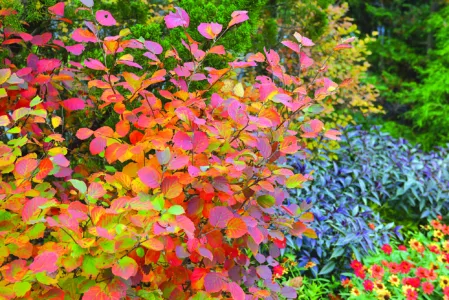
In the same plant family as Witch Hazel is my very favorite shrub, Fothergilla 'Mount Airy.' The common name is Witch Alder, but everyone I know simply calls it 'Fothergilla.' This plant will grow in full sun to part shade conditions, and prefers moist, but well-drained soil. This is another one that will not tolerate dry soil. The size is well-suited for an average garden at 3 to 6 feet tall and wide. The plant blooms before the foliage emerges in late April, with a unique bottlebrush-type bloom, and then the entire plant is a beautiful blaze of red, orange and yellow in October. I have 3 of them in my own garden, and they have been completely pest and disease-free. If a Fothergilla has a problem, it's usually due to environmental stress, such as being too dry or improper soil pH.
Another deciduous shrub is Spicebush (Lindera benzoin). Spicebush is native to the entire eastern United States, can grow 6 to 15 feet, and is another excellent woodland understory shrub. L. benzoin prefers partial to full shade and consistently moist soil. It will only tolerate full sun if the soil is also moist. It is important to give this one some room, because it tends to sucker. The fall foliage is a radiant yellow, and it is one of the first shrubs to bloom in the spring, sometimes as early as March. Spicebush is an important larval host plant for several types of native caterpillars, including the Spicebush Swallowtail, which is surely one of the most interesting-looking caterpillars in Pennsylvania.
This list of shrubs is not complete without mentioning Red Twig Dogwood, also called Red Osier Dogwood (Cornus sericea), which is native, and Yellow Twig Dogwood (Cornus sericea 'Flaviramea'), which is a cultivar. Both plants thrive in full to partial sun and damp soil, and they have absolutely brilliant fall color. After the foliage drops, they reveal beautifully colored stems, which are lovely to see all winter. I heavily rely on both plants for winter arrangements. It is important to prune out the older stems each season so that the plant continues to produce younger, more colorful stems, as they tend to discolor with age. I find that the Yellow Twig Dogwood, in particular, does sucker heavily, which is great for my purposes, but if you prefer a plant that stays where it's planted, be advised.
If you are still relying on Burning Bush (Euonymus alatus) or Japanese Barberry (Berberis thunbergii) for their fall color, please know that they are now considered to be highly invasive species. Even if these plants appear to be well-behaved in your garden, the seeds are consumed and dispersed miles away by birds. There are dense thickets of both species overtaking woodland areas and displacing native plants.
Moving on to perennials, we will begin with White Turtlehead (Chelone glabra). White Turtlehead is native to most of eastern North America, and is a host plant for the Baltimore Checkerspot butterfly. Preferring partial sun and moist soil, it blooms for about a month during the late summer and into the fall on 24 to 36 inch stems. The foliage tends to be bitter, so it is usually ignored by deer. The bloom is unique and unquestionably attractive to bees and other pollinators.
There are many kinds of perennial asters (Symphyotrichum spp), but one of our favorites is New England Aster (Symphyotrichum novae-angliae). It is native to eastern and central North America, blooms very late in the summer, and prefers full sun and wet to moist soil. This plant can get very tall and leggy, so we prefer to give it a "Chelsea Chop," which means we cut back the stems by about half in early June. This helps to prevent the plant from flopping due to the weight of the bloom later in the season. Bees absolutely love New England Aster, as do moths and butterflies. We also really like White Wood Aster (Eurybia divaricata). It blooms white, as the name suggests, and tolerates very dry soil, which makes it great for underplanting under established trees. White Wood Aster will only grow 2 to 3 feet high, but will spread via rhizomes.
Please consider planting Showy Goldenrod (Solidago speciosa). Folks tend to resist growing Goldenrod because some varieties are truly aggressive. You may even believe that you are allergic to it. Goldenrod has pollen that is too heavy to move in the wind; however, so it is usually not the cause of your seasonal allergies. Ragweed has an insignificant flower and blooms at about the same time, so Goldenrod often gets the blame for Ragweed pollen. Showy Goldenrod is native to the central and eastern United States, and it spreads very slowly. We have employed the "Chelsea Chop" method to control this plant's height at the Mifflin County Library Garden, which has resulted in an upright, beautiful plant that is an important source of nectar for native bees, butterflies, and moths. Showy Goldenrod is very easily grown via the winter sowing method.
Arkansas Bluestar (Amsonia hubrichtii) is native to Arkansas and Oklahoma, but it is a terrific three-season plant, and one of my personal favorites. Bluestar will tolerate most soil conditions, and full sun will produce the best fall color. In May, the plant blooms a pale blue color on billowing, feathery foliage, and then the entire plant turns yellow in the autumn. It's deer and rabbit resistant, generally trouble-free, and supports several types of pollinators. Mt. Cuba Center tested many varieties of Bluestar in their trial gardens and produced a research report that is referenced at the bottom of this article. The entire report is available online.
Finally, do not walk past the grasses at the garden center. If you can spare a bit of space for Little Bluestem (Schizachyrium scoparium) or Switchgrass (Panicum virgatum), they are both native to Pennsylvania. Native grasses provide food, shelter, and nesting material for wildlife, help stabilize the soil, and provide structure in your garden.
Sources
Darke, R. & Tallamy, D. (2014). The Living Landscape: Designing for beauty and biodiversity in the home garden. Timber Press.
Howard, E. (2026). Plant This, Not That: Over 200 native plant swaps for a more sustainable, pollinator-friendly garden. Workman Publishing.
Hoadley, S. & Reilly, L. (2024). Amsonia for the Mid-Atlantic Region. Mt. Cuba Center.